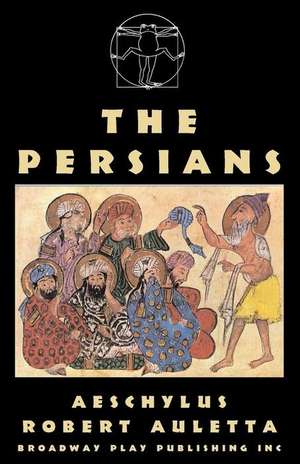
The Persians
Autor Aeschylus Editat de Robert Aulettaen Limba Engleză Paperback
Preț: 99.57 lei
Puncte Express: 149
Carte tipărită la comandă
Livrare economică 27 noiembrie-11 decembrie
Livrare prin curier în România Termenul estimat este afișat lângă disponibilitate.
Transport gratuit de la 400.00 lei Plată online sau ramburs, în funcție de opțiunile comenzii.
Retur gratuit în 14 zile Comandă securizată și suport în română.
Specificații
ISBN-13: 9780881453058
ISBN-10: 0881453056
Pagini: 82
Dimensiuni: 140 x 216 x 4 mm
Greutate: 0.1 kg
Editura: Broadway Play Publishing
ISBN-10: 0881453056
Pagini: 82
Dimensiuni: 140 x 216 x 4 mm
Greutate: 0.1 kg
Editura: Broadway Play Publishing
V-ar putea interesa
-
 The HistoriesHerodotus-26%Preț: 82.20 lei111.02 lei
 -
 AnnalsTacitus-18%Preț: 76.51 lei93.23 lei
 -
 HoraceEduard Fraenkel-32%Preț: 612.34 lei904.22 lei
 -
 On the MysteriesAndokides-29%Preț: 503.36 lei704.89 lei
 -
 -28%Preț: 385.37 lei538.02 lei
 -
 -33%Preț: 2048.93 lei3050.25 lei
 -
 Greek Oratory: Tradition and OriginalityStephen Usher-33%Preț: 607.53 lei901.31 lei
 -
 Aristophanes and the Definition of ComedyM. S. Silk-28%Preț: 427.58 lei595.34 lei
 -
 Medieval Narrative: An IntroductionTony Davenport-19%Preț: 337.26 lei417.45 lei
 -
 Apuleius: A Latin SophistS. J. Harrison-28%Preț: 372.78 lei519.77 lei
 -
 Aristophanes AcharniansS. Douglas Olson-33%Preț: 679.62 lei1007.07 lei
 -
 -31%Preț: 918.69 lei1333.64 lei
 -
 -31%Preț: 928.73 lei1353.27 lei
 -
 Oracles, Curses, and Risk Among the Ancient GreeksEsther Eidinow-25%Preț: 637.24 lei849.89 lei
 -
 -13%Preț: 341.25 lei390.07 lei
 -
 Blindness and Reorientation: Problems in Plato's RepublicC. D. C. Reeve-31%Preț: 626.52 lei909.33 lei
 -
 Constantine: History, Historiography and LegendSamuel N. C. Lieu-15%Preț: 435.22 lei512.02 lei
 -
 -18%Preț: 1256.91 lei1532.82 lei
 -
 Preț: 447.50 lei
 -
 The Franklin's Tale: York Notes Advanced - for 2026, 2027 examsJacqueline TasioulasPreț: 61.66 lei
 -
 Preț: 155.69 lei
 -
 Aksum and NubiaGeorge HatkePreț: 481.20 lei
 -
 -17%Preț: 165.52 lei198.90 lei
 -
 Hannibal and MeAndreas KluthPreț: 151.89 lei
 -
 Evidence of the GodsErich Von Däniken-22%Preț: 107.18 lei137.23 lei
 -
 The Praetorian Guard: A History of Rome's Elite Special ForcesDr Sandra Bingham-26%Preț: 366.47 lei493.02 lei
 -
 Temple of the WorldMiroslav VernerPreț: 271.45 lei
Descriere
Descriere de la o altă ediție sau format:
The Persians, Aeschylus' earliest surviving tragedy, holds a fascination both for readers of Greek drama and Greek history. Not only is it the earliest existing play in the Western tradition, it is drawn directly from the playwright's own experiences at the battle of Salamis, making it the only account of the Persian Wars composed by an eyewitness. And as pure tragedy, it is a masterpiece. Aeschylus tells the story of the war from the Persian point of view, and his pride in the great victory of Greeks is tempered with a real compassion for Xerxes and his vanquished nation. Lembke and Harrington have rendered this stunning work in a modern translation that loses none of the original's dramatic juxtaposition of serenity and violence, hope and despair.
The Persians, Aeschylus' earliest surviving tragedy, holds a fascination both for readers of Greek drama and Greek history. Not only is it the earliest existing play in the Western tradition, it is drawn directly from the playwright's own experiences at the battle of Salamis, making it the only account of the Persian Wars composed by an eyewitness. And as pure tragedy, it is a masterpiece. Aeschylus tells the story of the war from the Persian point of view, and his pride in the great victory of Greeks is tempered with a real compassion for Xerxes and his vanquished nation. Lembke and Harrington have rendered this stunning work in a modern translation that loses none of the original's dramatic juxtaposition of serenity and violence, hope and despair.
Recenzii
"The musicality of Deborah Roberts' translation of Aeschylus' Persians, the earliest Greek tragedy that has come down to us, rivals the playwright's own astonishing lyricism. She crafts extended speeches by the drama's characters into captivating set-pieces of performance poetry. Roberts also replicates Herodotus' celebrated storytelling energy in her translation of the passages from his Histories included in this volume. In her Introduction, Roberts examines Aeschylus' drama and Herodotus' representations of Persian culture as crucial records of ancient Greek conceptions of otherness and perceptively appraises the Persians itself as a sober contemplation upon the shared human toll of political ambition and warfare’s traumas and grief, making this book urgently relevant to contemporary audiences."
—James Bradley Wells, PhD, Edwin L. Minar Professor of Classical Studies, DePauw University
"In her new translation of Aeschylus’ Persians, Deborah Roberts seeks to balance readable English idiom with faithfulness to Aeschylean expression. This is not an easy feat, but Roberts is successful. She has produced a text that will be most suitable for the student or casual reader, due to its close translation and helpful bibliography. Roberts’ translation is lucid and often beautiful, and faithfully carries over some of the peculiarities of Aeschylean phrasing that make the Persians distinct. The introductory materials, notes, and excerpts from Herodotus contribute to a book that will help beginners not only to understand the play at first reading, but to begin thinking about it for themselves....In sum, Roberts’ translation will be a welcome resource for students, and a pleasure to readers of every level." —Isabella Reinhardt, University of Austin, in the Bryn Mawr Classical Review
—James Bradley Wells, PhD, Edwin L. Minar Professor of Classical Studies, DePauw University
"In her new translation of Aeschylus’ Persians, Deborah Roberts seeks to balance readable English idiom with faithfulness to Aeschylean expression. This is not an easy feat, but Roberts is successful. She has produced a text that will be most suitable for the student or casual reader, due to its close translation and helpful bibliography. Roberts’ translation is lucid and often beautiful, and faithfully carries over some of the peculiarities of Aeschylean phrasing that make the Persians distinct. The introductory materials, notes, and excerpts from Herodotus contribute to a book that will help beginners not only to understand the play at first reading, but to begin thinking about it for themselves....In sum, Roberts’ translation will be a welcome resource for students, and a pleasure to readers of every level." —Isabella Reinhardt, University of Austin, in the Bryn Mawr Classical Review
Notă biografică
Janet Lembke, a poet, is the author of Bronze and Iron, and is co-translator of the forthcoming edition of Euripides's Suppliants, also in the Greek Tragedy in New Translations series. C. John Herington is Professor of Classics and Talcott Professor of Greek at Yale University. He is the author of several books, including Poetry into Drama and Aeschylus.