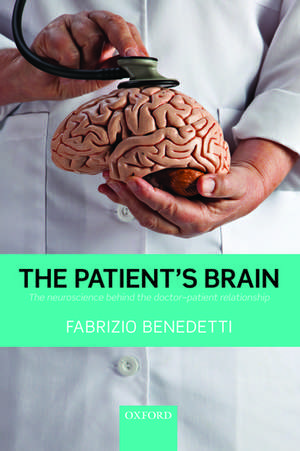
The Patient's Brain: The neuroscience behind the doctor-patient relationship
Autor Fabrizio Benedettien Limba Engleză Paperback – 7 oct 2010
Pregătirea pentru examenul de specialitate, fie că vorbim de rezidențiat în psihiatrie, neurologie sau certificări internaționale de tip „board”, impune adesea o înțelegere care depășește protocolul clinic standard. În „The Patient's Brain”, descoperim o abordare revoluționară care transformă interacțiunea umană din cabinet într-o serie de procese biologice cuantificabile. Observăm cum Fabrizio Benedetti reușește să pună bazele unei „neuroștiințe a relației”, oferind profesioniștilor din sănătate instrumentele necesare pentru a vedea, la propriu, cum atitudinea lor modifică chimia cerebrală a pacientului.
Cartea este structurată riguros pe etapele fundamentale ale experienței medicale: de la momentul în care individul resimte boala, până la interacțiunea efectivă cu terapeutul. Găsim aici explicații detaliate despre modul în care empatia și compasiunea nu sunt doar concepte etice, ci mecanisme care activează rețele moleculare și arii corticale specifice. Pe linia clinică a lucrării Relationship Power in Health Care de John B. Livingstone, dar cu un accent mult mai pronunțat pe fundamentul biologic și pe datele neuroștiințifice dure, volumul de față elimină ambiguitatea din jurul „abilităților de comunicare”.
Această lucrare reprezintă apogeul cercetărilor lui Benedetti, fiind strâns legată de opera sa anterioară, în special de apreciatul volum Placebo Effects. Dacă în lucrările sale precedente, precum Placebo Effects in Neurology, autorul explora impactul așteptărilor asupra rezultatelor terapeutice, în „The Patient's Brain” el extinde această viziune asupra întregului ecosistem format între medic și pacient. Este o lectură esențială pentru a înțelege cum biologia încrederii poate potența orice tratament convențional, oferind o perspectivă clinică și precisă asupra puterii pe care un cadru medical o exercită asupra capacității de recuperare a organismului.
Preț: 553.63 lei
Preț vechi: 676.21 lei
-18%
Carte tipărită la comandă
Livrare economică 05-16 iunie
Specificații
ISBN-10: 0199579512
Pagini: 304
Ilustrații: Illustrations (some col.)
Dimensiuni: 155 x 234 x 18 mm
Greutate: 0.56 kg
Editura: OUP OXFORD
Colecția OUP Oxford
Locul publicării:Oxford, United Kingdom
V-ar putea interesa
-
 It's Probably NothingNaga Munchetty-5%Preț: 144.73 lei152.35 lei
 -
 EmotionalLeonard Mlodinow-20%Preț: 59.88 lei75.20 lei
 -
 Words Can Change Your BrainAndrew Newberg-18%Preț: 57.18 lei70.03 lei
 -
 The Brain: A Very Short IntroductionMichael O'Shea-33%Preț: 45.40 lei67.74 lei
 -
 -24%Preț: 89.34 lei117.15 lei
 -
 The Great NerveKevin TraceyPreț: 151.85 lei
 -
 -27%Preț: 86.45 lei117.73 lei
 -
 A General Theory of LoveThomas LewisPreț: 94.05 lei
 -
 The Healing Power of EmotionDiana FoshaPreț: 364.65 lei
 -
 The Pocket Guide to Neuroscience for CliniciansLouis Cozolino-5%Preț: 191.09 lei201.14 lei
 -
 Introduction to Social NeuroscienceStephanie Cacioppo-16%Preț: 629.21 lei749.06 lei
 -
 The Neuroscience of PsychotherapyLouis Cozolino-5%Preț: 363.28 lei382.40 lei
 -
 -28%Preț: 54.69 lei75.44 lei
 -
 Preț: 100.51 lei
 -
 Preț: 116.26 lei
 -
 ShiftEthan KrossPreț: 116.73 lei
 -
 What We Value: The Neuroscience of Choice and ChangeDr Emily Falk-20%Preț: 121.70 lei151.61 lei
 -
 The Brain at RestJoseph JebelliPreț: 81.54 lei
 -
 Change Your Brain, Change Your PainDaniel Amen-28%Preț: 134.08 lei185.59 lei
 -
 The Other Side of ChangeMaya ShankarPreț: 116.28 lei
De ce să citești această carte
Recomandăm această carte oricărui medic sau psihoterapeut care dorește să înțeleagă biologia din spatele cuvintelor. Cititorul câștigă o perspectivă științifică asupra modului în care empatia și încrederea pot fi utilizate ca instrumente clinice reale, optimizând răspunsul terapeutic prin activarea sistemelor neurochimice endogene ale pacientului. Este o resursă indispensabilă pentru modernizarea practicii medicale și îmbunătățirea rezultatelor în tratamentul afecțiunilor cronice și neurologice.
Despre autor
Fabrizio Benedetti este profesor de fiziologie și neuroștiințe la Universitatea din Torino, Facultatea de Medicină, și un cercetător de renume mondial în domeniul efectului placebo și nocebo. Opera sa, care include titluri fundamentale precum Placebo Effects și Placebo Responses in Neurologic Clinical Trials, a redefinit modul în care medicina contemporană înțelege interacțiunea dintre minte și corp. Activitatea sa academică și clinică se concentrează pe mecanismele neurobiologice ale așteptărilor și ale contextului terapeutic, fiind distins cu numeroase premii internaționale pentru contribuția sa la neuroștiințele clinice.