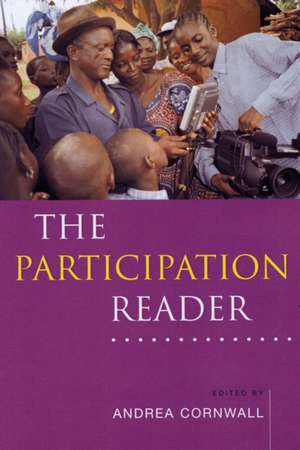
The Participation Reader
Editat de Andrea Cornwallen Limba Engleză Paperback – 12 mai 2011
Observăm că succesul oricărei intervenții de dezvoltare depinde fundamental de gradul de implicare a celor afectați, însă practica participării este adesea marcată de o „popularitate fără claritate”. The Participation Reader răspunde acestei probleme prin compilarea unor studii de caz și metodologii esențiale, de la „scara participării cetățenești” propusă de Sherry R. Arnstein, până la aplicațiile practice ale PRA (Participatory Rural Appraisal) analizate de Robert Chambers. Subliniem faptul că volumul nu se rezumă la teorie, ci oferă instrumente pentru înțelegerea modului în care cercetarea participativă poate fi utilizată pentru a genera cunoaștere nouă și pentru a democratiza procesul de luare a deciziilor.
Structura volumului este organizată riguros în două părți: prima explorează evoluția conceptuală a termenului — de la un simplu cuvânt la modă în era neoliberală la un instrument politic — în timp ce a doua parte se concentrează pe metodologii, incluzând perspective feministe și de cercetare cooperativă. Credem că această abordare oferă o perspectivă unică asupra dilemelor cu care se confruntă practicienii de pe teren.
Lucrarea acoperă aceeași arie ca Participation de Samuel Hickey, dar cu o abordare mult mai axată pe evoluția istorică a literaturii de specialitate, adunând texte care au inspirat generații de activiști. În contextul operei editorului Andrea Cornwall, acest volum consolidează temele explorate în Revolutionizing Development sau Feminisms, Empowerment and Development, rafinând analiza puterii și a reprezentării în politicile de dezvoltare. Este o resursă care documentează tranziția de la beneficiar pasiv la cetățean activ.
Preț: 180.03 lei
Preț vechi: 210.26 lei
-14%
Carte tipărită la comandă
Livrare economică 21 noiembrie-05 decembrie
Specificații
ISBN-10: 1842774034
Pagini: 464
Ilustrații: Illustrations
Dimensiuni: 154 x 234 x 30 mm
Greutate: 0.7 kg
Editura: Bloomsbury Publishing
Colecția Zed Books
Locul publicării:London, United Kingdom
V-ar putea interesa
-
 The Oxford Handbook of Participation in OrganizationsAdrian Wilkinson-20%Preț: 370.94 lei464.51 lei
 -
 Preț: 379.89 lei
 -
 Political Issues and Community WorkPaul Curno-9%Preț: 654.27 lei718.97 lei
 -
 Theories and Practices of DevelopmentKatie WillisPreț: 354.84 lei
 -
 Commons and Public Partnership: Legitimizing a Commons Political SphereDr Torange Khonsari-33%Preț: 552.38 lei820.12 lei
 -
 The Companion to Development StudiesVandana Desai-8%Preț: 543.23 lei590.48 lei
 -
 CommunityJ. Toby ReinerPreț: 138.63 lei
 -
 The Refusalist InternationalMikkel Bolt RasmussenPreț: 83.68 lei
 -
 Preț: 157.44 lei
 -
 Empathy and ResistanceKristina LunzPreț: 109.62 lei
 -
 Not Your Victim: How our Obsession with Race Entra ps and Divides UsMarie Kawthar DaoudaPreț: 143.00 lei
 -
 -26%Preț: 2017.31 lei2726.09 lei
 -
 -27%Preț: 1908.00 lei2601.26 lei
 -
 Collaborative Methods: Participatory Data Analysis in Feminist ResearchKaylan C. SchwarzPreț: 236.20 lei
 -
 The Craftivist Collective HandbookSarah P. Corbett-16%Preț: 137.37 lei163.11 lei
 -
 Adventures in DemocracyErica BennerPreț: 77.43 lei
 -
 Keep LeftPauline BryanPreț: 85.65 lei
 -
 Participatory Development PracticeAnthony KellyPreț: 239.86 lei
 -
 Preț: 202.29 lei
 -
 Contesting MegaprojectsGerardo del Cerro Santamaría-17%Preț: 415.51 lei500.61 lei
De ce să citești această carte
Recomandăm această carte studenților și practicienilor din domeniul studiilor de dezvoltare care doresc să înțeleagă rădăcinile intelectuale ale participării comunitare. Cititorul câștigă o viziune critică asupra modului în care participarea poate fi utilizată atât pentru emancipare, cât și pentru depolitizarea dezvoltării. Este o resursă metodologică esențială care transformă concepte abstracte în instrumente de lucru aplicabile în proiecte sociale și politici publice.
Despre autor
Andrea Cornwall (născută la 14 octombrie 1963) este profesor de dezvoltare globală și antropologie la SOAS, University of London, unde deține și funcția de Pro-Director pentru Cercetare și Întreprindere. Specialistă recunoscută în antropologia dezvoltării, Cornwall s-a concentrat de-a lungul carierei sale pe teme precum drepturile reproductive, democrația participativă și teoriile de empowerment. A editat numeroase volume de referință care analizează critic intersecția dintre gen, putere și politicile de dezvoltare, printre care se numără Men and Development și Development with a Body.
Descriere
Through excerpts from the texts that have inspired contemporary advocates of participation, accounts of the principles of participatory research and empirical studies that show some of the complexities of participation in practice, it offers a range of reflections on participation that will be of interest to those new to the field and experienced practitioners alike.
Bringing together for the first time classic and contemporary writings from a literature that spans a century, it offers a unique perspective on the possibilities and dilemmas that face those seeking to enable those affected by development projects, programmes and policies.
Cuprins
1. A Ladder of Citizen Participation - Sherry R. Arnstein
2. The Many Faces of Participation - Matthias Stiefel and Marshall Wolfe
3. What is Meant by People's Participation? - N. C. Saxena
4. Participation's Place in Rural Development: Seeking Clarity Through Specificity - John Cohen and Norman Uphoff
5. Depoliticizing Development: the Uses and Abuses of Participation - Sarah White
6. Participation: the Ascendancy of a Buzzword in the Neo-Liberal Era - Pablo Alejandro Leal
Part II - Participatory Methodologies: Principles and Applications
7. Production and Diffusion of New Knowledge - Orlando Fals Borda
8. The Historical Roots and Contemporary Urges in Participatory Research - Rajesh Tandon
9. New Paradigm Research Manifesto - New Paradigm Research Group London
10. Doing Feminist Participatory Research - Patricia Maguire
11. Cooperative Inquiry - Peter Reason
12. PRA Five Years Later - Robert Chambers and Irene Guijt
13. Ten Myths About PRA - Ian Scoones
14. Growing From the Grassroots: Building Participatory Planning, Monitoring and Evaluation Methods in PARC - Janet Symes and Sa'ed Jasser
15. Tools for Empowerment: Community Exchanges - Sheela Patel
16. Citizens Juries: a Radical Alternative for Social Research - Tom Wakeford
17. Voices Aloud: Making Communication and Change Together - Oga Steve Abah
18. Powerful Grassroots Women Communicators: Participatory Video in Bangladesh - Renuka Bery and Sara Stuart
Part III - Community and Participatory Development: Principles and Practice
19. Managing Local Participation: Rhetoric and Reality - Robert Chambers
20. Community Participation: History, Concepts and Controversies - James Midgley
21. The Making and Marketing of Participatory Development - David Mosse
22. Whose Voices? Whose Choices? Reflections on Gender and Participatory Development - Andrea Cornwall
23. Ethnicity and Participatory Development Methods in Botswana: Some Participants Are to Be Seen and Not Heard - Tlamelo Mompati and Gerard Prinsen
24. Towards a Repoliticization of Participatory Development: Political Capabilities and Spaces of Empowerment - Glyn Williams
Part IV - Participaton in Governance
25. Towards Participatory Local Governance: Six Propositions for Discussion - John Gaventa
26. The Politics of Domesticating Participation in Rural India - Ranjita Mohanty
27. Aiding Policy? Civil society Engagement in Tanzania's PRSP - Elaina Mack
28. Participation Without Representation: Chiefs, Councils and Forestry Law in the West African Sahel - Jesse C. Ribo
29. Talking Politics in Participatory Governance - Gianpaolo Baocchi
30. Co-Governance for Accountability: Beyond 'Exit' and 'Voice' - John Ackerman
Part V - Participation as Collective Action: Mobilization, Insurgency and Struggle
31. Users as Citizens: Collective Action and the Local Governance of Welfare - Marion Barnes
32. Insurgency and Spaces of Active Citizenship: the Story of the Western Cape Anti-Eviction Campaign in South Africa - Faranak Miraftab and Shana Wills
33. Pedagogical Guerrillas, Armed Democrats and Revolutionary Counter-Publics: Examining Paradox in the Zapatista Uprising in Chiapas, Mexico - Josee Johnston
34. Bodies as Sites of Struggle: Naripokkho and the Movement for Women's Rights in Bangladesh - Shireen Huq
35. Citizenship: a Perverse Confluence - Evelina Dagnino
Recenzii
Andrea Cornwall has created a powerful go-to volume on participation encompassing foundational literature, thoughtful reflections on processes and theories, insightful critiques and inspiring descriptions of participatory initiatives. Citizens, organizers, students and researchers will return to The Participation Reader again and again for grounded analyses of the problems and possibilities of "participation".
This volume is a compelling and critical look at both the concept and practice of participation, a topic that has been afflicted, in the words of one its contributors, by "popularity without clarity". It is a comprehensive effort at advancing clarity, and offers convincing analyses of the oversimplification, depoliticization, and instrumentalization that has characterized the debates and discourse on participation in recent times. With an impressive array of writers, including leading participation theorists and practitioners from around the world, we are led systematically through definitions, principles, methodologies, case studies and critiques, and emerge with sharper conceptual and strategic insights for advancing the democratization project.