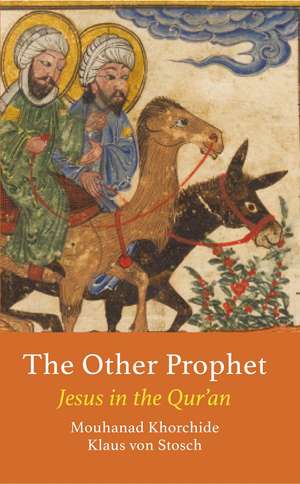
The Other Prophet: Jesus in the Qur’an: Interfaith Series
Autor Mouhanad Khorchide, Klaus von Stosch Traducere de Simon Pareen Limba Engleză Paperback – 18 iun 2025
Unique study of Jesus in the Qur’an by a Christian and a Muslim scholar writing together.
The Qur’an identifies Jesus as a sign of God, and he holds a place as one of the most important prophets in Islam. Looking at Jesus in Islam also reveals both deep differences from and rich connections to the view of Jesus in Christianity. In The Other Prophet, Mouhanad Khorchide and Klaus von Stosch explore and explain the position of the Qur’anic Jesus, with one scholar working from the Muslim and the other from the Christian theological perspective. Their combined research presents a history of Jesus’ presence in the Qur’an and provides astute observations to deepen the understanding of both Christians and Muslims. Here we find that a common view of Jesus from the Muslim and Christian sides is not only possible but also expands our understanding of Jesus and his message.
The Qur’an identifies Jesus as a sign of God, and he holds a place as one of the most important prophets in Islam. Looking at Jesus in Islam also reveals both deep differences from and rich connections to the view of Jesus in Christianity. In The Other Prophet, Mouhanad Khorchide and Klaus von Stosch explore and explain the position of the Qur’anic Jesus, with one scholar working from the Muslim and the other from the Christian theological perspective. Their combined research presents a history of Jesus’ presence in the Qur’an and provides astute observations to deepen the understanding of both Christians and Muslims. Here we find that a common view of Jesus from the Muslim and Christian sides is not only possible but also expands our understanding of Jesus and his message.
| Toate formatele și edițiile | Preț | Express |
|---|---|---|
| Paperback (1) | 108.65 lei 3-5 săpt. | +98.05 lei 6-10 zile |
| Gingko – 18 iun 2025 | 108.65 lei 3-5 săpt. | +98.05 lei 6-10 zile |
| Hardback (1) | 188.64 lei 3-5 săpt. | |
| Gingko – 21 noi 2019 | 188.64 lei 3-5 săpt. |
Preț: 108.65 lei
Preț vechi: 193.10 lei
-44% Nou
Puncte Express: 163
Preț estimativ în valută:
19.23€ • 22.54$ • 16.88£
19.23€ • 22.54$ • 16.88£
Carte disponibilă
Livrare economică 21 ianuarie-04 februarie 26
Livrare express 06-10 ianuarie 26 pentru 108.04 lei
Preluare comenzi: 021 569.72.76
Specificații
ISBN-13: 9781909942967
ISBN-10: 1909942960
Pagini: 332
Dimensiuni: 133 x 216 x 25 mm
Greutate: 0.29 kg
Editura: Gingko
Colecția Gingko
Seria Interfaith Series
ISBN-10: 1909942960
Pagini: 332
Dimensiuni: 133 x 216 x 25 mm
Greutate: 0.29 kg
Editura: Gingko
Colecția Gingko
Seria Interfaith Series
Notă biografică
Mouhanad Khorchide is professor of Islamic Studies and head of the Center for Islamic Theology at the University of Münster. Klaus von Stosch is professor of Catholic Theology and Didactics and chair of the Centre for Comparative Theology and Cultural Studies at the University of Paderborn. Simon Pare is a translator from French and German who lives in Paris.
Cuprins
1. Introduction
2. The State of Christology in the Seventh Century
2.1 The Chalcedon controversy
2.2 A political compromise on dogma
2.3 The neo-Chalcedonian doctrine of enhypostasis
2.4 Christological debates among non-Chalcedonians
2.5 The Arabian Peninsula as a confluence of heresies?
2.6 The situation in the Arabian Peninsula in the seventh century
3. New Developments in Modern Christology
3.1 The starting point of consciousness Christology
3.2 The modern paradigm shift in relational ontology and its impact on Christology
3.3 Testing against the historical Jesus
3.4 Multiple incarnations?
4. A Holistic Reading of Surahs 19, 3 and 5 in the Context of a Diachronic Reading of the Qur’an’s Verses about Jesus
4.1 Jesus in Surah Maryam
4.1.1 Zachariah and John
4.1.2 Mary and her child
4.1.3 Jesus’s self-image
4.1.4 An anti-Christological intervention in Q 19:34–40?
4.1.5 Further themes in Surah Maryam
4.1.6 Prophetological consolidation in the late Meccan and early Medinan periods
4.2 Surah al ‘Imran
4.2.1 Prologue (verses 1–32)
4.2.2 Narrative core (verses 33–62)
4.2.3 Religio-political arguments (verses 63–99)
4.2.4 Self-assurance of the Muslim community (verses 100–200)
4.2.5 Jesus crucified?
4.3 Surah al-Ma’ida
4.3.1 Structure and themes of the surah
4.3.2 Criticism of any deification of human beings
4.3.3 A break with Christianity?
5. Jesus’s Position in Qur’anic Prophetology (Zishan Ghaffar)
5.1 the early Meccan surahs: eschatological prophecy
5.1.1 Imminent eschatological expectation?
5.2 The middle Meccan surahs: prophetology as a combination of salvation, election and mercy
5.2.1 The new context of the proclamation in the middle Meccan
period and its central topoi
5.2.2 The Qur’an’s apostolic doctrine in the middle Meccan period
5.2.3 The birth of prophecy out of God’s mercy
5.2.4 Muhammad as Moses redivivus – the consolidation of Qur’anic prophetology in the middle Meccan period
5.3 Late Meccan prophetology: the apology of the messengers
5.4 Qur’anic prophetology in Medina
5.4.1 from existential to textual typology
5.4.2 from community of fate to the universal community of the covenant: Qur’anic prophetology between universality and
exclusivity
5.4.3 the Messenger Muhammad as lawmaker and his special
prestige as a prophetic dignitary
5.4.4 Prophetology as a counter-discourse to Christology?
6. The Work of Jesus Christ and the Qur’an: A Forensic Search for Functional Equivalents
6.1 God’s self-revelation in the Islamic tradition (with the involvement of Darius asghar-Zadeh)
6.2 The relation between God and humans as a liberating relationship
6.3 On the soteriological relevance of the Qur’an (with the involvement of Darius asghar-Zadeh)
6.4 Can God suffer?
6.5 Qur’anic stimuli for conceiving of emotions in God
7. New Perspectives on the Qur’an
7.1 Systematic conclusions from a Christian perspective
7.2 Systematic conclusions from a Muslim perspective
Bibliography
Reference text
2. The State of Christology in the Seventh Century
2.1 The Chalcedon controversy
2.2 A political compromise on dogma
2.3 The neo-Chalcedonian doctrine of enhypostasis
2.4 Christological debates among non-Chalcedonians
2.5 The Arabian Peninsula as a confluence of heresies?
2.6 The situation in the Arabian Peninsula in the seventh century
3. New Developments in Modern Christology
3.1 The starting point of consciousness Christology
3.2 The modern paradigm shift in relational ontology and its impact on Christology
3.3 Testing against the historical Jesus
3.4 Multiple incarnations?
4. A Holistic Reading of Surahs 19, 3 and 5 in the Context of a Diachronic Reading of the Qur’an’s Verses about Jesus
4.1 Jesus in Surah Maryam
4.1.1 Zachariah and John
4.1.2 Mary and her child
4.1.3 Jesus’s self-image
4.1.4 An anti-Christological intervention in Q 19:34–40?
4.1.5 Further themes in Surah Maryam
4.1.6 Prophetological consolidation in the late Meccan and early Medinan periods
4.2 Surah al ‘Imran
4.2.1 Prologue (verses 1–32)
4.2.2 Narrative core (verses 33–62)
4.2.3 Religio-political arguments (verses 63–99)
4.2.4 Self-assurance of the Muslim community (verses 100–200)
4.2.5 Jesus crucified?
4.3 Surah al-Ma’ida
4.3.1 Structure and themes of the surah
4.3.2 Criticism of any deification of human beings
4.3.3 A break with Christianity?
5. Jesus’s Position in Qur’anic Prophetology (Zishan Ghaffar)
5.1 the early Meccan surahs: eschatological prophecy
5.1.1 Imminent eschatological expectation?
5.2 The middle Meccan surahs: prophetology as a combination of salvation, election and mercy
5.2.1 The new context of the proclamation in the middle Meccan
period and its central topoi
5.2.2 The Qur’an’s apostolic doctrine in the middle Meccan period
5.2.3 The birth of prophecy out of God’s mercy
5.2.4 Muhammad as Moses redivivus – the consolidation of Qur’anic prophetology in the middle Meccan period
5.3 Late Meccan prophetology: the apology of the messengers
5.4 Qur’anic prophetology in Medina
5.4.1 from existential to textual typology
5.4.2 from community of fate to the universal community of the covenant: Qur’anic prophetology between universality and
exclusivity
5.4.3 the Messenger Muhammad as lawmaker and his special
prestige as a prophetic dignitary
5.4.4 Prophetology as a counter-discourse to Christology?
6. The Work of Jesus Christ and the Qur’an: A Forensic Search for Functional Equivalents
6.1 God’s self-revelation in the Islamic tradition (with the involvement of Darius asghar-Zadeh)
6.2 The relation between God and humans as a liberating relationship
6.3 On the soteriological relevance of the Qur’an (with the involvement of Darius asghar-Zadeh)
6.4 Can God suffer?
6.5 Qur’anic stimuli for conceiving of emotions in God
7. New Perspectives on the Qur’an
7.1 Systematic conclusions from a Christian perspective
7.2 Systematic conclusions from a Muslim perspective
Bibliography
Reference text
Recenzii
"...well-structured, beautifully written [and] artfully translated.... Having committed themselves to comparative theology, [Khorchide and von Stosch's] method has also been empathetic, as they explain: 'we try to feel our way into the other's beliefs and help each other to formulate our respective faith as persuasively as possible.'"
"The book... provides a new perspective on interreligious scholarship and lays the groundwork for an interreligious theology that engages Muslim and Christian theologians and scholars in studying Christology for a better understanding of the Qur’an."