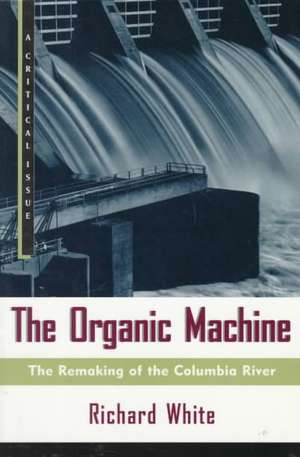
The Organic Machine
Autor Richard Whiteen Limba Engleză Paperback – 31 ian 1996
The Hill and Wang Critical Issues Series: concise, affordable works on pivotal topics in American history, society, and politics.
In this pioneering study, White explores the relationship between the natural history of the Columbia River and the human history of the Pacific Northwest for both whites and Native Americans. He concentrates on what brings humans and the river together: not only the physical space of the region but also, and primarily, energy and work. For working with the river has been central to Pacific Northwesterners' competing ways of life. It is in this way that White comes to view the Columbia River as an organic machine--with conflicting human and natural claims--and to show that whatever separation exists between humans and nature exists to be crossed.
In this pioneering study, White explores the relationship between the natural history of the Columbia River and the human history of the Pacific Northwest for both whites and Native Americans. He concentrates on what brings humans and the river together: not only the physical space of the region but also, and primarily, energy and work. For working with the river has been central to Pacific Northwesterners' competing ways of life. It is in this way that White comes to view the Columbia River as an organic machine--with conflicting human and natural claims--and to show that whatever separation exists between humans and nature exists to be crossed.
Preț: 83.73 lei
Puncte Express: 126
Carte disponibilă
Livrare economică 02-16 iunie
Specificații
ISBN-13: 9780809015832
ISBN-10: 0809015838
Pagini: 146
Dimensiuni: 140 x 216 x 9 mm
Greutate: 0.14 kg
Editura: Farrar, Straus and Giroux
ISBN-10: 0809015838
Pagini: 146
Dimensiuni: 140 x 216 x 9 mm
Greutate: 0.14 kg
Editura: Farrar, Straus and Giroux
V-ar putea interesa
-
 OrientalismEdward W. Said-31%Preț: 64.14 lei92.82 lei
 -
 -23%Preț: 257.91 lei333.64 lei
 -
 Rivers of the Sultan: The Tigris and Euphrates in the Ottoman EmpireFaisal H. HusainPreț: 249.26 lei
 -
 Land Use, Environment, and Social ChangeRichard WhitePreț: 220.27 lei
 -
 Power & Place in the North American WestRichard WhitePreț: 255.58 lei
 -
 The RhineMark CiocPreț: 218.06 lei
 -
 Nature's MetropolisWilliam CrononPreț: 128.32 lei
 -
 Something New Under the SunJ. R. McneillPreț: 137.75 lei
 -
 Conquest of NatureDavid BlackbournPreț: 176.79 lei
 -
 Global Environmental History: An Introductory ReaderJohn R. McNeill-15%Preț: 463.74 lei545.57 lei
 -
 Man and MicrobesArno Karlan-5%Preț: 98.15 lei103.31 lei
 -
 GlobalizationJürgen OsterhammelPreț: 186.15 lei
 -
 Great DivergenceKenneth PomeranzPreț: 114.11 lei
 -
 -20%Preț: 172.57 lei216.94 lei
 -
 The Nile: History's Greatest RiverTerje Tvedt-33%Preț: 217.98 lei326.98 lei
 -
 Preț: 386.24 lei
 -
 -5%Preț: 310.49 lei326.83 lei
 -
 The Sea and CivilizationLincoln PainePreț: 170.80 lei
 -
 The Dread Plague and the Cow KillersThomas RathPreț: 282.02 lei
 -
 -15%Preț: 445.45 lei524.06 lei
 -
 Technology and the Environment in HistorySara B PritchardPreț: 214.12 lei
 -
 The Unsettled PlainChris GratienPreț: 211.73 lei
 -
 -23%Preț: 581.70 lei755.44 lei
 -
 Preț: 135.29 lei
 -
 ColonialismJurgen OsterhammelPreț: 164.62 lei
 -
 Black Sea: Coasts and Conquests: From Pericles to PutinNeal Ascherson-32%Preț: 62.62 lei91.91 lei
 -
 -18%Preț: 864.96 lei1054.82 lei
 -
 The Lower Danube RiverAbdelazim Negm-18%Preț: 717.35 lei874.81 lei
 -
 -8%Preț: 591.69 lei643.13 lei
Notă biografică
Richard White, professor of History at the University of Washington in Seattle, is the author of The Middle Ground and It's Your Misfortune and None of My Own and the recipient of the Albert J. Beveridge and Western Heritage awards.
Textul de pe ultima copertă
In The Organic Machine, Richard White, a distinguished historian and leading scholar of the American West, explores the intimate relationship between nature and mankind along the Columbia River. Working on the cutting edge of environmental and social history, White demonstrates how, over the centuries, both native peoples and settlers have continually remade the river, treating it as a machine designed to churn out energy and sustenance. He assesses the impact on the Northwest ecology of enterprises that have marked the river's history, from salmon fishing to the Hanford Energy Works nuclear plant, and eloquently reveals the insights and illusions of those who work with the river.