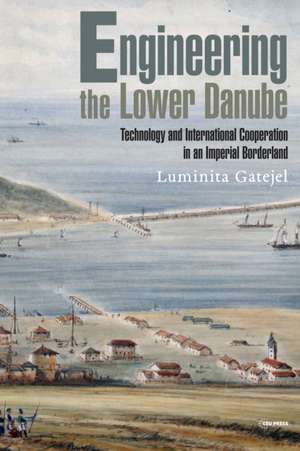
Engineering the Lower Danube: Technology and Territoriality in an Imperial Borderland, Late Eighteenth and Nineteenth Centuries: Historical Studies in Eastern Europe and Eurasia - CEU Press
Autor Luminita Gatejelen Limba Engleză Hardback – 5 ian 2023
Monografia Engineering the Lower Danube propusă de Luminita Gatejel oferă o analiză riguroasă a modului în care ingineria și politica imperială au remodelat cursul Dunării de Jos în secolul al XIX-lea. Remarcăm abordarea autoarei care depășește istoria diplomatică tradițională, focalizându-se pe transformarea fizică și juridică a două sectoare critice: Porțile de Fier și Delta Dunării. Volumul demonstrează cum necesitatea tehnică de a asigura navigația liberă a transformat acest spațiu de frontieră într-un teren de experimentare pentru noi forme de guvernanță internațională.
Structura lucrării urmărește o progresie logică, de la explorările inițiale și eforturile de conectare a fluviului cu marea, până la analiza detaliată a consecințelor Războiului Crimeii. Capitolele dedicate Deltei și Porților de Fier evidențiază tensiunile dintre interesele naționale emergente și aspirațiile imperiale de control. Reținem în mod deosebit modul în care este descrisă emergența profesiei de inginer, acești specialiști devenind mediatori esențiali între ambițiile politice și realitățile geografice dificile.
Lucrarea acoperă o arie tematică similară cu The European Commission of the Danube, 1856-1948 de Constantin Ardeleanu, însă Engineering the Lower Danube pune un accent mai pronunțat pe dimensiunea tehnologică și pe rolul inginerilor ca actori transnaționali, în timp ce Ardeleanu se concentrează pe evoluția instituțională a Comisiei Europene a Dunării. De asemenea, spre deosebire de Steamboat Modernity, care analizează impactul economic al navigației cu aburi, volumul de față investighează fundamentele tehnice și teritoriale care au făcut posibilă această modernizare.









Preț: 620.86 lei
Preț vechi: 674.85 lei
-8%
Carte indisponibilă temporar
Specificații
ISBN-10: 9633865794
Pagini: 348
Ilustrații: 15 Illustrations, unspecified
Dimensiuni: 152 x 229 x 23 mm
Greutate: 0.8 kg
Ediția:1
Editura: Amsterdam University Press
Colecția Central European University Press
Seria Historical Studies in Eastern Europe and Eurasia - CEU Press
Locul publicării:Oxford, United Kingdom
V-ar putea interesa
-
 OrientalismEdward W. Said-29%Preț: 66.94 lei94.31 lei
 -
 -16%Preț: 278.03 lei331.42 lei
 -
 Rivers of the Sultan: The Tigris and Euphrates in the Ottoman EmpireFaisal H. Husain-20%Preț: 276.56 lei345.60 lei
 -
 The RhineMark CiocPreț: 234.49 lei
 -
 Nature's MetropolisWilliam CrononPreț: 139.31 lei
 -
 Conquest of NatureDavid BlackbournPreț: 199.71 lei
 -
 Global Environmental History: An Introductory ReaderJohn R. McNeill-15%Preț: 481.94 lei566.99 lei
 -
 Man and MicrobesArno Karlen-5%Preț: 103.61 lei109.06 lei
 -
 GlobalizationJürgen OsterhammelPreț: 205.38 lei
 -
 Great DivergenceKenneth PomeranzPreț: 114.19 lei
 -
 -19%Preț: 179.13 lei220.39 lei
 -
 The Nile: History's Greatest RiverTerje Tvedt-32%Preț: 232.43 lei341.38 lei
 -
 The Organic MachineRichard WhitePreț: 89.70 lei
 -
 Preț: 401.33 lei
 -
 -5%Preț: 338.47 lei356.29 lei
 -
 The Sea and CivilizationLincoln PainePreț: 189.11 lei
 -
 The Dread Plague and the Cow KillersThomas RathPreț: 287.71 lei
 -
 -15%Preț: 470.77 lei553.85 lei
 -
 The Unsettled PlainChris GratienPreț: 219.51 lei
 -
 Preț: 481.36 lei
 -
 Preț: 145.59 lei
 -
 ColonialismJurgen OsterhammelPreț: 175.90 lei
 -
 Black Sea: Coasts and Conquests: From Pericles to PutinNeal Ascherson-30%Preț: 65.60 lei93.37 lei
 -
 The Black Sea from Paleogeography to Modern NavigationRomeo Bosneagu-18%Preț: 904.56 lei1103.13 lei
 -
 The Lower Danube RiverAbdelazim Negm-18%Preț: 717.35 lei874.81 lei
 -
 Die DonauMichael W. WeithmannPreț: 217.88 lei
Public țintă
AcademicDe ce să citești această carte
Această carte este esențială pentru cercetătorii interesați de istoria Europei de Est și de istoria tehnologiei. Cititorul va înțelege cum Dunărea a fost transformată dintr-o barieră naturală într-o arteră comercială vitală prin eforturi transnaționale. Este o resursă valoroasă pentru cei care doresc să exploreze rădăcinile cooperării internaționale moderne și modul în care expertiza tehnică a influențat trasarea granițelor politice în secolul al XIX-lea.
Despre autor
Luminita Gatejel este o cercetătoare specializată în istoria Europei Centrale și de Est, cu un interes distinct pentru istoria tehnologiei și a mobilității. Prin lucrarea de față, publicată în seria Historical Studies in Eastern Europe and Eurasia - CEU Press, ea aduce o contribuție semnificativă la înțelegerea modului în care proiectele de infrastructură și expertiza inginerească au modelat structurile politice și economice în regiunea Dunării de Jos. Studiile sale se remarcă prin utilizarea unei baze documentare vaste și prin capacitatea de a integra istoria regională în contexte imperiale și globale mai largi.
Notă biografică
Cuprins
Descriere
The Lower Danube-the stretch of Europe's second longest river between the Romanian-Serbian border and the confluence to the Black Sea-was effectively transformed during the late eighteenth and nineteenth centuries. In describing this lengthy undertaking, Luminita Gatejel proposes that remaking two key stretches-the Iron Gates and the delta-not only physically altered the river but also redefined it in a legal and political sense.
Since the late eighteenth century, military conflicts and peace treaties changed the nature of sovereignty over the area, as the expansionist tendencies of the Habsburg and British Empires encountered rival Ottoman and Russian imperial plans. The inconvenience that the river's physical shape obstructed free navigation and the growth of commercial traffic, was an increasing concern to all parties. This book shows that alongside imperial aspirations, transnational actors like engineers, commissioners and entrepreneurs were the driving force behind the river regulation. In this highly original, deeply researched, and carefully crafted study, Gatejel explores the formation of international cooperation, the emergence of technical expertise and the emergence of engineering as a profession. This constellation turned the Lower Danube into a laboratory for experimenting with new forms of international cooperation, economic integration, and nature transformation.