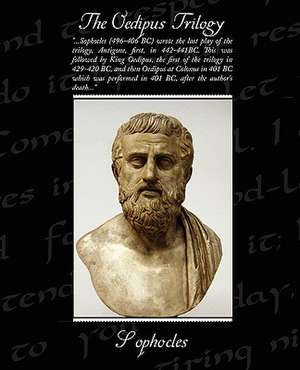
The Oedipus Trilogy
Autor Sophoclesen Limba Engleză Paperback – 21 oct 2008
Preț: 164.75 lei
Puncte Express: 247
Carte tipărită la comandă
Livrare economică 11-25 august
Livrare prin curier în România Termenul estimat este afișat lângă disponibilitate.
Transport gratuit de la 400.00 lei Plată online sau ramburs, în funcție de opțiunile comenzii.
Retur gratuit în 14 zile Comandă securizată și suport în română.
Specificații
ISBN-13: 9781438504063
ISBN-10: 1438504063
Pagini: 248
Dimensiuni: 191 x 235 x 13 mm
Greutate: 0.43 kg
Editura: Book Jungle
ISBN-10: 1438504063
Pagini: 248
Dimensiuni: 191 x 235 x 13 mm
Greutate: 0.43 kg
Editura: Book Jungle
V-ar putea interesa
-
 The Three Theban PlaysSophocles-43%Preț: 52.49 lei92.11 lei
 -
 Electra and Other PlaysSophocles-31%Preț: 63.71 lei92.57 lei
 -
 AntigoneSophocles-40%Preț: 16.82 lei28.02 lei
 -
 Antigone; Oedipus the King; ElectraSophocles-21%Preț: 50.33 lei63.46 lei
 -
 The Theban PlaysSophoclesPreț: 39.49 lei
 -
 Major BarbaraGeorge Bernard ShawPreț: 60.30 lei
Notă biografică
Sophocles is one of three ancient Greek tragedians whose plays have survived. His first plays were written later than, or contemporary with, those of Aeschylus; and earlier than, or contemporary with, those of Euripides. Sophocles wrote over 120 plays, but only seven have survived in a complete form: Ajax, Antigone, Women of Trachis, Oedipus Rex, Electra, Philoctetes and Oedipus at Colonus. For almost fifty years, Sophocles was the most celebrated playwright in the dramatic competitions of the city-state of Athens which took place during the religious festivals of the Lenaea and the Dionysia. He competed in thirty competitions, won twenty-four, and was never judged lower than second place. Aeschylus won thirteen competitions, and was sometimes defeated by Sophocles; Euripides won four. The most famous tragedies of Sophocles feature Oedipus and Antigone: they are generally known as the Theban plays, though each was part of a different tetralogy (the other members of which are now lost). Sophocles influenced the development of drama, most importantly by adding a third actor (attributed to Sophocles by Aristotle; to Aeschylus by Themistius), thereby reducing the importance of the chorus in the presentation of the plot. He also developed his characters to a greater extent than earlier playwrights.