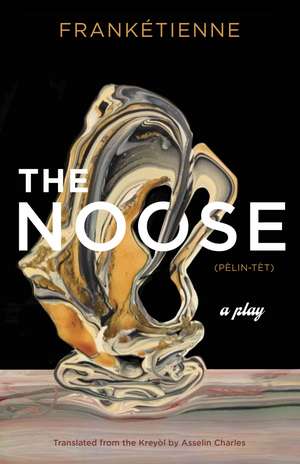
The Noose: A Play: Global Black Writers in Translation
Autor Frankétienne Traducere de Asselin Charles Cuvânt după de Jean Jonassainten Limba Engleză Hardback – 15 mai 2026
With recent productions in Canada and the United States, the publication of this play in English will provide a new generation of audiences access to this important text, accompanied by an introduction by translator Asselin Charles and an afterword by Jean Jonassaint, both preeminent scholars of Frankétienne’s literary output.
| Toate formatele și edițiile | Preț | Express |
|---|---|---|
| Paperback (1) | 166.97 lei Precomandă | |
| Vanderbilt University Press – 15 mai 2026 | 166.97 lei Precomandă | |
| Hardback (1) | 609.19 lei Precomandă | |
| Vanderbilt University Press – 15 mai 2026 | 609.19 lei Precomandă |



Preț: 609.19 lei
Preț vechi: 662.16 lei
-8% Precomandă
Puncte Express: 914
Preț estimativ în valută:
107.84€ • 125.26$ • 93.42£
107.84€ • 125.26$ • 93.42£
Carte nepublicată încă
Doresc să fiu notificat când acest titlu va fi disponibil:
Se trimite...
Preluare comenzi: 021 569.72.76
Specificații
ISBN-13: 9780826500052
ISBN-10: 0826500056
Pagini: 188
Dimensiuni: 152 x 229 mm
Editura: Vanderbilt University Press
Colecția Vanderbilt University Press
Seria Global Black Writers in Translation
ISBN-10: 0826500056
Pagini: 188
Dimensiuni: 152 x 229 mm
Editura: Vanderbilt University Press
Colecția Vanderbilt University Press
Seria Global Black Writers in Translation
Notă biografică
Frankétienne (born Frank Étienne on April 12, 1936, in Ravine-Sèche, Haiti) was a writer, poet, playwright, painter, musician, activist, and intellectual. He was recognized as one of Haiti’s leading writers and playwrights of both French and Haitian Creole and has been called “the father of Haitian letters” by the New York Times. As a painter, he was known for his colorful abstract works, often emphasizing the colors blue and red. He was a candidate for the Nobel Prize for Literature in 2009 and was made a Commander of the Arts and Letters in 2010.
Asselin Charles is a retired professor of language and literature. He is the literary translator of many works, including Anténor Firmin’s masterwork The Equality of the Human Races and Frankétienne’s great Kreyòl novel Dézafi.
Asselin Charles is a retired professor of language and literature. He is the literary translator of many works, including Anténor Firmin’s masterwork The Equality of the Human Races and Frankétienne’s great Kreyòl novel Dézafi.
Extras
Two Haitian men, Polydor, a middle-class intellectual, and Pyram, a blue-collar worker, are rooming together in a sparsely furnished, windowless basement studio apartment in New York. Polydor is lying in bed on his back, reading a book. He is so engrossed in his reading he does not notice Pyram coming into the room. Pyram combs his hair with his fingers, then walks toward Polydor’s bed...
Pyram:
Hey, man, check me out! What a devil!
Polydor:
(Polydor pretends not to hear.)
Pyram:
I’m hot as hell, all smoke and fire. I here.
Polydor:
What do you mean, “I here?” The correct phrase is “I’m here.” And since when were you ever so hot that you turned into a flaming devil?
Pyram:
Gimme a smoke. Got a Lucky Strike?
Polydor:
(Polydor hands Pyram a pack of cigarettes.)
Pyram:
Hey, man! Share the wealth.
(Hetakes several cigarettes.)
Polydor:
Put them back, man.
Pyram:
But I did.
Polydor:
You took three cigarettes, you cheat.
Pyram:
Hey, man, check me out! What a devil!
Polydor:
(Polydor pretends not to hear.)
Pyram:
I’m hot as hell, all smoke and fire. I here.
Polydor:
What do you mean, “I here?” The correct phrase is “I’m here.” And since when were you ever so hot that you turned into a flaming devil?
Pyram:
Gimme a smoke. Got a Lucky Strike?
Polydor:
(Polydor hands Pyram a pack of cigarettes.)
Pyram:
Hey, man! Share the wealth.
(Hetakes several cigarettes.)
Polydor:
Put them back, man.
Pyram:
But I did.
Polydor:
You took three cigarettes, you cheat.
Cuprins
Translator’s Introduction
The Noose: A Play
Afterword by Jean Jonassaint
Notes
The Noose: A Play
Afterword by Jean Jonassaint
Notes
Descriere
From the “father of Haitian letters,” Frankétienne’s most performed play of Haitians in exile during the Duvalier regime