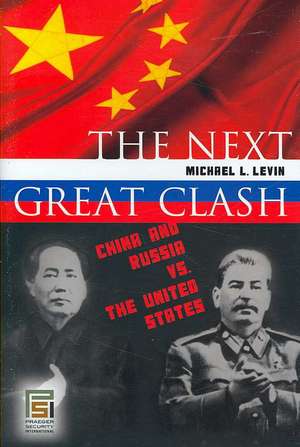
The Next Great Clash: China and Russia vs. the United States: Praeger Security International
Autor Michael Levinen Limba Engleză Hardback – 30 noi 2007
Levin contends that, since the turn of the century, the global War on Terror has distracted the United States from these developments, as China and Russia draw closer together in an alliance that may well displace American primacy. The Next Great Clash, augmented by personal experience in China, Russia, and the United States, combines years of scholarly research and political analysis-along with a riveting and up-to-date history of Chinese-Russian relations. This bold and iconoclastic tour de horizon is a must-read for anyone interested in international affairs.
Din seria Praeger Security International
- 30%
 Preț: 407.30 lei
 - 34%
 Preț: 382.83 lei
 - 21%
 Preț: 361.02 lei
 - 22%
 Preț: 345.89 lei
 - 29%
 Preț: 413.54 lei
 - 31%
 Preț: 388.13 lei
 - 28%
 Preț: 432.56 lei
 - 21%
 Preț: 345.39 lei
 - 42%
 Preț: 617.10 lei
 - 30%
 Preț: 348.62 lei
 - 21%
 Preț: 363.36 lei
 - 21%
 Preț: 347.50 lei
 - 21%
 Preț: 347.45 lei
 - 30%
 Preț: 395.83 lei
 - 21%
 Preț: 346.12 lei
 - 21%
 Preț: 346.24 lei
 - 21%
 Preț: 346.86 lei
 - 17%
 Preț: 362.86 lei
 - 22%
 Preț: 366.32 lei
 - 17%
 Preț: 361.94 lei
 - 40%
 Preț: 438.46 lei
 - 20%
 Preț: 348.78 lei
 - 30%
 Preț: 406.62 lei
 - 21%
 Preț: 346.52 lei
 - 20%
 Preț: 365.11 lei
 - 37%
 Preț: 295.16 lei
 - 21%
 Preț: 361.82 lei
 - 22%
 Preț: 332.50 lei
 - 21%
 Preț: 273.62 lei
 - 42%
 Preț: 617.29 lei
 - 19%
 Preț: 343.43 lei
 - 20%
 Preț: 325.83 lei
 - 21%
 Preț: 381.17 lei
 - 29%
 Preț: 418.84 lei
 - 20%
 Preț: 326.96 lei
 - 17%
 Preț: 360.61 lei
 - 20%
 Preț: 351.85 lei
 - 27%
 Preț: 365.68 lei
 - 37%
 Preț: 447.93 lei
 - 21%
 Preț: 382.95 lei
 - 32%
 Preț: 274.69 lei
 - 21%
 Preț: 382.42 lei
 - 21%
 Preț: 361.12 lei
 - 17%
 Preț: 326.87 lei
 - 29%
 Preț: 411.30 lei
 - 22%
 Preț: 331.27 lei
 - 20%
 Preț: 341.76 lei
 - 20%
 Preț: 380.06 lei
 - 21%
 Preț: 346.52 lei
 - 22%
 Preț: 378.09 lei
Preț: 325.01 lei
Preț vechi: 409.08 lei
-21%
Puncte Express: 488
Carte tipărită la comandă
Livrare economică 19 noiembrie-03 decembrie
Livrare prin curier în România Termenul estimat este afișat lângă disponibilitate.
Transport gratuit de la 400.00 lei Plată online sau ramburs, în funcție de opțiunile comenzii.
Retur gratuit în 14 zile Comandă securizată și suport în română.
Specificații
ISBN-13: 9780313345920
ISBN-10: 0313345929
Pagini: 216
Dimensiuni: 156 x 235 x 22 mm
Greutate: 0.49 kg
Editura: Bloomsbury Publishing
Colecția Praeger
Seria Praeger Security International
Locul publicării:New York, United States
ISBN-10: 0313345929
Pagini: 216
Dimensiuni: 156 x 235 x 22 mm
Greutate: 0.49 kg
Editura: Bloomsbury Publishing
Colecția Praeger
Seria Praeger Security International
Locul publicării:New York, United States
V-ar putea interesa
-
 Hegemony or SurvivalNoam Chomsky-19%Preț: 62.95 lei77.82 lei
 -
 Failed StatesNoam Chomsky-26%Preț: 62.72 lei84.58 lei
 -
 Imperial AmbitionsNoam ChomskyPreț: 114.24 lei
 -
 Fairness in International Law and InstitutionsThomas M. Franck-28%Preț: 536.65 lei746.12 lei
 -
 Central and Eastern Europe: The Challenge of TransitionRegina Cowen Karp-20%Preț: 308.41 lei383.57 lei
 -
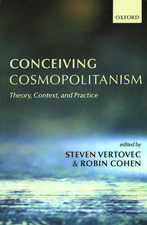 Conceiving Cosmopolitanism: Theory, Context, and PracticeSteven Vertovec-31%Preț: 557.33 lei807.64 lei
 -
 The Global Covenant: Human Conduct in a World of StatesRobert Jackson-28%Preț: 398.73 lei551.27 lei
 -
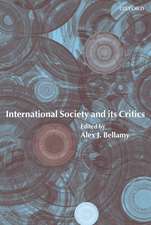 International Society and its CriticsAlex J. Bellamy-28%Preț: 394.67 lei548.88 lei
 -
 -28%Preț: 392.91 lei547.85 lei
 -
 -22%Preț: 331.27 lei424.33 lei
 -
 Preț: 134.08 lei
 -
 -21%Preț: 348.16 lei438.06 lei
 -
 Taming American PowerStephen M. WaltPreț: 146.44 lei
 -
 Key Concepts in International RelationsThomas DiezPreț: 394.84 lei
 -
 Machiavelli in BrusselsRinus Van SchendelenPreț: 199.72 lei
Cuprins
Tables
Acknowledgments
Abbreviations
Chapter 1: Introduction
Part One
Chapter 2: Eye of the Storm: The Theoretical Lens
Chapter 3: U.S. Foreign Policy, the Debt Explosion, and Demographic Trends
Chapter 4: Patterns in Chinese History
Chapter 5: Taiwan: The Tripwire
Part Two
Chapter 6: When Russia Met China: From the 1600s to 1911
Chapter 7: Caviar and Chopsticks: The Republican Era in China (1911-1949)
Chapter 8: Maotai and Vodka: The Communist Dynasty
Chapter 9: After the Fall
Chapter 10: In Concert with the Axis
Chapter 11: The Balance of Power
Notes
Bibliography
Index
Acknowledgments
Abbreviations
Chapter 1: Introduction
Part One
Chapter 2: Eye of the Storm: The Theoretical Lens
Chapter 3: U.S. Foreign Policy, the Debt Explosion, and Demographic Trends
Chapter 4: Patterns in Chinese History
Chapter 5: Taiwan: The Tripwire
Part Two
Chapter 6: When Russia Met China: From the 1600s to 1911
Chapter 7: Caviar and Chopsticks: The Republican Era in China (1911-1949)
Chapter 8: Maotai and Vodka: The Communist Dynasty
Chapter 9: After the Fall
Chapter 10: In Concert with the Axis
Chapter 11: The Balance of Power
Notes
Bibliography
Index
Recenzii
Levin analyzes one of the most topical subjects of modern world affairs: relationships among the US, Russia, and China. Levin discusses growing Russian-Chinese cooperation aimed at limiting American influence in the world..Levin has spent many years in China and in Russia. Therefore, he has been able to provide insights developed from many years of analytical research, his thorough knowledge of the subject, and valuable personal experience. Recommended. Upper-division undergraduate, graduate, and research collections.
. [R]aises an intellectual intriguing topic. It draws attention to the fact that Russia and China are two great powers that at present appear to be on rising trajectories, whereas the United States appears to be in decline. It is also important to consider that no single great power or combination of great powers other than Russia and China may in the foreseeable future successfully challenge the United States in its role as the world's only political and military superpower. Readers who are not students of international relations as a scholarly discipline will also appreciate a thumbnail sketch of major theories that deal with great-power competition. The book is also a valuable reference to a wealth of historical facts and narratives that bear on relations between the United States and China and China and Russia, from foreign deployments of U.S. troops, to recent China-Russia trade statistics, to Taiwan, Russia-China border treaties and clashes, and the role of pomp and protocol in China's foreign relations calculus. There is also a sensible, quick reference to relevant contemporary issues and actors such as the Shanghai Cooperation Organization, theater missile defense, North Korea, Iran, Sudan, Pakistan, and India.
. [R]aises an intellectual intriguing topic. It draws attention to the fact that Russia and China are two great powers that at present appear to be on rising trajectories, whereas the United States appears to be in decline. It is also important to consider that no single great power or combination of great powers other than Russia and China may in the foreseeable future successfully challenge the United States in its role as the world's only political and military superpower. Readers who are not students of international relations as a scholarly discipline will also appreciate a thumbnail sketch of major theories that deal with great-power competition. The book is also a valuable reference to a wealth of historical facts and narratives that bear on relations between the United States and China and China and Russia, from foreign deployments of U.S. troops, to recent China-Russia trade statistics, to Taiwan, Russia-China border treaties and clashes, and the role of pomp and protocol in China's foreign relations calculus. There is also a sensible, quick reference to relevant contemporary issues and actors such as the Shanghai Cooperation Organization, theater missile defense, North Korea, Iran, Sudan, Pakistan, and India.