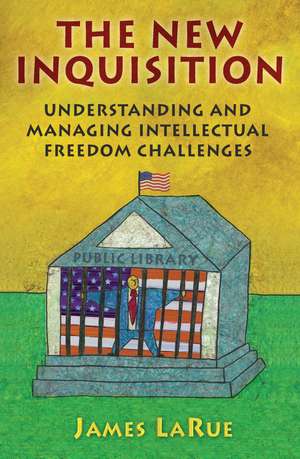
The New Inquisition: Understanding and Managing Intellectual Freedom Challenges
Autor James LaRueen Limba Engleză Paperback – 30 apr 2007
În peisajul actual al biblioteconomiei, unde numărul provocărilor la adresa colecțiilor de carte atinge cifre record, The New Inquisition aduce o perspectivă pragmatică și proactivă asupra modului în care libertatea intelectuală poate fi apărată fără a sacrifica relația cu comunitatea. Remarcăm faptul că James LaRue nu se limitează la prezentarea unor principii abstracte, ci oferă un set de instrumente concrete pentru transformarea potențialilor „adversari” în aliați, punând accent pe înțelegerea motivațiilor individuale din spatele tentativelor de cenzură.
Suntem de părere că valoarea acestui volum rezidă în experiența directă a autorului ca director de bibliotecă. Găsim în text o combinație rară de umor și rigoare profesională, aplicată pe situații tensionate de pe „linia întâi”. Față de lucrarea sa anterioară, On Censorship, care analiza fenomenul într-o notă mai largă, sau Public Library Collections in the Balance, care se concentra pe echilibrarea colecțiilor, noul volum oferă un ghid pas cu pas pentru menținerea integrității profesionale în fața realităților dure ale contestărilor publice.
Cititorii familiarizați cu Prepared Libraries, Empowered Teams de Becky Calzada vor aprecia în mod deosebit modul în care James LaRue extinde conceptul de pregătire a echipei către o strategie de comunicare externă mult mai nuanțată. În timp ce The Fight against Book Bans de Shannon M. Oltmann oferă o analiză cuprinzătoare a impactului cenzurii la nivel național, The New Inquisition se distinge prin focalizarea pe tactici individuale de gestionare a conflictelor și pe proceduri administrative care pot dezamorsa crizele înainte ca acestea să escaladeze. Este o resursă esențială pentru oricine dorește să înțeleagă nu doar „ce” se contestă, ci și „cum” să răspundă eficient, păstrând în același timp un climat de respect reciproc în spațiul public.
Preț: 236.21 lei
Preț vechi: 320.71 lei
-26%
Carte tipărită la comandă
Livrare economică 07-21 decembrie
Specificații
ISBN-10: 1591582857
Pagini: 172
Dimensiuni: 156 x 235 x 13 mm
Greutate: 0.28 kg
Editura: Bloomsbury Publishing
Colecția Libraries Unlimited
Locul publicării:New York, United States
V-ar putea interesa
-
 How to Defeat the Far RightNICK LOWLESPreț: 167.32 lei
 -
 That Book Is Dangerous!Adam SzetelaPreț: 198.52 lei
 -
 Preț: 95.03 lei
 -
 -16%Preț: 169.52 lei201.66 lei
 -
 Is This a Cry for Help?: A NovelEmily Austin-22%Preț: 84.20 lei107.77 lei
 -
 Preț: 89.81 lei
 -
 Preț: 410.46 lei
 -
 Practical Tips for Equality, Diversity and Inclusion in LibrariesBeth Montague-HellenPreț: 509.05 lei
 -
 Preț: 520.96 lei
 -
 -19%Preț: 501.74 lei619.44 lei
 -
 Preț: 399.09 lei
 -
 Radical School Librarianship: A Global ResponseJudi MoreillonPreț: 416.58 lei
 -
 Looking After Your BooksFrancesca GalliganPreț: 132.28 lei
 -
 Collection Management BasicsG. Edward Evans-16%Preț: 393.13 lei469.05 lei
 -
 -21%Preț: 276.30 lei349.22 lei
 -
 Empowering Library Staff and Customers: Building A Culture of Teamwork and TrustChristine D. Feldmann-18%Preț: 339.56 lei412.19 lei
 -
 -20%Preț: 279.01 lei349.16 lei
De ce să citești această carte
Această carte este indispensabilă bibliotecarilor și administratorilor de instituții culturale care se confruntă cu presiuni externe privind conținutul colecțiilor. Cititorul câștigă o strategie clară de comunicare și proceduri testate pentru a proteja libertatea de informare. Este un ghid practic care vă învață cum să rămâneți calmi și profesioniști în fața criticilor, transformând conflictele în oportunități de dialog comunitar, totul susținut de expertiza unui autor premiat în domeniu.
Descriere
Recenzii
James LaRue offers fresh advice on dealing with requests to pull books from public library collections. In an engaging anecdotal style, LaRue recounts numerous examples of real-life intellectual freedom challenges he has encountered during his years as director of a Colorado library system..LaRue advises preparation, but this book's most important contribution is its emphasis on the establishment of trust. LaRue;s most practical advice, and the approach that informs all aspects of this text, is, know your users...The New Inquisition is an entertaining and valuable read: LaRue's narrative voice is wholly likeable and reasonable. The book contains a good index and a short and very useful reference and resource list. It will make a good companion to other texts on the topic and is recommended for public libraries and academic libraries with a library studies program.
La Rue does what librarians do best--research. The book begins with a brief history of book censorship and moves to the origins of the Constitution and the Library Bill of Rights. With lively writing about relevant and current issues, the reader is engaged with example letters from concerned patrons provided. La Rue also includes Sample Request for Reconsideration forms and responses to past patron concerns, all of which are excellent resources for frontline librarians as well as the new generation of library students concerned about challenges to intellectual freedom.
This is a fresh, new and timely look at an old issue. LaRue puts a spirited case for dealing face-on with challenges - not being defensive, meeting the emotion, getting the tone right, offering alternatives, discussing the issues, following up the user's concerns, accepting that at times the matter will involve senior managers. Even though the context is U.S. public libraries, the issues here will translate into public libraries anywhere, and into school and children's libraries too. It is a real-life book about meeting challenges in an adult professional way.
Using his own experience, as well as his sense of humor, LaRue describes the kinds of challenges libraries typically face and the most effective ways to respond to them and even head them off. Dealing with intellectual freedom challenges may never become one of your favorite parts of the job.. [b]ut at least, armed with this book, you'll be better prepared
Reading the US Constitution periodically is a good idea, particularly while you are waiting for a special interest group bent on censorship to show up for a loud meeting. LaRue, a county-level director of libraries and therefore a battle-scarred veteran of the intellectual freedom wars, gives practical advice about resolving conflict with those who would limit access to certain information. He gives an historical perspective on the banning and burning of books, including the ever-present question of what children should be allowed to learn, the influence of certain religious and social groups, and the generation-driven aspect. With each he gives ways to find common ground and reasons to read together, and also lists ways to get the community involved in issues such as extending the network you already have, getting media involved, using your reputation and even working your way through the rubber chicken circuit.
[E]xamines the history of censorship, the fundamental role of libraries in defending freedom of information and the core documents of our profession..[a] sensible, practical approach to understanding and connecting with your community as a solid foundation to dealing with challenges.