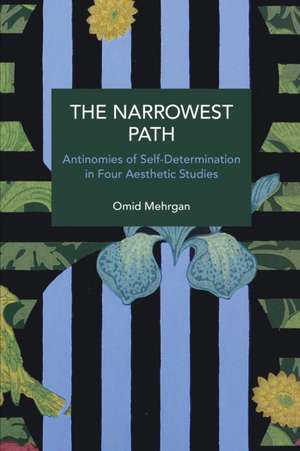
The Narrowest Path
Autor Omid Mehrganen Limba Engleză Paperback – 16 dec 2025
A strategic reconstruction of modern German thought from the standpoint of aesthetic theory, The Narrowest Path reveals the characteristically modern, revolutionary project of freedom-as-autonomy to be unresolvably antinomic. Basing himself on four seminal texts by Kleist, Hegel, Marx, and Adorno, Mehrgan develops four basic figures: the literary, the person, the republic, and the artwork. All flourished during the long period between the French Revolution and the aftermath of the Second World War in Europe. The key antagonist is the rule of capital, paradoxically enabling self-determination and thwarting it. Still present in contemporary revolutionary experiments, this daunting conflict, the book argues, shows itself best in the aesthetic — but the resolution lies elsewhere.
Preț: 197.34 lei
Puncte Express: 296
Carte tipărită la comandă
Livrare economică 08-22 decembrie
Livrare prin curier în România Termenul estimat este afișat lângă disponibilitate.
Transport gratuit de la 400.00 lei Plată online sau ramburs, în funcție de opțiunile comenzii.
Retur gratuit în 14 zile Comandă securizată și suport în română.
Specificații
ISBN-13: 9798888905616
Pagini: 247
Dimensiuni: 152 x 229 x 14 mm
Greutate: 0.35 kg
Editura: Haymarket Books
Pagini: 247
Dimensiuni: 152 x 229 x 14 mm
Greutate: 0.35 kg
Editura: Haymarket Books
V-ar putea interesa
-
 Beauty is in the StreetJoachim C. HäberlenPreț: 94.61 lei
 -
 The Alienation EffectOwen HatherleyPreț: 278.51 lei
 -
 The Birth of Tragedy and The Case of WagnerFriedrich NietzschePreț: 78.08 lei
 -
 The World as Will and Representation, Vol. 2Arthur Schopenhauer-34%Preț: 154.20 lei232.97 lei
 -
 MeditationsMarcus AureliusPreț: 34.00 lei
 -
 Philosophy of RightG W F HegelPreț: 85.07 lei
 -
 The Dehumanization of Art and Other Essays on Art, Culture, and LiteratureJosé Ortega Y. GassetPreț: 93.58 lei
 -
 The Art of FreedomJuliane RebentischPreț: 170.04 lei
 -
 Theory Of The Avant-GardePeter BurgerPreț: 155.33 lei
 -
 The Revolutionary SelfLynn HuntPreț: 205.81 lei
 -
 Freedom: A Disease Without CureSlavoj Zizek-28%Preț: 56.73 lei78.89 lei
 -
 The Poverty of Our FreedomAxel HonnethPreț: 169.21 lei
 -
 Rethinking EmancipationJacques RancièrePreț: 84.47 lei
 -
 Aesthetic TheoryTheodor W. Adorno-38%Preț: 174.38 lei281.95 lei
 -
 Aesthetics and PoliticsTheodor AdornoPreț: 99.52 lei
 -
 Mimesis, Expression, ConstructionFredric JamesonPreț: 241.75 lei
 -
 Marxism and the Moral Basis of ArtNorman Arthur Fischer-18%Preț: 755.31 lei921.11 lei
 -
 Crisis and AstonishmentDr. Eugenia RoldanPreț: 375.95 lei
 -
 Art and Autonomy A Critical ReaderSven LüttickenPreț: 287.26 lei
 -
 Kant, Adorno, and the Forms of HistoryWilliam S. Allen-33%Preț: 583.29 lei864.77 lei
Notă biografică
Omid Mehrgan, Ph.D. (2018), Johns Hopkins University, is adjunct assistant professor at New York University, Department of Liberal Studies. He has published on aesthetic theory, the Anthropocene, translation studies, Iranian cinema, and translations of major works in critical theory, including those by Walter Benjamin and Theodor W. Adorno in Farsi.
Cuprins
Acknowledgments
Abbreviations
Introduction: ‘Not Truth in History, But History in Truth’
1 The Opus Against the Apparatus
2 The Aesthetic Equation and Its Antinomy
3 Antinomic of Form: The Birth of Art’s Double Character
4 The Special Problematic: What is an Aesthetic Antinomy?
5 The General Problematic: Structure Faces History
6 A Note on Kleist’s Novella
1 The Antinomic Act of Literature in Michael Kohlhaas
1 Prologue: The Desire of Michael Kohlhaas
2 Kohlhaas Follows His Thing: A Failed Forensics
3 Luther Stops Kohlhaas: On the Historical Plateau
4 The Gypsy Woman Moves Kohlhaas: A Fantastic Tragedy
5Kohlhaas Following Kohlhaas: What is a Literary Act?
2 The Human Antinomy in Hegel’s Philosophy of Right
1 Introduction
2 The Human Antinomy and Its Personal Resolution
3 The Form of the Person: Infinite Self-Relation
4 The Personal Antinomy and Its Political Resolution
3 The Political Antinomy in Marx’s The Eighteenth Brumaire of Louis Bonaparte
1 Introduction
2 The Constituted Form: The Proclaimed Republic
3 The Constituent Content: The Presuppositions of the Republic
4 The Antinomy of the Republic: The Politics of Capital
5 The Resolution to Come
4 Figuring the Answer: A Reconstruction of Adorno’s Aesthetic Theory
1 Problematic. Art’s Double Character as Antinomy
2 Analytic of the Autonomous: Form as Separation
3 Analytic of the Social: Form as Repetition
4 Dialectic. The Sublime and The Ridiculous: Form as Participation
5 Conclusion
Bibliography
Index
Abbreviations
Introduction: ‘Not Truth in History, But History in Truth’
1 The Opus Against the Apparatus
2 The Aesthetic Equation and Its Antinomy
3 Antinomic of Form: The Birth of Art’s Double Character
4 The Special Problematic: What is an Aesthetic Antinomy?
5 The General Problematic: Structure Faces History
6 A Note on Kleist’s Novella
1 The Antinomic Act of Literature in Michael Kohlhaas
1 Prologue: The Desire of Michael Kohlhaas
2 Kohlhaas Follows His Thing: A Failed Forensics
3 Luther Stops Kohlhaas: On the Historical Plateau
4 The Gypsy Woman Moves Kohlhaas: A Fantastic Tragedy
5Kohlhaas Following Kohlhaas: What is a Literary Act?
2 The Human Antinomy in Hegel’s Philosophy of Right
1 Introduction
2 The Human Antinomy and Its Personal Resolution
3 The Form of the Person: Infinite Self-Relation
4 The Personal Antinomy and Its Political Resolution
3 The Political Antinomy in Marx’s The Eighteenth Brumaire of Louis Bonaparte
1 Introduction
2 The Constituted Form: The Proclaimed Republic
3 The Constituent Content: The Presuppositions of the Republic
4 The Antinomy of the Republic: The Politics of Capital
5 The Resolution to Come
4 Figuring the Answer: A Reconstruction of Adorno’s Aesthetic Theory
1 Problematic. Art’s Double Character as Antinomy
2 Analytic of the Autonomous: Form as Separation
3 Analytic of the Social: Form as Repetition
4 Dialectic. The Sublime and The Ridiculous: Form as Participation
5 Conclusion
Bibliography
Index