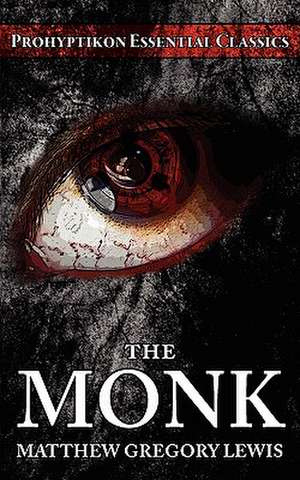
The Monk
Autor Matthew Gregory Lewis Editat de Colin J. E. Luptonen Limba Engleză Paperback – 24 mar 2009
Preț: 88.72 lei
Puncte Express: 133
Carte indisponibilă temporar
Livrare prin curier în România Termenul estimat este afișat lângă disponibilitate.
Transport gratuit de la 400.00 lei Plată online sau ramburs, în funcție de opțiunile comenzii.
Retur gratuit în 14 zile Comandă securizată și suport în română.
Specificații
ISBN-13: 9780981224435
ISBN-10: 0981224431
Pagini: 404
Dimensiuni: 127 x 203 x 23 mm
Greutate: 0.44 kg
Editura: Prohyptikon Publishing Inc.
Locul publicării:United Kingdom
ISBN-10: 0981224431
Pagini: 404
Dimensiuni: 127 x 203 x 23 mm
Greutate: 0.44 kg
Editura: Prohyptikon Publishing Inc.
Locul publicării:United Kingdom
V-ar putea interesa
-
 XNORTHANGER ABBEY_CLASSICS PBJane AustenPreț: 28.01 lei
 -
 Three Gothic NovelsHorace Walpole-17%Preț: 78.81 lei94.71 lei
 -
 The Mysteries of UdolphoAnn Radcliffe-27%Preț: 70.66 lei96.30 lei
 -
 The Castle of OtrantoHorace Walpole-34%Preț: 47.36 lei71.46 lei
 -
 Preț: 68.38 lei
 -
 The MonkMatthew LewisPreț: 55.39 lei
 -
 The Marquise de GangeThe Marquis de Sade-18%Preț: 53.22 lei64.76 lei
 -
 Les Liaisons dangereusesPierre Choderlos De LaclosPreț: 60.95 lei
 -
 The Vampyre and Other Tales of the MacabreJohn PolidoriPreț: 59.61 lei
 -
 Melmoth the WandererCharles Maturin-13%Preț: 65.62 lei75.75 lei
 -
 FrankensteinMary ShelleyPreț: 37.54 lei
 -
 The Picture of Dorian GrayOscar WildePreț: 35.93 lei
 -
 York Notes Companions Gothic LiteratureSusan ChaplinPreț: 94.31 lei
 -
 Frankenstein (Special Edition)Mary Shelley-31%Preț: 96.24 lei138.62 lei
 -
 Preț: 41.26 lei
 -
 The Castle of OtrantoHorace WalpolePreț: 38.66 lei
 -
 The Castle of Otranto and The Mysterious MotherHorace Walpole-16%Preț: 141.60 lei168.46 lei
 -
 Tales of WonderMatthew Gregory Lewis-22%Preț: 224.89 lei289.25 lei
 -
 -18%Preț: 169.41 lei205.38 leiRecomandat
 -
 The Gothic Tales of the Marquis de SadeD. A. F. Marquis de SadePreț: 71.69 lei
 -
 -17%Preț: 48.41 lei58.25 lei
 -
 Preț: 62.80 lei
 -
 Preț: 98.09 lei
Descriere
Descriere de la o altă ediție sau format:
"A masterpiece of the Gothic genre, The Monk tells the story of the Capuchin friar Ambrosio and his fall from grace through desire, greed and lust. Favourably reviewed at first, the novel was later so widely and raucously denounced for its perceived licentiousness, blasphemy and corrupting influence that Lewis had to remove controversial passages from future editions. Unsurprisingly, amidst this furore, the book was immensely popular with the reading public.
Suffused with eroticism, and focusing on the corrupting influence of power, The Monk pioneered a shocking new form of Gothic novel, where elements such as mob violence, incest and brutal murder replaced the gentler horrors of earlier practitioners of the genre."
"A masterpiece of the Gothic genre, The Monk tells the story of the Capuchin friar Ambrosio and his fall from grace through desire, greed and lust. Favourably reviewed at first, the novel was later so widely and raucously denounced for its perceived licentiousness, blasphemy and corrupting influence that Lewis had to remove controversial passages from future editions. Unsurprisingly, amidst this furore, the book was immensely popular with the reading public.
Suffused with eroticism, and focusing on the corrupting influence of power, The Monk pioneered a shocking new form of Gothic novel, where elements such as mob violence, incest and brutal murder replaced the gentler horrors of earlier practitioners of the genre."
Recenzii
The Monk was so highly popular that it seemed to create an epoch in our literature.
Notă biografică
Hugh Thomas (Lord Thomas of Swynnerton) is widely known for his work on the history of Spain, including his epic masterpiece The Spanish Civil War, available as a Modern Library Paperback.