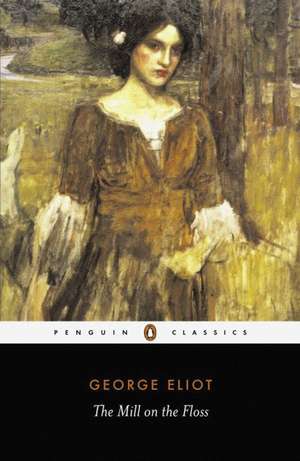
The Mill on the Floss
Autor George Elioten Limba Engleză Paperback – 29 apr 2003
Proza lui George Eliot se distinge printr-o acuratețe psihologică neiertătoare, dublată de o inteligență sclipitoare care refuză simplificările morale. Putem afirma că în The Mill on the Floss, limbajul nu servește doar la descrierea unui peisaj rural, ci devine un instrument de disecție a sufletului uman, pendulând între ironie detașată și un lirism profund în scenele de o vulnerabilitate copleșitoare. Reținem aici destinul lui Maggie Tulliver, o eroină a cărei sete de cunoaștere și afecțiune se lovește constant de pragmatismul rigid al fratelui său, Tom, și de prejudecățile unei comunități din Lincolnshire. Ca și Middlemarch, acest roman explorează limitările impuse individului de structurile sociale, dar dintr-o perspectivă mult mai intimă și tragică, axată pe legăturile de sânge și pe greutatea trecutului. Dacă în Silas Marner întâlnim o formă de izbăvire prin comunitate, aici George Eliot alege să exploreze izolarea și imposibilitatea reconcilierii dintre dorința personală și datoria familială. Ediția de față, publicată de WORDSWORTH EDITIONS LTD, este organizată riguros, oferind nu doar textul integral, ci și un aparat critic valoros. Cuprinsul relevă o progresie de la cronologia vieții autoarei către o serie de apendice esențiale: traduceri din Feuerbach și eseuri despre tragedia greacă, care oferă cititorului cheia intelectuală prin care Eliot și-a construit personajele. Este o operă despre maturizare, marcată de prezența simbolică a râului Floss, care oglindește fluxul ireversibil al timpului și al consecințelor morale.
Preț: 75.09 lei
Carte disponibilă
Livrare economică 02-16 noiembrie
Livrare express 17-23 octombrie pentru 30.87 lei
Specificații
ISBN-10: 0141439629
Pagini: 704
Dimensiuni: 129 x 198 x 32 mm
Greutate: 0.43 kg
Editura: Penguin Books
Locul publicării:London, United Kingdom
V-ar putea interesa
-
 Sense and SensibilityJane AustenPreț: 28.01 lei
 -
 Silas MarnerGeorge EliotPreț: 28.01 lei
 -
 To the LighthouseVirginia WoolfPreț: 28.01 lei
 -
 RomolaGeorge Eliot-22%Preț: 64.36 lei82.35 lei
 -
 Adam BedeGeorge Eliot-22%Preț: 64.26 lei82.37 lei
 -
 EmmaJane Austen-15%Preț: 44.30 lei52.34 lei
 -
 George Eliot: A Very Short IntroductionJuliette Atkinson-19%Preț: 57.42 lei71.30 lei
 -
 -20%Preț: 39.57 lei49.53 lei
 -
 Victorian LiteratureVictor SheaPreț: 271.12 lei
 -
 Middlemarch: A Study of Provincial LifeGeorge Eliot-20%Preț: 177.10 lei220.71 lei
 -
 Middlemarch (Collector's Edition)George EliotPreț: 76.75 lei
 -
 -11%Preț: 62.08 lei70.00 lei
 -
 North and SouthElizabeth GaskellPreț: 58.22 lei
 -
 Oliver TwistCharles DickensPreț: 37.41 lei
 -
 Mansfield ParkJane AustenPreț: 38.38 lei
 -
 Sons and LoversD. H. LawrencePreț: 28.01 lei
 -
 MiddlemarchGeorge EliotPreț: 28.01 lei
 -
 The Mill on the FlossHelen EdmundsonPreț: 91.73 lei
De ce să citești această carte
Pentru cititorii care apreciază proza clasică de o mare profunzime psihologică. Recomandăm această carte deoarece oferă unul dintre cele mai emoționante portrete ale copilăriei și adolescenței din literatura victoriană. Veți câștiga o înțelegere nuanțată a conflictului dintre identitatea proprie și așteptările sociale, totul într-o ediție de colecție ce include documente istorice și analize critice care îmbogățesc experiența lecturii.
Despre autor
George Eliot, pseudonimul literar al lui Mary Ann Evans (1819-1880), a fost una dintre figurile centrale ale epocii victoriene, recunoscută pentru realismul său filosofic. Viața sa, marcată de o relație neconvențională și de o educație intelectuală vastă, a influențat direct temele sale predilecte: moralitatea provincială și condiția femeii. De la debutul cu Adam Bede până la capodopera Middlemarch, Eliot s-a impus prin capacitatea de a transforma experiențele rurale în interogații universale despre datorie și pasiune, rămânând până astăzi un reper al literaturii engleze.
Descriere scurtă
Brought up at Dorlcote Mill, Maggie Tulliver worships her brother Tom and is desperate to win the approval of her parents, but her passionate, wayward nature and her fierce intelligence bring her into constant conflict with her family. As she reaches adulthood, the clash between their expectations and her desires is painfully played out as she finds herself torn between her relationships with three very different men: her proud and stubborn brother; hunchbacked Tom Wakem, the son of her family's worst enemy; and the charismatic but dangerous Stephen Guest. With its poignant portrayal of sibling relationships, The Mill on the Floss is considered George Eliot's most autobiographical novel; it is also one of her most powerful and moving.
In this edition, writer and critic A.S. Byatt, author of Possession, provides full explanatory notes and an introduction relating The Mill on the Floss to George Eliot's own life and times.
Mary Ann Evans (1819-80) began her literary career as a translator, and later editor, of the Westminster Review. In 1857, she published Scenes of Clerical Life, the first of eight novels she would publish under the name of 'George Eliot', including The Mill on the Floss, Middlemarch, and Daniel Deronda.
If you enjoyed The Mill on the Floss, you might like Thomas Hardy's Jude the Obscure, also available in Penguin Classics.
Notă biografică
Textul de pe ultima copertă
Descriere
'Was her life to be always like this? - always bringing some new source of inward strife?'When the miller Mr Tulliver becomes entangled in lawsuits, he sets off a chain of events that will profoundly affect the lives of his family and bring into conflict his passionate daughter Maggie with her inflexible but adored brother Tom. As she grows older, Maggie's discovery of romantic love draws her once more into a struggle to reconcile familial and moral claims with her own desires. Strong-willed, compassionate, and intensely loyal, Maggie seeks personal happiness and inner peace but risks rejection and ostracism in her close-knit community.Opening with one of the most powerful fictional evocations of childhood, The Mill on the Floss (1860) vividly portrays both the 'oppressive narrowness' and the appeal of provincial England, the comedy as well as the tragedy of obscure lives. George Eliot's most autobiographical novel was also her most controversial, and has been the subject of animated debate ever since. This edition combines the definitive Clarendon text with a lively new introduction and notes.ABOUT THE SERIES: For over 100 years Oxford World's Classics has made available the widest range of literature from around the globe. Each affordable volume reflects Oxford's commitment to scholarship, providing the most accurate text plus a wealth of other valuable features, including expert introductions by leading authorities, helpful notes to clarify the text, up-to-date bibliographies for further study, and much more.
Recenzii
This Broadview edition includes a critical introduction and extensive contextualizing notes as well as a broad range of appendices drawn from contemporary documents dealing with issues such as 19th-century views of disability, education, and the Woman Question.
“This edition of George Eliot’s most passionate novel about a woman’s life is accompanied by a selection of contemporary materials that demonstrate the surprisingly radical context of the author’s views at this point in her career. Oliver Lovesey has selected brief, eminently readable portions from Eliot’s own translations, essays, and reviews that will educate the reader in the ‘real’ George Eliot—a woman of amazing education herself, and of profoundly original thought that transcended the conventions of her time. The edition also includes the full text of the author’s poem, ‘Brother and Sister,’ a parallel narrative of Eliot’s childhood that is crucial to the reader’s understanding of the novel, as well as other very useful selections from historical documents and contemporary reviews of the novel.” — Mary Wilson Carpenter, Queen’s University
“This edition is a splendid presentation of George Eliot’s most autobiographical novel. The long and generous introduction dispels some of the myths about the author’s life, traces subtle relations between the novel and the moral complexities Eliot faced in Victorian society, places the novel in the context of her life’s work, and offers valuable analyses of the novel’s style and structure. Footnotes throughout the text helpfully explain dialect words, obsolete expressions and literary allusions. Excerpts from George Eliot’s critical writings, added as appendices, give insight into some of the ideas about fiction, religion, and the place of women in society that entered into the writing of The Mill on the Floss.” — Jacob Korg, Professor Emeritus, University of Washington
Cuprins
Introduction
George Eliot: A Brief Chronology
A Note on the Text
The Mill on the Floss
Appendix A: George Eliot’s Translations, Essays, Reviews, and Poems
- From George Eliot’s translation of Ludwig Feuerbach’s The Essence of Christianity (1854)
- [George Eliot], “Margaret Fuller and Mary Wollstonecraft,” Leader (13 October 1855)
- From [George Eliot], review of Thomas Keightley’s Life, Opinions, and Writings of John Milton, The Westminster Review (October 1855)
- [George Eliot], “The Antigone and Its Moral,” Leader (29 March 1856)
- From [George Eliot], “Silly Novels by Lady Novelists,” The Westminster Review (October 1856)
- From George Eliot, “Notes on ‘The Spanish Gypsy’ and Tragedy in General” (1868)
- George Eliot, “Brother and Sister,” The Legend of Jubal and Other Poems (1874)
- Spectator (7 April 1860)
- [E.S. Dallas], The Times (19 May 1860)
- [Dinah Mulock], Macmillan’s Magazine (April 1861)
- From Henry James, The Atlantic Monthly (October 1866)
- From Mrs. Anna Jameson, “St. Christopher,” Sacred and Legendary Art, vol. 2 (1848)
- From Daniel Defoe, “Of the Tools the Devil Works with,” The History of the Devil (1727)
- From Thomas à Kempis, The Imitation of Christ (1737)
- From Auguste Comte, The Catechism of Positivism (1858)
- From Samuel Hare, Cases and Observations Illustrative of the Beneficial Results (1857)
- From [William Ballantyne Hodgson], “‘Classical’ Instruction: Its Use and Abuse,” The Westminster Review(October 1853)