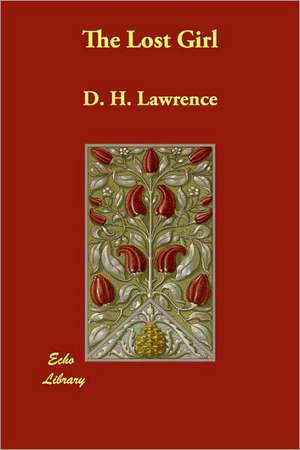
The Lost Girl
Autor D. H. Lawrenceen Limba Engleză Paperback – 24 iun 2008
Preț: 157.92 lei
Puncte Express: 237
Carte tipărită la comandă
Livrare economică 16-23 noiembrie
Livrare prin curier în România Termenul estimat este afișat lângă disponibilitate.
Transport gratuit de la 400.00 lei Plată online sau ramburs, în funcție de opțiunile comenzii.
Retur gratuit în 14 zile Comandă securizată și suport în română.
Specificații
ISBN-13: 9781406891423
ISBN-10: 1406891428
Pagini: 280
Dimensiuni: 152 x 229 x 16 mm
Greutate: 0.41 kg
Editura: Echo Library
Colecția Echo Library
Locul publicării:United Kingdom
ISBN-10: 1406891428
Pagini: 280
Dimensiuni: 152 x 229 x 16 mm
Greutate: 0.41 kg
Editura: Echo Library
Colecția Echo Library
Locul publicării:United Kingdom
V-ar putea interesa
-
 Sense and SensibilityJane AustenPreț: 28.01 lei
 -
 Lady Chatterley's LoverD. H. LawrencePreț: 28.01 lei
 -
 To the LighthouseVirginia WoolfPreț: 28.01 lei
 -
 D. H. LawrenceJohn WorthenPreț: 133.21 lei
 -
 EmmaJane Austen-24%Preț: 50.51 lei66.77 lei
 -
 The Lost DomainAlain-Fournier-19%Preț: 63.74 lei78.75 lei
 -
 There Lives a Young Girl in Me Who Will Not DieTove DitlevsenPreț: 78.04 lei
 -
 The Picture of Dorian GrayOscar WildePreț: 35.80 lei
 -
 The Fox, the Captain's Doll, the LadybirdD. H. LawrencePreț: 504.88 lei
 -
 The Runaway GirlsJacqueline Wilson-26%Preț: 47.77 lei64.59 lei
 -
 The Ha-HaJennifer DawsonPreț: 70.45 lei
 -
 God's Little AcreErskine CaldwellPreț: 129.97 lei
 -
 Burning Man: The Ascent of DH LawrenceFrances Wilson-26%Preț: 69.46 lei93.84 lei
 -
 The FoxD. H. LawrencePreț: 56.39 lei
 -
 Women in LoveD. H. LawrencePreț: 37.47 lei
 -
 Oliver TwistCharles DickensPreț: 37.41 lei
 -
 Sons and LoversD. H. LawrencePreț: 28.01 lei
 -
 An Inspector Calls: Annotation-Friendly EditionJ. B. PriestleyPreț: 86.45 lei
 -
 This SlaveryEthel Carnie HoldsworthPreț: 141.81 lei
Cuprins
General editor's preface; Acknowledgements; Chronology; Cue-titles; Introduction; The Lost Girl; Appendix; Explanatory notes; Textual apparatus; A note on pounds, shillings and pence.
Descriere
Descriere de la o altă ediție sau format:
This edition of The Lost Girl offers a text corresponding to Lawrence's expectations.
This edition of The Lost Girl offers a text corresponding to Lawrence's expectations.
Notă biografică
Born on September 11, 1885, in Eastwood, Nottinghamshire, England, David Herbert Lawrence was the fourth child of a coal miner and a former schoolteacher. His upbringing in a working-class family deeply influenced his literary themes, particularly the tensions between industrialization and nature. Lawrence's early education and experiences in his hometown laid the foundation for his future works.In 1912, Lawrence met Frieda Weekley, with whom he eloped to Europe, marking the beginning of his extensive travels. This period saw the creation of some of his most significant novels, including Sons and Lovers (1913) and The Rainbow (1915), which explored complex human relationships and societal constraints. His candid portrayal of sexuality and critique of industrial society often led to controversy and censorship.Despite facing persecution and public misrepresentation, Lawrence continued to produce influential works across various genres. His final novel, Lady Chatterley's Lover (1928), was notorious for its explicit content and faced numerous legal challenges. Lawrence's relentless exploration of human emotions and social norms has solidified his legacy as a pivotal figure in modernist literature.