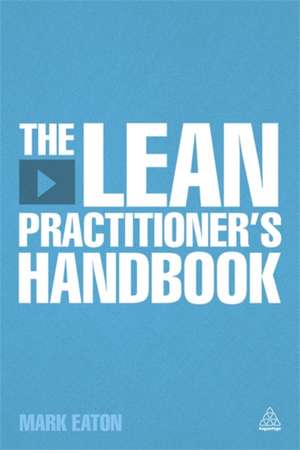
The Lean Practitioner's Handbook
Autor Mark Eatonen Limba Engleză Paperback – 3 feb 2013
Imaginați-vă o echipă blocată în procese redundante, unde o sesiune de tip Rapid Improvement Event (RIE) reușește, în doar câteva zile, să elimine blocaje care trenau de luni de zile. The Lean Practitioner's Handbook nu se mulțumește să explice ce este Lean, ci demonstrează cum să transformăm această teorie în realitate operațională. Apreciem în mod deosebit rigoarea cu care Mark Eaton abordează faza de definire a proiectelor (scoping), prevenind astfel eșecul multor inițiative înainte ca acestea să înceapă.
Remarcăm că volumul este organizat ca un flux de lucru logic: începe cu planificarea strategică și conceptele cheie, trece prin cartografierea fluxului de valoare (Value Stream Mapping) și culminează cu mecanisme de menținere a progresului, cum ar fi Leader Standard Work (LSW). Această structură indică o înțelegere profundă a faptului că Lean nu este un eveniment singular, ci un sistem de management zilnic. Complementar volumului Lean Execution de Clifford Fiore, care se concentrează pe condițiile procesuale necesare pentru succesul hărților de valoare, lucrarea lui Eaton acoperă zona critică a implicării echipei și a comunicării rezultatelor, elemente adesea ignorate în manualele pur tehnice.
Deși autorul a mai publicat lucrări în domenii diverse, de la inginerie la consultanță, această carte reprezintă chintesenta carierei sale de 15 ani în managementul schimbării. Față de Value Stream Management de Don Tapping, care utilizează un storyboard vizual pentru implementare, manualul de față oferă un suport mai vast pentru facilitatori, incluzând resurse digitale și ghiduri pentru evenimente 2P și 3P. Este un instrument autoritar pentru cei care doresc rezultate măsurabile și sustenabile în managementul calității.
Preț: 315.11 lei
Carte tipărită la comandă
Livrare economică 14-28 iulie
Specificații
ISBN-10: 0749467738
Pagini: 328
Dimensiuni: 156 x 234 x 18 mm
Greutate: 0.5 kg
Editura: Kogan Page
V-ar putea interesa
-
 Preț: 112.81 lei
 -
 The Toyota Way FieldbookJeffrey Liker-18%Preț: 219.56 lei267.88 lei
 -
 -18%Preț: 185.16 lei226.81 lei
 -
 -18%Preț: 208.10 lei253.57 lei
 -
 -36%Preț: 205.65 lei322.83 lei
 -
 -37%Preț: 287.27 lei455.43 lei
 -
 Financial Times Guide to Lean, TheAndy BrophyPreț: 192.46 lei
 -
 Implementing Lean Software Development: From Concept to CashTom PoppendieckPreț: 324.71 lei
 -
 -5%Preț: 435.58 lei458.50 lei
 -
 The Improvement GuideGerald J Langley-19%Preț: 411.82 lei508.42 lei
 -
 Lean ThinkingJames P. WomackPreț: 211.54 leiRecomandat
 -
 Kaizen ForeverBob EmilianiPreț: 150.33 lei
 -
 -18%Preț: 849.55 lei1036.04 lei
 -
 Lean Six Sigma For DummiesMartin Brenig-JonesPreț: 159.91 lei
 -
 -26%Preț: 171.41 lei230.24 lei
 -
 Andy & Me: Crisis & Transformation on the Lean JourneyPascal DennisPreț: 295.44 lei
 -
 Preț: 376.92 lei
 -
 Leading the Lean Enterprise TransformationGeorge Koenigsaecker-11%Preț: 425.83 lei478.45 lei
 -
 -8%Preț: 468.71 lei509.47 lei
 -
 The Simplicity of LeanPhilip HoltPreț: 191.24 lei
De ce să citești această carte
Recomandăm această carte profesioniștilor care au depășit etapa teoretică și au nevoie de un plan de execuție. Veți învăța cum să organizați ateliere de îmbunătățire rapidă și cum să utilizați template-uri concrete pentru a rezolva problemele din fluxul de producție sau servicii. Este un câștig imediat pentru orice manager care urmărește eficiența operațională fără a sacrifica moralul echipei.
Despre autor
Mark Eaton este director general și de operațiuni la Amnis, o firmă de consultanță specializată în implementarea și susținerea îmbunătățirilor organizaționale. De profesie inginer, Eaton și-a dedicat ultimii 15 ani rafinării metodologiilor Lean și Sigma în diverse sectoare de activitate. Expertiza sa nu se limitează la instrumente tehnice, ci integrează planificarea strategică și managementul schimbării, oferind o perspectivă pragmatică asupra modului în care organizațiile pot adopta o cultură a îmbunătățirii continue.
Descriere scurtă
While Lean Thinking is an established approach to developing a culture of continuous improvement, the process of implementing Lean in any organization can be complicated, with programs often ending in failure.
The Lean Practitioner's Handbook bridges the gap between the tools and the concepts of Lean and offers a practical, easily accessible resource for anyone preparing for, implementing or evaluating Lean activities. Eaton discusses key areas, such as: aspects of a Lean Program; scoping a program; value stream mapping; 2P and 3P events; rapid improvement events; managing for daily improvement; engaging the team; spotting problems and communicating progress.
For Eaton, Lean needs to be part of the organization's culture. Discussing Lean as it applies to organizational change and strategic planning, this book covers a wide variety of tools and concepts and explains how to apply them in practice.
Cuprins
Introduction
01 Planning for Lean
Structuring a Lean programme
Dealing with the issues that arise
Myth buster
Closing thoughts
02 Key Lean concepts
What is Lean?
Overview of the Toyota Production System (TPS)
The 14 principles of the ‘Toyota Way’
Toyota 4Ps – developing leadership commitment
Muda, mura, muri
The seven wastes (and eighth waste)
The fi ve principles of Lean
Comparing the Toyota Production System with Lean
Comparing Lean with other improvement methodologies
Closing thoughts
03 Scoping projects
An overview of scoping
Lean A3s
Project charters and project initiation documents
The practicalities of scoping
Scoping case study
Tactics for making scoping easier
Closing thoughts
04 Value stream mapping events
Key concepts in value stream mapping
Three-stage value stream mapping
Two-stage value stream mapping
Alternative approaches to value stream mapping
The practicalities of value stream mapping
Value stream mapping case study
Closing thoughts
05 2P/3P events
2P events
3P events
2P case study (local government)
2P case study (health care)
3P case study (manufacturing)
Closing thoughts
06 Rapid improvement events (RIE)
Key RIE concepts and tools
Running rapid improvement events
4-day RIE case study (manufacturing)
3-day RIE case study (health care)
1-day RIE case study (logistics)
Closing thoughts
07 Managing for daily improvement (MDI)
Managing for daily improvement: everybody, every day
Embedding the change after an RIE
Closing thoughts
08 Leader standard work (LSW)
Creating a culture to support Lean
The behaviours of Lean leaders
Daily, weekly, monthly LSW
Structured problem solving in LSW
Managing the process
Closing thoughts
09 Strategic planning
Strategic preparation
Policy deployment (hoshin kanri)
Transformation mapping
Enterprise level value stream mapping (ELVSM)
Closing thoughts
10 Engaging the team
Engaging individuals
Engaging people during Lean events
Dealing with difficult people
Closing thoughts
11 Ensuring success
The top three warning signs
The six elements of success
The bumpy road to Lean
Closing thoughts
12 Communications and celebrations
The purpose of communications
The purpose of celebrations
The style of communication
Types of communications
Types of celebrations
Presenting Lean topics
Closing thoughts
13 Key tools and concepts
Glossary
References
Index
Notă biografică
Mark Eaton is the MD and operations director of Amnis, a consulting company specializing in helping organizations prepare for, implement and sustain improvement using a combination of Strategic Planning, Lean/Sigma and Change Management approaches. Eaton is an Engineer by training but has spent the last 15 years involved in service improvement, business improvement and Lean in a variety of sectors.