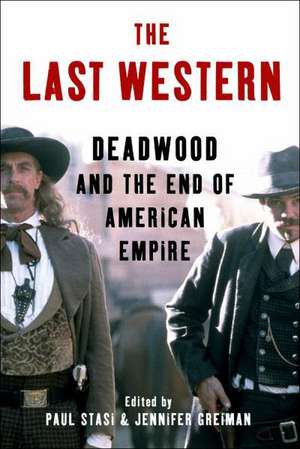
The Last Western: Deadwood and the End of American Empire
Editat de Paul Stasi, Jennifer Greimanen Limba Engleză Paperback – 14 feb 2013
Descoperim în The Last Western o analiză academică riguroasă coordonată de Paul Stasi și Jennifer Greiman, cercetători a căror autoritate în studiile americane și literatură fundamentează această explorare a serialului Deadwood. Jennifer Greiman, autoare a unor studii despre suveranitatea în scrierile antebelice, și Paul Stasi, cunoscut pentru lucrările sale despre modernism și imperialism, reunesc aici perspective din istorie, film și studii media pentru a demonstra că Deadwood nu este doar un serial istoric, ci o meditație provocatoare asupra formării imperiului S.U.A.
Remarcăm modul în care volumul este structurat pentru a reflecta complexitatea tematică a producției HBO. Prima parte, „No Law at all in Deadwood”, investighează starea de anomie, violența și retorica frontierii în era post-9/11, în timp ce a doua parte, „Taking people’s money”, se concentrează pe economia politică, identitatea rasială și „mâna invizibilă” a formării statului. Cititorii familiarizați cu Deadwood de Ina Rae Hark vor aprecia modul în care acest volum extinde discuția de la contextul de producție al HBO către o analiză politică și filosofică mult mai profundă a excepționalismului american.
Poziționată în continuarea preocupărilor lui Paul Stasi din Modernism, Imperialism and the Historical Sense, lucrarea examinează cum estetica particulară a serialului devine un vehicul pentru a discuta despre legitimitatea politică și deposedarea de capital. Volumul reușește să ancoreze tensiunile contemporane despre clasă și rasă într-un cadru de secol XIX, oferind o perspectivă critică asupra modului în care genul Western a transmis povestea națională americană.
Preț: 263.67 lei
Preț vechi: 309.98 lei
-15%
Carte tipărită la comandă
Livrare economică 04-18 decembrie
Specificații
ISBN-10: 1441126309
Pagini: 224
Dimensiuni: 150 x 226 x 15 mm
Greutate: 0.39 kg
Editura: Bloomsbury Publishing
Colecția Bloomsbury Academic
Locul publicării:New York, United States
V-ar putea interesa
-
 The Television Studies BookChristine GeraghtyPreț: 294.41 lei
 -
 TV Cops: The Contemporary American Television Police DramaJonathan Nichols-Pethick-21%Preț: 354.16 lei446.51 lei
 -
 Democracy's SpectacleJennifer Greiman-19%Preț: 487.65 lei602.03 lei
 -
 -38%Preț: 292.94 lei472.62 lei
 -
 Televising War: From Vietnam to IraqPhD Andrew Hoskins-22%Preț: 240.23 lei306.55 lei
 -
 -14%Preț: 693.68 lei806.60 lei
 -
 Television Aesthetics and StyleSteven Peacock-13%Preț: 243.73 lei279.75 lei
 -
 -15%Preț: 264.17 lei310.94 lei
 -
 The South Bank Show: Final CutMelvyn Bragg-27%Preț: 68.36 lei93.11 lei
 -
 Preț: 256.84 lei
 -
 Chasing Zebras: The Unofficial Guide to House, M.D.Barbara Barnett-27%Preț: 105.74 lei143.99 lei
 -
 Raise Some Shell: Teenage Mutant Ninja Turtles: Pop Classics #1Richard Rosenbaum-31%Preț: 72.13 lei104.53 lei
 -
 Timeless Adventures: How Doctor Who Conquered TVJack O'Connell-31%Preț: 71.31 lei102.82 lei
 -
 The Inbetweeners A-ZMatthew RichardsonPreț: 112.12 lei
De ce să citești această carte
Această colecție de eseuri se adresează cercetătorilor și studenților din domeniile studiilor americane, filmului și sociologiei, oferind o demontare critică a miturilor frontierei. Cititorul câștigă o înțelegere profundă a modului în care un produs de cultură populară poate reflecta mecanismele complexe ale puterii, suveranității și capitalismului, transformând vizionarea unui serial într-un exercițiu de analiză politică și istorică rafinată.
Despre autor
Paul Stasi deține un doctorat la University of California, Berkeley (2006) și este în prezent profesor la University at Albany, unde predă literatură anglofonă. Interesele sale de cercetare vizează intersecția dintre estetică și structurile socio-politice, fiind autorul unor volume de referință precum Modernism, Imperialism and the Historical Sense și The Persistence of Realism in Modernist Fiction. Jennifer Greiman este conferențiar la aceeași instituție, fiind recunoscută pentru studiile sale asupra democrației și vieții publice în literatura americană, expertiză care completează viziunea critică a acestui volum despre evoluția imperiului american.
Descriere
Cuprins
Part I - No Law at all in Deadwood: Statelessness, Violence, and Sovereignty
Chapter 1: A Terrible Beauty? Deadwood, Frontier Rhetoric, and U.S. Hegemony in the Post-9/11 Era --Erik Altenbernd and Alex Young
Chapter 2: Listen to the Thunder:' Deadwood and the Extraordinary Depiction of Ordinary Violence --Justin A. Joyce
Chapter 3: Vile Task: Founding and Democracy in Deadwood's Imperial Imagination --Ronald Schmidt
Part II -Taking people's money: Agency, Identity and Political Economy
Chapter 4: It's all f***ing amalgamation and capital, ain't it?: Deadwood, the Pinkertons, and the Closing of the Frontier -- Jeffrey Scraba and John David Miles
Chapter 5: The Gothic Frontier of Modernity: The 'Invisible Hand' of State-Formation in Deadwood --Julia M. Wright
Chapter 6: Securing the Color: The Racial Economy of Deadwood -- Daniel Worden
Part III - A Sovereign F***ing Community: Sexuality and the Frontiers of the Social
Chapter 7: The Return of the Father: Deadwood and the Contemporary Gender Politics of Complexity -- David Greven
Chapter 8: The World is Less Than Perfect: Nontraditional Family Structures in Deadwood -- Paul Zinder
Chapter 9: Messages from Invisible Sources: Surveillance and the Public Sphere in Deadwood -- Mark Berrettini
Recenzii
Scholars and students interested in Deadwood and HBO will find much that is useful, as will scholars interested in how television drama can articulate anxieties and concerns about contemporary issues via historical or generic forms. Summing Up: Highly recommended. General readers, undergraduate students, graduate students, and research faculty.
The collections handily meet the challenge that vexes much writing about film, an ephemeral genre in which retelling can overshadow reflection. One way the various essayists accomplish this is by recalling powerful scenes from Deadwood that form indelible tableaus . These essayists represent perspectives not only from literary studies but from political science, film studies, and history.
Anchored by the editors' incisive introduction, this timely volume goes a long way to redress the dearth of scholarship on one of the richest television dramas in recent years. One of the book's particular strengths--rare for an anthology of this nature--is its focus; from a variety of disciplinary perspectives, the contributors plumb the intersection of Deadwood's visual style, its treatment of genre, and its exploration of political economy at the formation and waning of the American empire. Several of the chapters will be required reading for my course on contemporary American television.
This wonderfully thought-provoking book invites the reader to "Go West!" And here, the journey West is also a journey in -- into the heart of the anxieties and desires that continue to shape contemporary experiences of American Empire.
By initially seating David Milch's Deadwood among the other significant HBO shows that interrogate American iconography and culture at the turn of this century, The Sopranos and The Wire, Stasi and Greiman have managed to produce a surprisingly cohesive examination of what they call "The Last Western" through a variety of academic voices and disciplines. What results is a useful volume of essays that at once consider a diversity of concerns in the show, political, social, and familial, while still supporting a central argument that this unfinished series may represent a new understanding of the limits of the Western in narrating American hopes and anxieties as well as providing an important acknowledgment that those same hopes and anxieties continue to haunt contemporary American life. This is a must have volume for those seeking to delve further into the significance of the all-too-short-lived series but also to those interested in understanding how popular media reflects and refracts the conflicts of a contemporary American experience.