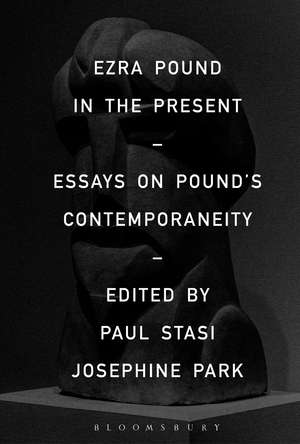
Ezra Pound in the Present: Essays on Pound's Contemporaneity
Editat de Paul Stasi, Josephine Parken Limba Engleză Paperback – 19 apr 2018
Preț: 256.84 lei
Puncte Express: 385
Carte tipărită la comandă
Livrare economică 07-21 decembrie
Livrare prin curier în România Termenul estimat este afișat lângă disponibilitate.
Transport gratuit de la 400.00 lei Plată online sau ramburs, în funcție de opțiunile comenzii.
Retur gratuit în 14 zile Comandă securizată și suport în română.
Specificații
ISBN-13: 9781501341786
ISBN-10: 1501341782
Pagini: 268
Ilustrații: 5 b/w illustrations
Dimensiuni: 152 x 229 x 15 mm
Greutate: 0.36 kg
Ediția:NIPPOD
Editura: Bloomsbury Publishing
Colecția Bloomsbury Academic
Locul publicării:New York, United States
ISBN-10: 1501341782
Pagini: 268
Ilustrații: 5 b/w illustrations
Dimensiuni: 152 x 229 x 15 mm
Greutate: 0.36 kg
Ediția:NIPPOD
Editura: Bloomsbury Publishing
Colecția Bloomsbury Academic
Locul publicării:New York, United States
Cuprins
List of Figures
Preface
Acknowledgments
List of Abbreviations
I. Pound's Methods
1. Why Pound's Imagist Poems Still Matter
Charles Altieri (University of California, Berkeley, USA)
2. Not-So-Distant Reading
Josephine Park (University of Pennsylvania, USA)
3. Paleolithic Media: Deep Time and Ezra Pound's Methods
Aaron Jaffe (University of Louisville, USA)
II. Pound's Worlds
4. "I am all for the triangle": The Geopolitical Aesthetic of Pound's Japan
Christopher Bush (Northwestern University, USA)
5. Ezra Pound and the Globalization of Literature
Jean-Michel Rabaté (University of Pennsylvania, USA)
6. Ezra Pound and the Comparative Literature of the Present, or, Triptych Rome/London/Pisa
Christine Froula (Northwestern University, USA)
II. Pound's Value
7. Ezra Pound and the Critique of Value
Paul Stasi (University at Albany, USA)
8. Ezra Pound's Effective Demand: Keynes, Causality, and The Cantos
C.D. Blanton (University of California, Berkeley, USA)
Bibliography
Notes on Contributors
Index
Preface
Acknowledgments
List of Abbreviations
I. Pound's Methods
1. Why Pound's Imagist Poems Still Matter
Charles Altieri (University of California, Berkeley, USA)
2. Not-So-Distant Reading
Josephine Park (University of Pennsylvania, USA)
3. Paleolithic Media: Deep Time and Ezra Pound's Methods
Aaron Jaffe (University of Louisville, USA)
II. Pound's Worlds
4. "I am all for the triangle": The Geopolitical Aesthetic of Pound's Japan
Christopher Bush (Northwestern University, USA)
5. Ezra Pound and the Globalization of Literature
Jean-Michel Rabaté (University of Pennsylvania, USA)
6. Ezra Pound and the Comparative Literature of the Present, or, Triptych Rome/London/Pisa
Christine Froula (Northwestern University, USA)
II. Pound's Value
7. Ezra Pound and the Critique of Value
Paul Stasi (University at Albany, USA)
8. Ezra Pound's Effective Demand: Keynes, Causality, and The Cantos
C.D. Blanton (University of California, Berkeley, USA)
Bibliography
Notes on Contributors
Index
Recenzii
This provocative collection includes essays by both established and emerging scholars who engage what one of the contributors, Christoper Bush, calls "the proximity of what is admirable and what is execrable in [Pound's] work." Many of Pound's concerns-finance capitalism, the US's Founding Fathers, what is meant by "world" literature, the US and East Asia-are also present concerns, and Pound's particular blindness and insights regarding those concerns may illuminate today's readers. Different readers will value different essays in this volume. For this reviewer, the strongest contributions are Charles Altieri's on Pound's imagist poems and the "epiphanic model" of much contemporary poetry; Bush's on Japan's "mediation" of China for Pound; Christine Froula's on the "triptych" of the Pisan Cantos, Sextus Propertius, and Mauberley; and C. D. Blanton's on J. D. Keynes, Major Douglas, and the Fifth Decade of Cantos . This collection of essays will help readers think about Pound's work in fresh ways. Summing Up: Highly recommended.
'An enclosure for stray animals,' Pound quipped of his name. Eight cutting-edge readers of his work have been here editorially gathered into discussion, less to define an enclosure than to open out onto a series of contemporary critical fields that situate Pound where he has always belonged-amid the changing reaches of the present, bringing news, good or bad, that stays news.
This is a book we have been waiting for a long time: a volume exploring Ezra Pound's significance for our life now. These illuminating essays are pioneer work: they offer critiques of Pound's poetry and criticism in the contexts of globalization, digital culture, East Asia, and capitalism, giving scholars unexpected opportunities of evaluating contemporary theories of reading, university disciplines, theories of value, and economic phenomena such as the current banking crisis. The outstanding scholars reunited in this collection have cut paths in the wilderness so that we may follow. We owe them gratitude.
Pound studies often repeat the command to 'Make it new!' as a kind of catechism, but this collection actually does it. Avoiding mechanical repetitions of over-familiar truisms, these essays set in motion Pound's conviction that 'we do not know the past in chronological sequence... what we know we know by ripples and spiral eddying out from us and our time.' Park, Stasi, and their contributors honor Pound by reimagining him for the 21st century.
[The book] is a crucial and timely intervention in Pound Studies, assessing as well as galvanising a new phase of innovative work in the field.
'An enclosure for stray animals,' Pound quipped of his name. Eight cutting-edge readers of his work have been here editorially gathered into discussion, less to define an enclosure than to open out onto a series of contemporary critical fields that situate Pound where he has always belonged-amid the changing reaches of the present, bringing news, good or bad, that stays news.
This is a book we have been waiting for a long time: a volume exploring Ezra Pound's significance for our life now. These illuminating essays are pioneer work: they offer critiques of Pound's poetry and criticism in the contexts of globalization, digital culture, East Asia, and capitalism, giving scholars unexpected opportunities of evaluating contemporary theories of reading, university disciplines, theories of value, and economic phenomena such as the current banking crisis. The outstanding scholars reunited in this collection have cut paths in the wilderness so that we may follow. We owe them gratitude.
Pound studies often repeat the command to 'Make it new!' as a kind of catechism, but this collection actually does it. Avoiding mechanical repetitions of over-familiar truisms, these essays set in motion Pound's conviction that 'we do not know the past in chronological sequence... what we know we know by ripples and spiral eddying out from us and our time.' Park, Stasi, and their contributors honor Pound by reimagining him for the 21st century.
[The book] is a crucial and timely intervention in Pound Studies, assessing as well as galvanising a new phase of innovative work in the field.