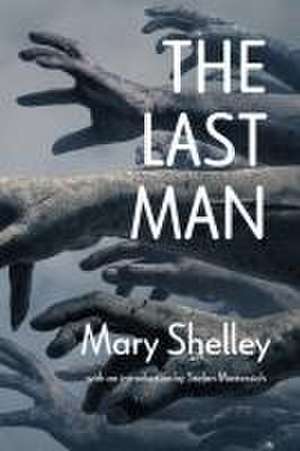
The Last Man
Autor Mary Shelleyen Limba Engleză Paperback – 5 dec 2023
Preț: 140.29 lei
Puncte Express: 210
Carte disponibilă
Livrare economică 28 septembrie-12 octombrie
Livrare prin curier în România Termenul estimat este afișat lângă disponibilitate.
Transport gratuit de la 400.00 lei Plată online sau ramburs, în funcție de opțiunile comenzii.
Retur gratuit în 14 zile Comandă securizată și suport în română.
Specificații
ISBN-13: 9798986210452
Pagini: 486
Dimensiuni: 152 x 229 x 29 mm
Greutate: 0.78 kg
Editura: Atopon Books
Pagini: 486
Dimensiuni: 152 x 229 x 29 mm
Greutate: 0.78 kg
Editura: Atopon Books
V-ar putea interesa
-
 The Question Concerning TechnologyMartin HeideggerPreț: 93.83 lei
 -
 The History of AlexanderQuintus Curtius Rufus-20%Preț: 73.48 lei91.41 lei
 -
 Animal FarmGeorge Orwell-29%Preț: 49.05 lei69.01 lei
 -
 Nineteen Eighty-Four (1984): 1984George Orwell-27%Preț: 51.63 lei70.55 lei
 -
 12 Rules for LifeJordan B. Peterson-30%Preț: 65.19 lei92.77 lei
 -
 LolitaVladimir Nabokov-19%Preț: 57.28 lei70.77 lei
 -
 DeadlockedCharlaine HarrisPreț: 56.77 lei
 -
 The Complete Poetry Of Edgar Allan PoeEdgar Allan PoePreț: 40.91 lei
 -
 Fevre DreamGeorge R. R. MartinPreț: 57.86 lei
 -
 Lucky Cat: Bearer of Good FortuneDanielle Selber-26%Preț: 55.25 lei75.12 lei
 -
 Preț: 96.34 lei
 -
 Rosen, M: Many Different Kinds of LoveMichael Rosen-20%Preț: 98.71 lei123.39 lei
 -
 -25%Preț: 54.38 lei72.19 lei
 -
 Kenneth D. King's Smart Fitting SolutionsKenneth D. KingPreț: 231.63 lei
 -
 BAKEMONOGATARI (manga), volume 11NisioisinPreț: 69.85 lei
 -
 Live GreenJen Chillingsworth-25%Preț: 54.11 lei72.04 lei
 -
 Karamazov BrothersFyodor DostoevskyPreț: 41.86 lei
 -
 Crime and PunishmentFyodor DostoevskyPreț: 38.84 lei
 -
 Notes From Underground & Other StoriesFyodor DostoevskyPreț: 40.49 lei
 -
 Carrion ComfortDan Simmons-22%Preț: 75.04 lei96.44 lei
 -
 Moby DickHerman MelvillePreț: 38.97 lei
 -
 HamletWilliam ShakespearePreț: 29.94 lei
 -
 Don QuixoteMiguel de CervantesPreț: 28.01 lei
 -
 Three MusketeersAlexandre DumasPreț: 38.91 lei
 -
 Robinson CrusoeDaniel DefoePreț: 36.06 lei
 -
 The IdiotFyodor DostoevskyPreț: 39.41 lei
 -
 Preț: 42.78 lei
 -
 Mad about SleevesMinna KonttijärviPreț: 270.09 lei
Notă biografică
MARY SHELLEY was born in 1797, the daughter of the early feminist writer Mary Wollstonecraft and the novelist and radical philosopher William Godwin. Married to the poet Percy Bysshe Shelley, she was at the center of the British Romantic movement of the early 19th century, author of the classic novel Frankenstein (1818), often considered the first example of the science fiction genre. After her husband's death in 1822, she went on to a long career as a novelist, biographer, and travel writer. Among her many works is The Last Man (1826), an uncannily prescient novel set in the late 21st century amidst a time of plague and climatic catastrophe. She died in 1851.
Descriere
Descriere de la o altă ediție sau format:
Mary Shelley’s third published novel, The Last Man, is a disillusioned vision of the end of civilization, set in the twenty-first century. The book offers a sweeping account of war, plague, love, and desolation. It is the sort of apocalyptic vision that was widespread at the time, though Shelley’s treatment of the theme goes beyond the conventional; it is extraordinarily interesting and deeply moving.
If The Last Man is in some sense a “conventional” text of the period, it is also intensely personal in its origin; Shelley refers in her journal to the last man as her alter ego, “the last relic of a beloved race, my companions extinct before me.” The novel thus develops out of and contributes to a network of story and idea in which fantasy, allusion, convention, and autobiography are densely interwoven.
This new version of the first edition (1826) sets out to provide not only a thoroughly annotated text, but also contextual materials to help the reader acquire knowledge of the intellectual and literary milieu out of which the novel emerged. Appendices include material on “the last man” as early nineteenth-century hero, texts from the debate initiated by Malthus in 1798 about the adequacy of food supply to sustain human population, various accounts of outbreaks of plague, and Shelley’s poems representing her feelings after the death of her husband.
Mary Shelley’s third published novel, The Last Man, is a disillusioned vision of the end of civilization, set in the twenty-first century. The book offers a sweeping account of war, plague, love, and desolation. It is the sort of apocalyptic vision that was widespread at the time, though Shelley’s treatment of the theme goes beyond the conventional; it is extraordinarily interesting and deeply moving.
If The Last Man is in some sense a “conventional” text of the period, it is also intensely personal in its origin; Shelley refers in her journal to the last man as her alter ego, “the last relic of a beloved race, my companions extinct before me.” The novel thus develops out of and contributes to a network of story and idea in which fantasy, allusion, convention, and autobiography are densely interwoven.
This new version of the first edition (1826) sets out to provide not only a thoroughly annotated text, but also contextual materials to help the reader acquire knowledge of the intellectual and literary milieu out of which the novel emerged. Appendices include material on “the last man” as early nineteenth-century hero, texts from the debate initiated by Malthus in 1798 about the adequacy of food supply to sustain human population, various accounts of outbreaks of plague, and Shelley’s poems representing her feelings after the death of her husband.
Recenzii
Mary Shelley’s third published novel, The Last Man, is a disillusioned vision of the end of civilization, set in the twenty-first century. The book offers a sweeping account of war, plague, love, and desolation. It is the sort of apocalyptic vision that was widespread at the time, though Shelley’s treatment of the theme goes beyond the conventional; it is extraordinarily interesting and deeply moving.
If The Last Man is in some sense a “conventional” text of the period, it is also intensely personal in its origin; Shelley refers in her journal to the last man as her alter ego, “the last relic of a beloved race, my companions extinct before me.” The novel thus develops out of and contributes to a network of story and idea in which fantasy, allusion, convention, and autobiography are densely interwoven.
This new version of the first edition (1826) sets out to provide not only a thoroughly annotated text, but also contextual materials to help the reader acquire knowledge of the intellectual and literary milieu out of which the novel emerged. Appendices include material on “the last man” as early nineteenth-century hero, texts from the debate initiated by Malthus in 1798 about the adequacy of food supply to sustain human population, various accounts of outbreaks of plague, and Shelley’s poems representing her feelings after the death of her husband.
“Anne McWhir’s edition of The Last Man is first rate! Mary Shelley’s novel is well served by a careful editor who provides an informed introduction, comprehensive annotations, and well-chosen appendices that contextualize this richly complex novel—Shelley herself would have been pleased!” — Charles E. Robinson, University of Delaware
If The Last Man is in some sense a “conventional” text of the period, it is also intensely personal in its origin; Shelley refers in her journal to the last man as her alter ego, “the last relic of a beloved race, my companions extinct before me.” The novel thus develops out of and contributes to a network of story and idea in which fantasy, allusion, convention, and autobiography are densely interwoven.
This new version of the first edition (1826) sets out to provide not only a thoroughly annotated text, but also contextual materials to help the reader acquire knowledge of the intellectual and literary milieu out of which the novel emerged. Appendices include material on “the last man” as early nineteenth-century hero, texts from the debate initiated by Malthus in 1798 about the adequacy of food supply to sustain human population, various accounts of outbreaks of plague, and Shelley’s poems representing her feelings after the death of her husband.
“Anne McWhir’s edition of The Last Man is first rate! Mary Shelley’s novel is well served by a careful editor who provides an informed introduction, comprehensive annotations, and well-chosen appendices that contextualize this richly complex novel—Shelley herself would have been pleased!” — Charles E. Robinson, University of Delaware
Cuprins
Acknowledgements
Introduction
Mary Wollstonecraft Shelley: A Brief Chronology
A Note on the Text
The Last Man
Appendix A: Some Contemporaries of the Last Man
Introduction
Mary Wollstonecraft Shelley: A Brief Chronology
A Note on the Text
The Last Man
- Introduction
- Volume 1
- Volume 2
- Volume 3
Appendix A: Some Contemporaries of the Last Man
- George Gordon, Lord Byron, “Darkness” (1816)
- Thomas Campbell, “The Last Man” (1823)
- Thomas Campbell, letter in The Times, 24 March 1825
- Thomas Hood, from “The Last Man” (1826)
- George Dibdin Pitt, from The Last Man; or; The Miser of Eltham Green (1833)
- Thomas Love Beddoes, notes for a projected play, The Last Man
- Virgil, from Aeneid 6
- Jean-Baptiste Cousin de Grainville, from The Last Man; or Omegarus and Syderia, A Romance in Futurity (1806)
- Edward Gibbon, from The Decline and Fall of the Roman Empire (1776-88)
- Daniel Defoe, from A Journal of the Plague Year (1722)
- Charles Brockden Brown, from Arthur Mervyn (1799-1800)
- John Wilson, from The City of the Plague (1816)
- From “Contagion and Sanitary Laws,” Westminster Review 3 (1825): 134-67
- Constantin Francois de Chasseboeuf, comte de Volney, from The Ruins (1791)
- William Godwin, from Political Justice (1793)
- Thomas Robert Malthus, from An Essay on Population (1798)
- Mary Wollstonecraft, from The French Revolution (1794)
- Edmund Burke, from A Letter to a Noble Lord (1796)
- Percy Bysshe Shelley, from Notes to Queen Mab (1813)
- Percy Bysshe Shelley, from Preface to The Revolt of Islam (1818)
- William Godwin, from Essay on Sepulchres (1809)
- “The Choice”
- “On Reading Wordsworth’s Lines on Peel Castle”
- “To Jane— (with the ’Last Man’)”
- From The Literary Magnet of Monthly Journal of the Belles Lettres, ns 1 (January 1826): 56
- From The Literary Gazette, and Journal of the Belles Letters, 474 ( Saturday 18 Feb. 1826): 56
- From Monthly Review 1 (1826): 333-35
- From Blackwood’s 21 (January 1827): 54
- From Mary Shelley, Rambles in Germany and Italy (1844)