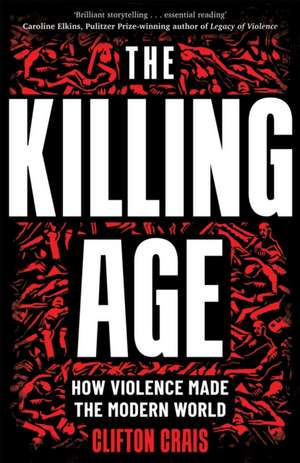
The Killing Age
Autor Clifton Craisen Limba Engleză Paperback – 13 noi 2025 – vârsta de la 18 ani
| Toate formatele și edițiile | Preț | Express |
|---|---|---|
| Paperback (1) | 135.58 lei 22-36 zile | +36.54 lei 5-11 zile |
| Pan Macmillan – 13 noi 2025 | 135.58 lei 22-36 zile | +36.54 lei 5-11 zile |
| Hardback (2) | 242.50 lei 22-36 zile | |
| University of Chicago Press – 25 noi 2025 | 242.50 lei 22-36 zile | |
| Pan Macmillan – 22 ian 2026 | 204.60 lei Precomandă |
Preț: 135.58 lei
Nou
Puncte Express: 203
Preț estimativ în valută:
23.99€ • 28.13$ • 21.07£
23.99€ • 28.13$ • 21.07£
Carte disponibilă
Livrare economică 19 ianuarie-02 februarie 26
Livrare express 02-08 ianuarie 26 pentru 46.53 lei
Preluare comenzi: 021 569.72.76
Specificații
ISBN-13: 9781035013425
ISBN-10: 1035013428
Pagini: 736
Dimensiuni: 152 x 234 x 46 mm
Greutate: 0.82 kg
Ediția:Air Iri OME
Editura: Pan Macmillan
Colecția Picador
ISBN-10: 1035013428
Pagini: 736
Dimensiuni: 152 x 234 x 46 mm
Greutate: 0.82 kg
Ediția:Air Iri OME
Editura: Pan Macmillan
Colecția Picador
Notă biografică
Clifton Crais is professor of history at Emory University. He is the author or editor of eight other books, including the memoir History Lessons: A Memoir of Madness, Memory, and the Brain, and Sara Baartman and the Hottentot Venus: A Ghost Story and a Biography, coauthored with Pamela Scully.
Cuprins
List of Figures, Maps, and Tables
Note on Language, Place-Names, and Measures
Dramatis Personae
Chronology
Preface
Introduction
Part One | The Business of Death
1: Guns
2: Financing the Mortecene
Part Two | African Holocausts
3: Lands of the Dead
4: Gods of War
5: Amerikani
Part Three | Pirates, Indians, and Gentlemen Warlords
6: Asian Waters
7: “Going after the Flesh”
Part Four | The American Ways of Killing
8: Deepwater Genocides
9: Extinguishing Nature
10: Death on the Great Plains
Part Five | Lands of the Dead
11: American Slavery
12: Castes of Another Name
13: Farming War
Part Six | Empire: Twilight of the Warlords
14: Conquering Africa, Part One
15: Conquering Africa, Part Two
16: Savageries of the New Imperialism in India
17: The Terrors of Free Trade in China
18: New World Empires
19: The Great Lands of the Dead
Epilogue: The Modern Age
Acknowledgments
Appendix 1: Weapons, 1700–1900
Appendix 2: Human Deaths and Loss, 1750–1914
Appendix 3: Wild Animal Deaths, 1750–1900
Appendix 4: Climate in the Eighteenth and Nineteenth Centuries
Appendix 5: Global Distribution of Wealth, 1750–1900
Notes
Index
Note on Language, Place-Names, and Measures
Dramatis Personae
Chronology
Preface
Introduction
Part One | The Business of Death
1: Guns
2: Financing the Mortecene
Part Two | African Holocausts
3: Lands of the Dead
4: Gods of War
5: Amerikani
Part Three | Pirates, Indians, and Gentlemen Warlords
6: Asian Waters
7: “Going after the Flesh”
Part Four | The American Ways of Killing
8: Deepwater Genocides
9: Extinguishing Nature
10: Death on the Great Plains
Part Five | Lands of the Dead
11: American Slavery
12: Castes of Another Name
13: Farming War
Part Six | Empire: Twilight of the Warlords
14: Conquering Africa, Part One
15: Conquering Africa, Part Two
16: Savageries of the New Imperialism in India
17: The Terrors of Free Trade in China
18: New World Empires
19: The Great Lands of the Dead
Epilogue: The Modern Age
Acknowledgments
Appendix 1: Weapons, 1700–1900
Appendix 2: Human Deaths and Loss, 1750–1914
Appendix 3: Wild Animal Deaths, 1750–1900
Appendix 4: Climate in the Eighteenth and Nineteenth Centuries
Appendix 5: Global Distribution of Wealth, 1750–1900
Notes
Index
Recenzii
“Crais’s stroke of inspiration is to reread the history of the world, 1759–1900, through the lens of the simple question, ‘Where are the guns? The guns turn out to be everywhere we look, empowering the men who own them to satisfy their every desire, from Black bodies to pick their cotton to whale oil to light their steps to buffalo hides to spin their machines to elephant tusks to make billiard balls for their recreation; their guns enable them to devastate the planet and decimate its nonhuman herds, leaving it to us, their descendants, to clean up the mess. The fuel on which the almighty engine of Progress runs thus turns out to be nothing more complicated than gunpowder. Synoptic in its reach, overwhelming in its detail, The Killing Age leaves one feeling like Jonathan Swift’s Gulliver, who came to prefer the company of peaceable horses to membership of humankind, ‘the most pernicious little race of odious vermin that Nature ever suffered to crawl upon the surface of the earth.’”
“A vast, unsparing world history from the 1750s on, Crais chronicles the rise of industrial technologies of death able to kill at horrific scale from the battlefield to the slaughterhouse. It is a book about how monstrous actions became normalised parts of the global economy, and are the root of our current environmental crises.”
“Combining brilliant storytelling with rich and deeply researched evidence, The Killing Age is essential reading for anyone seeking a global history that reexamines the past on a massive scale while also illuminating the processes that gave rise to many of today’s fault lines and crises.”
“A bracing, unflinching history of how violence—selling it and dealing it—created the carbon-intensive economy that is now transforming our planet. Crais has redefined the Anthropocene as the age of bloodshed.”
“The Killing Age is a broad-ranging, provocative look at how interlocking and far-reaching processes—exports of Anglo-American guns, enslavement, land-grabbing, and genocide—shaped the emergence of the modern world. Numerous regional histories come to look different within this global frame: particularly the expanding and industrializing United States. This vital book will be widely discussed and productively debated for years to come.”
“A tour de force that puts humans’ capacity for both violence and invention at the center of world history. With impressive narrative scope, The Killing Age draws readers into a world of trade forged in blood, challenging us to understand the origins of our era in a new—and deeply disturbing—light.”
"The Killing Age provides an urgent corrective to grand narratives that naturalize the role of violence in human history. Crais strips the modern 'civilizing' project of intellectual camouflage, obliging us to confront the naked reality of a modern world order spawned from the barrel of a gun. This is a courageous and highly readable work of scholarship, which lays bare a nexus of forces that—if left unchecked—will surely destroy the future of life on Earth."
"We normally think of the 20th-century as the Killing Age, but Crais firmly locates this 200 years earlier by showing how the proliferation of European–especially British–guns and gunpowder around the world led to massive destruction of human life and wildlife, disrupted societies and ecologies on a continental scale and laid the ground for the nightmares of the 20th-century and the looming environmental catastrophes of the 21st. Our understanding of the global history of the last 300 years will never be the same again."
"Crais offers a sweeping and immensely learned condemnation of Anglo-American greed and slaughter. He brings environmental and political history together to support his provocative argument that killing--of both people and animals--became the West's most profound contribution to world history."
“A masterful global history that demolishes the idea that the 'Better Angels of Our Nature' reduced violence and paved the way for a peaceful modern age. Crais convincingly demonstrates that killing, enslavement and environmental destruction instead birthed the modern world. This is an urgent book that is essential reading for anyone who wants to understand how our conflict- and crisis-ridden age came to be, and the challenges that we will face as the climate continues to break down.”
"This is the most urgently important book I have read this year or in many years. With the perfect blend of passion and clinical precision, Crais shows how deeply our modern world has been built on violence. The Killing Age will provoke, enrage, and inform its readers--and it will change how they see the world. An epic masterpiece."