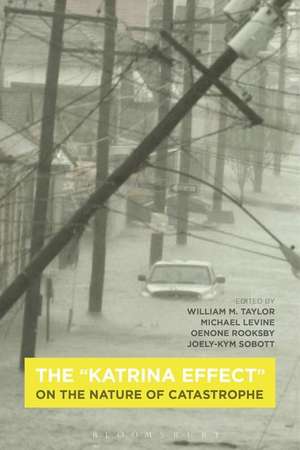
The "Katrina Effect": On the Nature of Catastrophe
Editat de William M. Taylor, Michael P. Levine, Oenone Rooksby, Joely-Kym Sobotten Limba Engleză Paperback – 26 aug 2015
Ne-a atras atenția modul în care The "Katrina Effect" reușește să integreze perspective din domenii aparent divergente — de la etica arhitecturală și filosofia politică, până la sociologia dezastrelor și studiile media. Această abordare interdisciplinară transformă evenimentul din 2005 într-un laborator de analiză a vulnerabilităților sistemice ale societății contemporane. Subliniem faptul că volumul nu se limitează la cronica unei catastrofe naturale, ci investighează modul în care termenul „Katrina” a devenit un simbol pentru eșecul relațiilor sociale și economice preexistente.
Merită menționat că această lucrare extinde cadrul propus de There is No Such Thing as a Natural Disaster de Gregory Squires, aducând date noi despre modul în care percepția publică și discursul cultural modelează realitatea post-dezastru. În timp ce alte titluri se concentrează pe mecanismele imediate ale crizei, The "Katrina Effect" analizează „natura” catastrofei ca pe un construct social complex. În contextul operei editorului William M. Taylor, cartea reprezintă o evoluție firească a preocupărilor sale din Prospects for an Ethics of Architecture. Dacă în lucrarea anterioară Taylor încuraja arhitecții și filosofii să reconsidere rolul designului în perioade dificile, aici aplică aceste interogații etice pe terenul concret al reconstrucției și rezilienței urbane. Ritmul textului este unul academic, dens, însă structura clară în 408 pagini facilitează navigarea prin nuanțele politice și culturale ale subiectului.
Preț: 191.48 lei
Preț vechi: 229.47 lei
-17%
Carte disponibilă
Livrare economică 29 octombrie-12 noiembrie
Specificații
ISBN-10: 1472595173
Pagini: 408
Ilustrații: illustrations
Dimensiuni: 156 x 234 x 18 mm
Greutate: 0.73 kg
Editura: Bloomsbury Publishing
Colecția Bloomsbury Academic
Locul publicării:London, United Kingdom
V-ar putea interesa
-
 The Severed Head - Capital VisionsJulia KristevaPreț: 172.34 lei
 -
 Analytic Freud: Philosophy and PsychoanalysisMichael LevinePreț: 478.02 lei
 -
 Prospects for an Ethics of ArchitectureWilliam M. Taylor-18%Preț: 1472.19 lei1795.36 lei
 -
 Pantheism: A Non-Theistic Concept of DeityMichael P. Levine-15%Preț: 501.91 lei590.48 lei
 -
 Sociology Looks at the ArtsJulia Rothenberg-18%Preț: 1366.93 lei1666.99 lei
 -
 -33%Preț: 593.66 lei883.63 lei
 -
 Everyday Surveillance: Vigilance and Visibility in Postmodern LifeWilliam G. Staples-19%Preț: 322.16 lei398.19 lei
 -
 Landscapes of Writing in Chicano LiteratureI. Martín-JunqueraPreț: 389.10 lei
 -
 Watching Arabic Television in EuropeChristina SladePreț: 378.59 lei
 -
 Leadership and EthicsJacqueline Boaks-16%Preț: 278.87 lei330.03 lei
 -
 The Greatest Classrooms of the WorldWilliam M. TaylorPreț: 124.31 lei
 -
 -5%Preț: 262.97 lei276.81 lei
 -
 First Comes Love: Power Couples, Celebrity Kinship and Cultural PoliticsProfessor Shelley Cobb-24%Preț: 212.07 lei278.44 lei
 -
 -26%Preț: 178.50 lei241.11 lei
 -
 -37%Preț: 851.27 lei1360.29 lei
 -
 -38%Preț: 801.55 lei1299.40 lei
 -
 -26%Preț: 165.02 lei222.98 lei
 -
 -38%Preț: 769.60 lei1240.96 lei
 -
 -20%Preț: 179.23 lei222.81 lei
 -
 TransEvolutionDaniel EstulinPreț: 135.35 lei
De ce să citești această carte
Recomandăm această carte studenților și cercetătorilor din științe sociale sau studii culturale care doresc să înțeleagă mecanismele din spatele crizelor moderne. Cititorul câștigă o perspectivă critică asupra modului în care dezastrele naturale scot la iveală inegalități structurale profunde. Este o resursă esențială pentru a înțelege de ce Katrina rămâne un punct de cotitură în critica neoliberalismului și a politicilor publice actuale.
Despre autor
Coordonată de o echipă de experți condusă de William M. Taylor, această lucrare reflectă expertiza colectivă în domeniul arhitecturii, filosofiei și studiilor sociale. Taylor, un cercetător consacrat al teoriei arhitecturale, este cunoscut pentru lucrările sale care investighează dimensiunea etică a spațiului construit. Interesul său pentru modul în care mediul antropic răspunde provocărilor globale se regăsește în toate proiectele sale editoriale publicate de Bloomsbury Academic, unde promovează dialogul între disciplinele tehnice și cele umaniste.
Caracteristici
Notă biografică
Descriere scurtă
Cuprins
Recenzii
The 'Katrina effect' describes the process by which the 2005 hurricane that devastated New Orleans became a central point of reference for larger critiques of existing social, political, and economic relations and structures. Katrina, the editors suggest, became shorthand to describe the failure of institutions, leaders, and policies in a variety of contexts and for the reckoning and debates that followed those failures, both in the US and abroad. This excellent collection of 14 essays probes the 'Katrina effect' from a variety of disciplinary perspectives. Contributions come from an international roster of historians, philosophers, sociologists, architects, urban planners, and journalists. The essays explore the impact of the disaster on New Orleans (the photo essay by local journalist James O'Byrne is especially noteworthy), but they also place the city and hurricane in larger contexts, including discussions of US urban policy, neoliberal economic policies, and the politics of memory. Several authors compare and contrast events in New Orleans with the situation in Port-au-Prince following the 2010 earthquake. The editors provide an excellent introduction. A valuable collection that will be of great interest to scholars in a range fields. Summing Up: Highly recommended. Upper-division undergraduates and above.