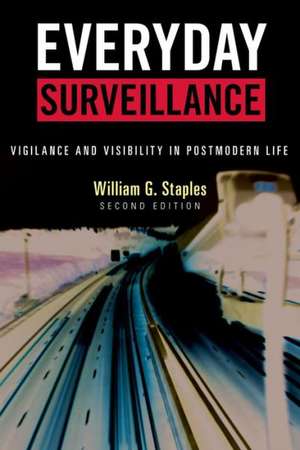
Everyday Surveillance: Vigilance and Visibility in Postmodern Life
Autor William G. Staplesen Limba Engleză Paperback – 18 oct 2013
Thoroughly revised, the second edition considers new topics, such as the rise of social media, and updates research throughout. Everyday Surveillance introduces students to concepts of social control and incites classroom discussion about how surveillance impacts the ways we understand people and our lives at home, work, school, or in the community.
Preț: 322.16 lei
Preț vechi: 398.19 lei
-19%
Puncte Express: 483
Carte tipărită la comandă
Livrare economică 19 noiembrie-03 decembrie
Livrare prin curier în România Termenul estimat este afișat lângă disponibilitate.
Transport gratuit de la 400.00 lei Plată online sau ramburs, în funcție de opțiunile comenzii.
Retur gratuit în 14 zile Comandă securizată și suport în română.
Specificații
ISBN-13: 9780742541108
ISBN-10: 074254110X
Pagini: 255
Ilustrații: 1 table
Dimensiuni: 150 x 229 x 16 mm
Greutate: 0.36 kg
Ediția:2nd Edition.
Editura: Bloomsbury Publishing
Colecția Rowman & Littlefield
Locul publicării:New York, United States
ISBN-10: 074254110X
Pagini: 255
Ilustrații: 1 table
Dimensiuni: 150 x 229 x 16 mm
Greutate: 0.36 kg
Ediția:2nd Edition.
Editura: Bloomsbury Publishing
Colecția Rowman & Littlefield
Locul publicării:New York, United States
Cuprins
Preface to the Second Edition
1. Everyday Surveillance
2. The Scaffold, the Penitentiary, And Beyond
3. The Gaze and Its Compulsions
4. Bodily Intrusions
5. WIRED.I.AM: The Digital Life 2.0
6. The Anatomy of Visibility
Endnotes
Selected References
Index
About the Author
1. Everyday Surveillance
2. The Scaffold, the Penitentiary, And Beyond
3. The Gaze and Its Compulsions
4. Bodily Intrusions
5. WIRED.I.AM: The Digital Life 2.0
6. The Anatomy of Visibility
Endnotes
Selected References
Index
About the Author
Recenzii
This book is very well written. . . . It offers a fascinating chronicle of the rage to invent new forms of surveillance, as well as pithy conceptualizations that organize the empirical materials nicely. As such, it clearly meets Staples's stated goal of providing an accessible undergraduate textbook. (praise for previous edition)
The suggestion made by Everyday Surveillance that a 'quiet revolution' is occurring in which we are all targets is a thought provoking one. It reminds us that we all are responsible for encouraging surveillance by being seduced by its promises, fearing the consequences without it and heralding it as society's salvation. The book flags up some new directions in which the study of visual, informational and communication technologies might profitably head.(praise for previous edition)
Lively and engaging. Instructors looking for a sociological treatment of an interesting contemporary issue will find that this book would provoke discussion and debate among students in undergraduate or graduate courses. (praise for previous edition)
William G. Staples has authored an impressive, well-written, and exhaustive historical analysis of what he terms society's ever-increasing 'culture of surveillance' and 'postmodern surveillance practices.' While extremely readable and eye opening, Everyday Surveillance . . . is a wide-ranging historical overview of the progression of surveillance and control tactics beginning in the 1700s and continuing all the way to the controversial surveillance tactics employed by government agencies today. . . .Ultimately, this book clearly and effectively challenges the reader to consider how technology has benefited or damaged society. Staples does not pass judgment or offer personal opinion on the techniques described throughout the book; however, he challenges the reader in the hope of creating public discourse regarding concepts of justice, transparency, societal control, and voyeurism. . . .This book should be viewed as an advanced sociological, historical, analytical, and at times philosophical discourse on a topic relevant to all security practitioners and society as a whole.
This insightful and wonderfully accessible book shows how surveillance has radically transformed just about every aspect of social life. Whether at home, school, work, or in online worlds, surveillance defines and mediates our experiences. This completely revised edition of Everyday Surveillance is the perfect guide for making sense of these changes and their consequences.
George Orwell was wrong. The modern problem of surveillance isn't Big Brother but the thousands upon thousands of "Tiny Brothers" that record and track our daily existence. William Staples offers a compelling account of the rise of private surveillance-complementing but also complicating the watchful eye of the State-and the equanimity with which this has been greeted by the public.
William Staples blends sophisticated social theorizing with a keen eye for the minute ways that surveillance touches our day-to-day lives. In the process he brings to light the often otherwise invisible powers of contemporary monitoring practices.
William Staples offers an engaging, succinct, contemporary introduction to the micro-management of ever more areas of daily life through surveillance technology. While attuned to the depths of change, he does not lose sight of what remains unchanged. Ideal for a range of beginning social science courses!
Through incisive analysis, Everyday Surveillance charts the various ways that surveillance shapes the postmodern moment: from the routinized gathering of data by 'smart' technologies when we shop, work, travel, or protest, to new categories of punishment that blur the line between incarceration and freedom-where those under house arrest are subject to 'participatory monitoring' with the expectation that they come to supervise themselves. Through interviews and observations, Staples offers a 'sociology of the postmodern' that is a wide-ranging, historically grounded, and theoretically informed engagement with the techniques of surveillance and social control.
The first edition of William Staples' Everyday Surveillance was an instant classic which played a significant part in establishing the field of Surveillance Studies. So it is a delight to see the publication of this almost entirely updated second edition, which not only deals with the transformations that have taken place since 9/11 but also with the increasing ubiquity of surveillance in everyday life through social practices, culture and technology. This is absolutely essential reading for anyone who wonders exactly how it is that surveillance came to be everywhere in our lives.
The beauty of this book? It's true to its title. Surveillance is demystified. It's not an occasional or remote occurrence but an intrinsic aspect of all our everyday lives. We are challenged to understand and come to terms with a culture of surveillance in which 'Big Brother is us.' Staples guides us between the multi-faceted vigilance of digital systems and the enhanced visibility of our mundane life-paths, noting subtle shifts from modern to postmodern practices. This book deftly draws attention to the key questions that we discount to our detriment.
The suggestion made by Everyday Surveillance that a 'quiet revolution' is occurring in which we are all targets is a thought provoking one. It reminds us that we all are responsible for encouraging surveillance by being seduced by its promises, fearing the consequences without it and heralding it as society's salvation. The book flags up some new directions in which the study of visual, informational and communication technologies might profitably head.(praise for previous edition)
Lively and engaging. Instructors looking for a sociological treatment of an interesting contemporary issue will find that this book would provoke discussion and debate among students in undergraduate or graduate courses. (praise for previous edition)
William G. Staples has authored an impressive, well-written, and exhaustive historical analysis of what he terms society's ever-increasing 'culture of surveillance' and 'postmodern surveillance practices.' While extremely readable and eye opening, Everyday Surveillance . . . is a wide-ranging historical overview of the progression of surveillance and control tactics beginning in the 1700s and continuing all the way to the controversial surveillance tactics employed by government agencies today. . . .Ultimately, this book clearly and effectively challenges the reader to consider how technology has benefited or damaged society. Staples does not pass judgment or offer personal opinion on the techniques described throughout the book; however, he challenges the reader in the hope of creating public discourse regarding concepts of justice, transparency, societal control, and voyeurism. . . .This book should be viewed as an advanced sociological, historical, analytical, and at times philosophical discourse on a topic relevant to all security practitioners and society as a whole.
This insightful and wonderfully accessible book shows how surveillance has radically transformed just about every aspect of social life. Whether at home, school, work, or in online worlds, surveillance defines and mediates our experiences. This completely revised edition of Everyday Surveillance is the perfect guide for making sense of these changes and their consequences.
George Orwell was wrong. The modern problem of surveillance isn't Big Brother but the thousands upon thousands of "Tiny Brothers" that record and track our daily existence. William Staples offers a compelling account of the rise of private surveillance-complementing but also complicating the watchful eye of the State-and the equanimity with which this has been greeted by the public.
William Staples blends sophisticated social theorizing with a keen eye for the minute ways that surveillance touches our day-to-day lives. In the process he brings to light the often otherwise invisible powers of contemporary monitoring practices.
William Staples offers an engaging, succinct, contemporary introduction to the micro-management of ever more areas of daily life through surveillance technology. While attuned to the depths of change, he does not lose sight of what remains unchanged. Ideal for a range of beginning social science courses!
Through incisive analysis, Everyday Surveillance charts the various ways that surveillance shapes the postmodern moment: from the routinized gathering of data by 'smart' technologies when we shop, work, travel, or protest, to new categories of punishment that blur the line between incarceration and freedom-where those under house arrest are subject to 'participatory monitoring' with the expectation that they come to supervise themselves. Through interviews and observations, Staples offers a 'sociology of the postmodern' that is a wide-ranging, historically grounded, and theoretically informed engagement with the techniques of surveillance and social control.
The first edition of William Staples' Everyday Surveillance was an instant classic which played a significant part in establishing the field of Surveillance Studies. So it is a delight to see the publication of this almost entirely updated second edition, which not only deals with the transformations that have taken place since 9/11 but also with the increasing ubiquity of surveillance in everyday life through social practices, culture and technology. This is absolutely essential reading for anyone who wonders exactly how it is that surveillance came to be everywhere in our lives.
The beauty of this book? It's true to its title. Surveillance is demystified. It's not an occasional or remote occurrence but an intrinsic aspect of all our everyday lives. We are challenged to understand and come to terms with a culture of surveillance in which 'Big Brother is us.' Staples guides us between the multi-faceted vigilance of digital systems and the enhanced visibility of our mundane life-paths, noting subtle shifts from modern to postmodern practices. This book deftly draws attention to the key questions that we discount to our detriment.