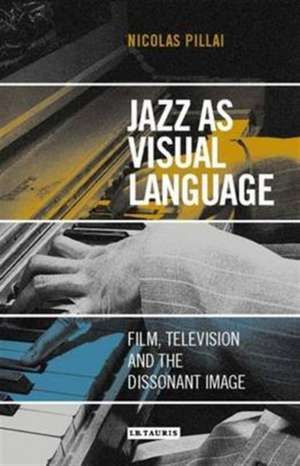
Jazz as Visual Language: Film, Television and the Dissonant Image
Autor Nicolas Pillaien Limba Engleză Hardback – 15 noi 2016
Preț: 788.40 lei
Preț vechi: 1262.92 lei
-38%
Puncte Express: 1183
Carte disponibilă
Livrare economică 17 noiembrie-01 decembrie
Livrare prin curier în România Termenul estimat este afișat lângă disponibilitate.
Transport gratuit pentru acest produs Plată online sau ramburs, în funcție de opțiunile comenzii.
Retur gratuit în 14 zile Comandă securizată și suport în română.
Specificații
ISBN-13: 9781784533441
ISBN-10: 1784533440
Pagini: 192
Ilustrații: 20 bw integrated
Dimensiuni: 144 x 218 x 20 mm
Greutate: 0.36 kg
Editura: Bloomsbury Publishing
Colecția I.B.Tauris
Locul publicării:London, United Kingdom
ISBN-10: 1784533440
Pagini: 192
Ilustrații: 20 bw integrated
Dimensiuni: 144 x 218 x 20 mm
Greutate: 0.36 kg
Editura: Bloomsbury Publishing
Colecția I.B.Tauris
Locul publicării:London, United Kingdom
V-ar putea interesa
-
 A 1980s ChildhoodMichael A. JohnsonPreț: 71.99 lei
 -
 Go-Go LiveNatalie HopkinsonPreț: 151.78 lei
 -
 Silhouettes from Popular CultureOlly Moss-19%Preț: 73.87 lei90.90 lei
 -
 You Win or You DieAyelet Haimson Lushkov-41%Preț: 95.82 lei163.74 lei
 -
 Reading The Sopranos: Hit TV from HBODavid Lavery-22%Preț: 131.78 lei168.21 lei
 -
 -25%Preț: 180.20 lei241.65 lei
 -
 -22%Preț: 156.93 lei200.32 lei
 -
 -20%Preț: 168.17 lei210.53 lei
 -
 -15%Preț: 165.03 lei193.40 lei
 -
 -20%Preț: 169.05 lei211.07 lei
 -
 Art and AdvertisingJoan Gibbons-19%Preț: 186.78 lei231.60 lei
 -
 All Roads Lead to Wells: Stories of the Hippie DaysSusan SafyanPreț: 126.94 lei
 -
 Milk and Honey: Contemporary Art in CaliforniaJustin Van HoyPreț: 278.44 lei
Cuprins
1. Introduction
2. Len Lye
3. Gjon Mili
4. Jazz 625
Coda: Jazz in motion
2. Len Lye
3. Gjon Mili
4. Jazz 625
Coda: Jazz in motion
Recenzii
This is a thought-provoking book that addresses a fascinating and still under-researched topic, and will be of great value to scholars working interested in film, television or jazz studies. More widely, though, it will be an engaging read for anybody with an interest in how jazz is represented in the broadcast media, and how this representation can influence our own definitions of jazz.
A very interesting study that brings jazz studies and film studies together comfortably and in lucid language enlarges the range of both research fields.
The final study on Jazz 625 is excellent ... Backed up by a full table of transmissions, and with intriguing and fascinating discussion [...] it picks a sensitive and delicate path through critical writing on the subject and explores the ground-breaking series in real depth. For this alone, the book is very valuable.
Jazz as Visual Language provides three strong case studies, demonstrating in a detailed and nuanced way three case-specific interactions between music on-screen and the different types of audio-visual media analysed here ... It brings together different angles and perspectives in an enriching and inspiring interdisciplinary approach.
Jazz as Visual Language: Film, Television and the Dissonant Image [is] an especially pertinent and timely intervention into jazz scholarship and film theory simultaneously. [.] Pillai's written account of jazz and visual media proves transformative in its own right, contributing much to the study of jazz, television and film music studies.
A very interesting study that brings jazz studies and film studies together comfortably and in lucid language enlarges the range of both research fields.
The final study on Jazz 625 is excellent ... Backed up by a full table of transmissions, and with intriguing and fascinating discussion [...] it picks a sensitive and delicate path through critical writing on the subject and explores the ground-breaking series in real depth. For this alone, the book is very valuable.
Jazz as Visual Language provides three strong case studies, demonstrating in a detailed and nuanced way three case-specific interactions between music on-screen and the different types of audio-visual media analysed here ... It brings together different angles and perspectives in an enriching and inspiring interdisciplinary approach.
Jazz as Visual Language: Film, Television and the Dissonant Image [is] an especially pertinent and timely intervention into jazz scholarship and film theory simultaneously. [.] Pillai's written account of jazz and visual media proves transformative in its own right, contributing much to the study of jazz, television and film music studies.