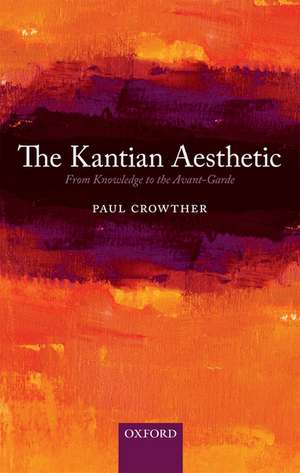
The Kantian Aesthetic: From Knowledge to the Avant-Garde
Autor Paul Crowtheren Limba Engleză Hardback – 25 mar 2010
Preț: 606.30 lei
Preț vechi: 880.79 lei
-31%
Puncte Express: 909
Carte tipărită la comandă
Livrare economică 20 noiembrie-01 decembrie
Livrare prin curier în România Termenul estimat este afișat lângă disponibilitate.
Transport gratuit pentru acest produs Plată online sau ramburs, în funcție de opțiunile comenzii.
Retur gratuit în 14 zile Comandă securizată și suport în română.
Specificații
ISBN-13: 9780199579976
ISBN-10: 0199579970
Pagini: 224
Dimensiuni: 144 x 223 x 18 mm
Greutate: 0.41 kg
Editura: OUP OXFORD
Colecția OUP Oxford
Locul publicării:Oxford, United Kingdom
ISBN-10: 0199579970
Pagini: 224
Dimensiuni: 144 x 223 x 18 mm
Greutate: 0.41 kg
Editura: OUP OXFORD
Colecția OUP Oxford
Locul publicării:Oxford, United Kingdom
V-ar putea interesa
-
 Essays on DescartesPaul Hoffman-31%Preț: 604.06 lei873.99 lei
 -
 Descartes: An Analytic and Historical IntroductionGeorges Dicker-11%Preț: 376.76 lei422.71 lei
 -
 Kant on Practical Justification: Interpretive EssaysMark Timmons-31%Preț: 868.32 lei1259.35 lei
 -
 -14%Preț: 575.34 lei669.00 lei
 -
 Humean Moral PluralismMichael B. Gill-31%Preț: 564.68 lei817.55 lei
 -
 -31%Preț: 711.52 lei1031.47 lei
 -
 -29%Preț: 409.10 lei573.48 lei
 -
 Nietzsche on Art and LifeDaniel Came-31%Preț: 558.61 lei808.41 lei
 -
 -17%Preț: 366.23 lei442.39 lei
 -
 Kant on Mind, Action, and EthicsJulian Wuerth-32%Preț: 696.97 lei1031.75 lei
 -
 -31%Preț: 789.18 lei1146.49 lei
 -
 -13%Preț: 302.94 lei347.69 lei
 -
 Hegelian MetaphysicsRobert Stern-21%Preț: 402.02 lei508.96 lei
 -
 John Locke and Natural PhilosophyPeter R. Anstey-11%Preț: 329.98 lei372.03 lei
 -
 Hume's Epistemology in the Treatise: A Veritistic InterpretationFrederick F. Schmitt-31%Preț: 607.87 lei876.29 lei
 -
 -13%Preț: 251.19 lei287.95 lei
 -
 Inspirations from Kant: EssaysLeslie Stevenson-28%Preț: 465.35 lei650.03 lei
 -
 -11%Preț: 330.42 lei372.26 lei
 -
 An Introduction to Kant's Moral PhilosophyJennifer K. UlemanPreț: 201.56 lei
 -
 Phenomenology of the Visual Arts (even the frame)Paul CrowtherPreț: 171.71 lei
 -
 Preț: 153.79 lei
 -
 The Transhistorical ImagePaul CrowtherPreț: 307.40 lei
 -
 The Phenomenology of Modern Art: Exploding Deleuze, Illuminating StyleProfessor Paul Crowther-22%Preț: 333.50 lei428.58 lei
 -
 The Kant DictionaryDr Lucas Thorpe-25%Preț: 206.34 lei274.80 lei
 -
 Menschliches, AllzumenschlichesFriedrich NietzschePreț: 122.03 lei
Recenzii
the test is whether the author's positions is coherently related to other scholarship in the field of study and illuminating in its own right in some respect. Crowther's book passes this test with flying colours,
an exciting and provocative thesis... the book is well-written and it gives readers who have some familiarity with Kant's critical project plenty to consider.
It is a fascinating fact about Kant's Critique of Judgment (as with his entire oeuvre) that so many scholars who delve seriously and deeply into its themes and objectives can reveal something new and illuminating about Kant's aims, purposes, or implications for the present. Crowther achieves this. Ultimately, the test is whether the author's position is coherently related to other scholarship in the field of study and illuminating in its own right in some respect. Crowther's book passes this test with flying colours.
Those who want to develop Kant's ideas in new directions will find, as I have, that Crowther's approach brings one to think about what is really important in Kant's account and why that might be worth preserving
an exciting and provocative thesis... the book is well-written and it gives readers who have some familiarity with Kant's critical project plenty to consider.
It is a fascinating fact about Kant's Critique of Judgment (as with his entire oeuvre) that so many scholars who delve seriously and deeply into its themes and objectives can reveal something new and illuminating about Kant's aims, purposes, or implications for the present. Crowther achieves this. Ultimately, the test is whether the author's position is coherently related to other scholarship in the field of study and illuminating in its own right in some respect. Crowther's book passes this test with flying colours.
Those who want to develop Kant's ideas in new directions will find, as I have, that Crowther's approach brings one to think about what is really important in Kant's account and why that might be worth preserving
Notă biografică
Paul Crowther is Professor of Philosophy at the National University of Ireland, Galway. He is a former Official Fellow of Corpus Christi College, Oxford, and the author of a number of monographs exploring aesthetics, art history, and the philosophy of culture.
Cuprins
- Introduction
- 1: The Transcendental Deduction; Objective Knowledge and the Unity of Self- Consciousness
- 2: Imagination and the Conditions of Knowledge
- 3: Pure Aesthetic Judgment: A Harmony of Imagination and Understanding
- 4: The Universality and Justification of Taste
- 5: Adherent Beauty and Concepts of Perfection
- 6: From Aesthetic Ideas to the Avant-Garde: The Scope of Fine Art
- 7: The Kantian Sublime Revisited