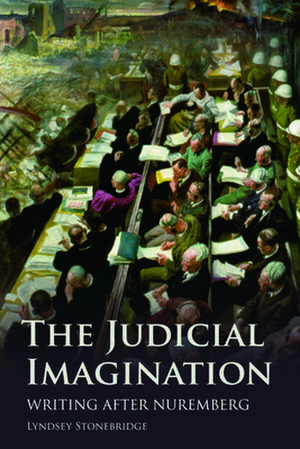
The Judicial Imagination
Autor Lyndsey Stonebridgeen Limba Engleză Paperback – 21 mai 2014
Preț: 175.65 lei
Preț vechi: 210.92 lei
-17%
Puncte Express: 263
Carte disponibilă
Livrare economică 06-20 noiembrie
Livrare express 23-29 octombrie pentru 60.35 lei
Livrare prin curier în România Termenul estimat este afișat lângă disponibilitate.
Transport gratuit de la 400.00 lei Plată online sau ramburs, în funcție de opțiunile comenzii.
Retur gratuit în 14 zile Comandă securizată și suport în română.
Specificații
ISBN-13: 9780748691258
ISBN-10: 0748691251
Pagini: 178
Ilustrații: black & white illustrations, figures
Dimensiuni: 152 x 231 x 14 mm
Greutate: 0.3 kg
Editura: EDINBURGH UNIVERSITY PRESS
ISBN-10: 0748691251
Pagini: 178
Ilustrații: black & white illustrations, figures
Dimensiuni: 152 x 231 x 14 mm
Greutate: 0.3 kg
Editura: EDINBURGH UNIVERSITY PRESS
V-ar putea interesa
-
 Hotel BemelmansLudwig Bemelmans-44%Preț: 78.78 lei139.68 lei
 -
 Aldous Huxley: An English IntellectualNicholas Murray-27%Preț: 88.30 lei120.27 lei
 -
 Ted HughesTed HughesPreț: 69.59 lei
 -
 Twentieth-Century Scottish PoetryDouglas DunnPreț: 159.36 lei
 -
 Preț: 45.28 lei
 -
 Diaries, 1942-1954James Lees-Milne-25%Preț: 82.89 lei109.86 lei
 -
 Contemporary British FictionNick Bentley-12%Preț: 159.09 lei181.09 lei
 -
 -17%Preț: 175.24 lei209.97 lei
 -
 Literature of the 1980s: After the WatershedJoseph Brooker-17%Preț: 174.15 lei209.68 lei
 -
 Modernist LiteratureRachel Potter-17%Preț: 172.87 lei208.86 lei
 -
 IntermodernismKristin Bluemel-17%Preț: 180.72 lei216.52 lei
 -
 Djuna Barnes and Affective ModernismJulie Taylor-25%Preț: 597.38 lei793.88 lei
 -
 -17%Preț: 181.39 lei217.74 lei
 -
 Harbors and High SeasDean KingPreț: 157.88 lei
 -
 Preț: 266.61 lei
 -
 Utterly Other DiscourseEllen G FriedmanPreț: 127.78 lei
Notă biografică
Lyndsey Stonebridge is Professor of Literature and Critical Theory at the University of East Anglia. She is the author of The Writing of Anxiety: Imagining Wartime in 1940s British Culture (Palgrave, 2007); The Destructive Element: British Psychoanalysis and Modernism (Macmillan, 1998) and the co-editor (with Marina Mackay) of British Fiction after Modernism: The Novel at Mid-Century (Palgrave, 2006) and (with John Phillips) of Reading Melanie Klein (Routledge, 1998).
Cuprins
Introduction; Gathering Ashes: The Judicial Imagination in the Age of Trauma; Part One: Writing After Nuremberg; Chapter One: 'An event that did not become an experience': Rebecca West's Nuremberg; Chapter Two: The Man in the Glass Booth: Hannah Arendt's Irony; Chapter Three: Fiction in Jerusalem: Muriel Spark's Idiom of Judgement; Part Two: Territorial Rights; Chapter Four: 'We Refugees': Hannah Arendt and the Perplexities of Human Rights; Chapter Five: 'Creatures of an Impossible Time': Late Modernism, Human Rights and Elizabeth Bowen; Chapter Six: The Dark Background of Difference: Love and the Refugee in Iris Murdoch; Bibliography.
Recenzii
Stonebridge eloquently addresses a dilemma at the heart of the judicial imagination--the tension between law and poetic justice, traumatic history that resists comprehension and the ethical testimony of literature. -- Mary Jacobus, Professor of English, University of Cambridge Analyzing disciplinary and stylistic practices among such thinkers as Arendt, West, Spark, and Gellhorn, The Judicial Imagination fully matches the rigor, moral authority, and observational acumen of its subjects. This is an important and unusually enriching study. -- Michael Steinberg, Keeney Professor of History and Director, Cogut Center for the Humanities, Brown University Stonebridge eloquently addresses a dilemma at the heart of the judicial imagination--the tension between law and poetic justice, traumatic history that resists comprehension and the ethical testimony of literature. Analyzing disciplinary and stylistic practices among such thinkers as Arendt, West, Spark, and Gellhorn, The Judicial Imagination fully matches the rigor, moral authority, and observational acumen of its subjects. This is an important and unusually enriching study.