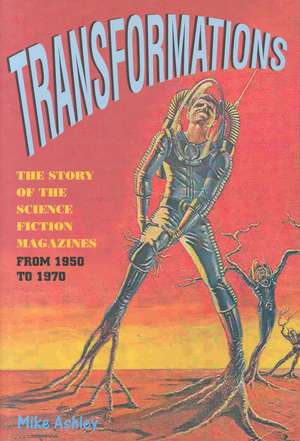
Transformations: The Story of the Science Fiction Magazines from 1950 to 1970
Autor Mike Ashleyen Limba Engleză Paperback – 30 mai 2005
În literatura academică dedicată anticipației, evoluția suportului fizic al textului a fost adesea eclipsată de analiza pur literară, lăsând o lacună în înțelegerea modului în care piața editorială a modelat estetica genului. Considerăm că Transformations vine să umple exact acest gol, oferind o cronică minuțioasă a deceniilor care au transformat science-fiction-ul dintr-un fenomen de nișă într-o forță culturală globală. Autorul Mike Ashley analizează perioada critică 1950-1970, marcată de declinul formatului „pulp” și ascensiunea publicațiilor elegante, proces care a coincis cu maturizarea stilistică a unor giganți precum Isaac Asimov sau Philip K. Dick.
Observăm în acest volum o rigoare documentară care face legătura între contextul Războiului Rece și inovațiile narative ale epocii. Comparabil cu The World of Science Fiction, 1926-1976 în ceea ce privește ambiția istorică, Transformations este actualizat pentru a evidenția schimbările structurale de după 1950, punând un accent deosebit pe mișcarea „New Wave” condusă de Michael Moorcock. Structura cărții urmărește o progresie logică, de la „A Galaxy of Stars” la „The New Wave”, culminând cu un aparat critic impresionant: directoare ale editorilor, liste ale artiștilor care au semnat coperțile și o secțiune dedicată revistelor non-engleze.
Această lucrare continuă demersul început de autor în Time Machines, unde a explorat începuturile genului, și face trecerea spre Gateways to Forever. Dacă în Yesterday's Tomorrows autorul se concentra pe autorii britanici uitați, aici Mike Ashley își lărgește perspectiva asupra întregii industrii de profil, oferind o resursă indispensabilă pentru înțelegerea fundamentelor pe care s-au construit marile francize cinematografice de astăzi.
Preț: 266.61 lei
Carte tipărită la comandă
Livrare economică 26 noiembrie-10 decembrie
Specificații
ISBN-10: 0853237794
Pagini: 410
Ilustrații: 1 black & white tables
Dimensiuni: 152 x 229 x 23 mm
Greutate: 0.63 kg
Editura: Liverpool University Press
Colecția Liverpool University Press
V-ar putea interesa
-
 Preț: 122.06 lei
 -
 Preț: 158.05 lei
 -
 The Mammoth Book of MerlinMike Ashley-25%Preț: 69.53 lei93.16 lei
 -
 Ten Minute Stories / Day and Night StoriesAlgernon BlackwoodPreț: 112.13 lei
 -
 The Face of the Earth and Other ImaginingsAlgernon BlackwoodPreț: 88.53 lei
 -
 The Tracer of Lost Persons / The Tree of HeavenRobert W. ChambersPreț: 97.28 lei
 -
 Starlight ManMike AshleyPreț: 135.55 lei
 -
 Preț: 79.64 lei
 -
 Observations Sur Le Langage Du Pays de VaudEmmanuel DeveleyPreț: 87.69 lei
 -
 Preț: 133.37 lei
 -
 Livre À Épeler Et À Lire. 3e ÉditionCollectifPreț: 86.92 lei
 -
 Preț: 86.92 lei
 -
 Histoire et procédés du polytypage et de la stéréotypieArmand-Gaston CamusPreț: 116.07 lei
 -
 Traduction Des Exercices Grecs Élémentaires Et GraduésAlexis ChassangPreț: 79.54 lei
 -
 Les Vrais principes de lecture, d'orthographe et de la prononciation françaiseNicolas-Antoine ViardPreț: 123.19 lei
 -
 Deutsch-amerikanische AlltagskommunikationHiltraud Casper-Hehne-23%Preț: 1910.91 lei2481.70 lei
 -
 Sprache, Sprechen und IdentitätMarijana KresicPreț: 185.18 lei
De ce să citești această carte
Recomandăm acest volum oricărui cercetător sau pasionat de istoria literară care dorește să înțeleagă cum a supraviețuit science-fiction-ul colapsului pieței de reviste din anii '50. Cititorul câștigă o perspectivă rară asupra mecanismelor editoriale din spatele unor capodopere precum „Dune”. Este o resursă esențială pentru a vedea cum designul de copertă și viziunea editorilor au definit vocabularul vizual al genului înainte de era blockbuster-elor hollywoodiene.
Despre autor
Mike Ashley (născut în 1948) este unul dintre cei mai respectați cercetători și editori britanici specializați în science-fiction, fantasy și literatură „weird”. Cu o carieră dedicată documentării arhivelor literare, Ashley a editat numeroase antologii, precum Queens of the Abyss sau Nature's Warnings, și a scris istorii de referință ale revistelor de gen. Expertiza sa este recunoscută internațional, fiind considerat un istoric al culturii populare care reușește să combine rigoarea academică cu o pasiune autentică pentru literatura de consum. În seria publicată de Liverpool University Press, el sintetizează decenii de cercetare asupra evoluției pieței de carte și a revistelor periodice.
Descriere scurtă
In Transformations, the second volume in his acclaimed three-volume history of science fiction magazines, science fiction historian Mike Ashley brings his unparalleled knowledge to bear on the period from the beginning of the Cold War through the end of the 1960s, an era of tremendous change in the writing of and the marketplace for science fiction.
Ashley begins his story with the decline of the pulp magazines at the end of the 1940s and their replacement by new digest-sized and glossy magazines. That switch, and the increased respectability that came with it, coincided with a true golden age of science fiction writing in the early 1950s, with such giants of the genre as Isaac Asimov, Philip K. Dick, Frank Herbert, and Harlan Ellison all publishing regularly in a wide range of such magazines.
As Ashley shows, by the end of the decade, sales had slumped, all but six of the science fiction magazines had folded, and the future looked bleak—until the surprising rebirth of the genre through the work of British writers Michael Moorcock and J. G. Ballard. Ashley also considers how the popularity of Star Trek and the movie version of 2001: A Space Odyssey influenced the future of the science fiction magazine.
For fans of science fiction seeking to understand how their favorite genre evolved from Amazing Stories to Babylon 5, Transformations will be essential reading.
Notă biografică
Cuprins
Acknowledgements
Chapter One: A Galaxy of Stars
Chapter Two: Saturation and Suffocation
Chapter Three: The Best of British?
Chapter Four: Creative Chaos
Chapter Five: Transformations
Chapter Six: The Times they are a-Changing
Chapter Seven: The New Wave
Chapter Eight: Fantasy versus Reality
Chapter Nine: Aftermath
Appendix 1: Non-English Language Science-Fiction Magazines
Appendix 2: Summary of Science-Fiction Magazines
Appendix 3: Directory of Magazine Editors and Publishers
Appendix 4: Directory of Magazine Cover Artists
Select Bibliography
Index