
The Irish Story: Telling Tales and Making it Up in Ireland
Autor R. F. Fosteren Limba Engleză Paperback – 4 sep 2002
In this provocative and extremely funny book Roy Foster demolishes the clichés that surround Ireland's past, examining how key moments have been turned into myths - and, more recently, airbrushed and repackaged for Hollywood and popular culture.
Whether discussing the 'misery tourism' of Famine theme parks, ideas of mystical Celticism, the contested 'Irishness' of Yeats or the sentimentalized childhoods ofAngela's Ashesand Gerry Adams's memoir,The Irish Storybrilliantly separates the tall tales from the truth.
'Brilliantly scathing ... combative, incisive and immensely enjoyable'
Fintan O'Toole,Irish Times
'Inspirational ... challenging, illuminating and witty'
Antonia Fraser,Irish TimesBooks of the Year
'Very funny ... the Irish story has rarely received so lively and unbiased an unfolding'
Patricia Craig,Independent
'A complex and supremely intelligent revision of Irish identity'
Colm Tóibín,IndependentBooks of the Year
'Blazingly good ... lucid and elegant'
John Lloyd,Financial Times
R. F. Fosteris Carroll Professor of Irish History at the University of Oxford and a Fellow of Hertford College, Oxford. His books includeModern Ireland: 1600-1972,Luck and the IrishandW. B. Yeats: A Life.
| Toate formatele și edițiile | Preț | Express |
|---|---|---|
| Paperback (2) | 88.62 lei 6-8 săpt. | |
| Penguin Books – 4 sep 2002 | 88.62 lei 6-8 săpt. | |
| Oxford University Press – 25 sep 2007 | 89.72 lei 41-52 zile |
Preț: 88.62 lei
Nou
Puncte Express: 133
Preț estimativ în valută:
15.68€ • 18.39$ • 13.77£
15.68€ • 18.39$ • 13.77£
Carte tipărită la comandă
Livrare economică 31 ianuarie-14 februarie 26
Preluare comenzi: 021 569.72.76
Specificații
ISBN-13: 9780140296853
ISBN-10: 0140296859
Pagini: 304
Dimensiuni: 129 x 198 x 17 mm
Greutate: 0.22 kg
Editura: Penguin Books
Colecția Penguin
Locul publicării:London, United Kingdom
ISBN-10: 0140296859
Pagini: 304
Dimensiuni: 129 x 198 x 17 mm
Greutate: 0.22 kg
Editura: Penguin Books
Colecția Penguin
Locul publicării:London, United Kingdom
V-ar putea interesa
-
 Foster, R: Luck and the IrishProfessor R F Foster-33%Preț: 59.25 lei88.17 lei
 -
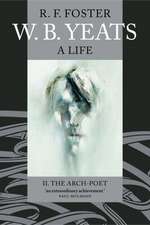 W. B. Yeats: A Life II: The Arch-Poet 1915-1939R. F. FosterPreț: 282.23 lei
 -
 W. B. Yeats, A Life I: The Apprentice Mage 1865-1914R. F. Foster-12%Preț: 274.67 lei311.27 lei
 -
 -36%Preț: 558.85 lei873.15 lei
 -
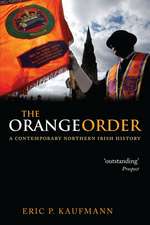 The Orange Order: A Contemporary Northern Irish HistoryEric P. Kaufmann-14%Preț: 275.00 lei318.09 lei
 -
 The English ConstitutionWalter Bagehot-21%Preț: 49.01 lei61.65 lei
 -
 Food in Medieval England: Diet and NutritionC. M. Woolgar-20%Preț: 404.47 lei504.65 lei
 -
 Contested Island: Ireland 1460-1630S. J. Connolly-12%Preț: 366.30 lei416.93 lei
 -
 -8%Preț: 348.07 lei380.20 lei
 -
 -31%Preț: 386.67 lei561.02 lei
 -
 Divided Kingdom: Ireland 1630-1800S. J. Connolly-22%Preț: 338.08 lei430.85 lei
 -
 The Poetry of Derek MahonHugh Haughton-9%Preț: 339.24 lei372.57 lei
 -
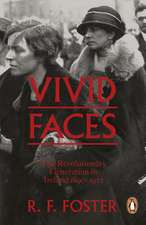 Vivid Faces: The Revolutionary Generation in Ireland, 1890-1923Professor R F FosterPreț: 90.39 lei
 -
 The Lost ImperialistAndrew Gailey-27%Preț: 75.02 lei103.32 lei
 -
 Charles Dickens and His CircleLucinda HawksleyPreț: 102.79 lei
Notă biografică
R.F.
Foster
is
Carroll
Professor
of
Irish
History
at
Oxford
University.
His
books
include
MODERN
IRELAND
1600-1972
and
the
first
volume
of
W.B.
YEATS:
A
LIFE.
In
2000
he
was
a
Booker
Prize
judge.
THE
IRISH
STORY
was
shortlisted
for
the
2001
Orwell
Prize.
Descriere
Descriere de la o altă ediție sau format:
Roy Foster is one of the leaders of the iconoclastic generation of Irish historians. In this opinionated, entertaining book he examines how the Irish have written, understood, used, and misused their history over the past century. Foster argues that, over the centuries, Irish experience itself has been turned into story. He examines how and why the key moments of Ireland's past--the 1798 Rising, the Famine, the Celtic Revival, Easter 1916, the Troubles--have been worked into narratives, drawing on Ireland's powerful oral culture, on elements of myth, folklore, ghost stories and romance. The result of this constant reinterpretation is a shifting "Story of Ireland," complete with plot, drama, suspense, and revelation. Varied, surprising, and funny, the interlinked essays in The Irish Story examine the stories that people tell each other in Ireland and why. Foster provides an unsparing view of the way Irish history is manipulated for political ends and that Irish misfortunes are sentimentalized and packaged. He offers incisive readings of writers from Standish O'Grady to Trollope and Bowen; dissects the Irish government's commemoration of the 1798 uprising; and bitingly critiques the memoirs of Gerry Adams and Frank McCourt. Fittingly, as the acclaimed biographer of Yeats, Foster explores the poet's complex understanding of the Irish story--"the mystery play of devils and angels which we call our national history"--and warns of the dangers of turning Ireland into a historical theme park. The Irish Story will be hailed by some, attacked by others, but for all who care about Irish history and literature, it will be essential reading.
Roy Foster is one of the leaders of the iconoclastic generation of Irish historians. In this opinionated, entertaining book he examines how the Irish have written, understood, used, and misused their history over the past century. Foster argues that, over the centuries, Irish experience itself has been turned into story. He examines how and why the key moments of Ireland's past--the 1798 Rising, the Famine, the Celtic Revival, Easter 1916, the Troubles--have been worked into narratives, drawing on Ireland's powerful oral culture, on elements of myth, folklore, ghost stories and romance. The result of this constant reinterpretation is a shifting "Story of Ireland," complete with plot, drama, suspense, and revelation. Varied, surprising, and funny, the interlinked essays in The Irish Story examine the stories that people tell each other in Ireland and why. Foster provides an unsparing view of the way Irish history is manipulated for political ends and that Irish misfortunes are sentimentalized and packaged. He offers incisive readings of writers from Standish O'Grady to Trollope and Bowen; dissects the Irish government's commemoration of the 1798 uprising; and bitingly critiques the memoirs of Gerry Adams and Frank McCourt. Fittingly, as the acclaimed biographer of Yeats, Foster explores the poet's complex understanding of the Irish story--"the mystery play of devils and angels which we call our national history"--and warns of the dangers of turning Ireland into a historical theme park. The Irish Story will be hailed by some, attacked by others, but for all who care about Irish history and literature, it will be essential reading.
Recenzii
Reading Foster will sharpen your wits, leave you less likely to be duped by a story simply because it's told with a brogue.
Erudite and acerbic
Interesting, suggestive, mostly urbane, sometimes scathing.
Foster is a formidably funny and exciting writer, and it is a joy to watch as he charmingly herds each sacred cow to the slaughter.
Foster's superb portrait of the essayist Hubert Butler evokes an Irish Orwell; someone who for 60 years, at times reviled and at others ignored, spoke subtle, lucid truth.... Foster eviscerates what he sees as the cramping of the past in memoirs by Frank McCourt and Gerry Adams.... What Foster is really going after is not politics but a way of thinking and writing 'for an audience in search of reaffirmation rather than dislocation
Roy Foster is one of the most elegant and probing writers on Irish topics and also one of the most controversial. In Ireland itself, where history matters, Foster attracts Cornel West-scale publicity. He's the leading figure in a generation of 'revisionist' historians who have chipped away at what they describe as Irish myths. American readers are about to get a fresh taste of his stiletto pen and icon-smashing habits when his latest book, 'The Irish Story' hits these shores.
The outpouring of literature from Ireland has ever been enormous, and nothing seems to stem it, or to reduce the excellence of the best of it. Occasionally, amid that plenitude there emerges a book that startles and provokes to the point of demanding extraordinary attention. Such a book is The Irish Story.... I can think of no book that more clearly, provocatively and intelligently delineates the important underlying contemporary truths of Ireland and the Irish than this insightful, courageous and splendid work.
Foster is a graceful stylist, a droll wit, and a serious scholar. For the student of Irish history, this volume of revisionist history is often refreshing in its genteel insolence and polite polemics. It provides a dozen thoughtful essays, many blending biography and literary criticism with skeptical scrutiny of traditional historiography.
The whole book is written in lively, colorful, and exact prose.... As Foster has ruefully reflected, his nation is 'too prone to mistake verbiage for eloquence, fanaticism for piety, and swagger for patriotism.' These are faults not particular to the Irish, although the Irish might be said to be especially spectacular in their use.
Interesting, suggestive, mostly urbane, sometimes scathing.... Foster...despises most of the acts of commemoration. He speaks of 'commercialized theme-park history' purveyed by 'commemoralist historians.' He is offended by officially sponsored bad taste and by what he regards, on the part of many of his professional colleagues, as bad history. Some of the episodes he recounts make for painful reading, especially if you are Irish. It is exasperating to find tragic acts and sufferings turned to commercial use by the Irish Tourist Board, the government and local politicians.
Foster's writing, which is lively and unsparing, has already inspired much commentary in the UK and in Ireland.
Erudite and acerbic
Interesting, suggestive, mostly urbane, sometimes scathing.
Foster is a formidably funny and exciting writer, and it is a joy to watch as he charmingly herds each sacred cow to the slaughter.
Foster's superb portrait of the essayist Hubert Butler evokes an Irish Orwell; someone who for 60 years, at times reviled and at others ignored, spoke subtle, lucid truth.... Foster eviscerates what he sees as the cramping of the past in memoirs by Frank McCourt and Gerry Adams.... What Foster is really going after is not politics but a way of thinking and writing 'for an audience in search of reaffirmation rather than dislocation
Roy Foster is one of the most elegant and probing writers on Irish topics and also one of the most controversial. In Ireland itself, where history matters, Foster attracts Cornel West-scale publicity. He's the leading figure in a generation of 'revisionist' historians who have chipped away at what they describe as Irish myths. American readers are about to get a fresh taste of his stiletto pen and icon-smashing habits when his latest book, 'The Irish Story' hits these shores.
The outpouring of literature from Ireland has ever been enormous, and nothing seems to stem it, or to reduce the excellence of the best of it. Occasionally, amid that plenitude there emerges a book that startles and provokes to the point of demanding extraordinary attention. Such a book is The Irish Story.... I can think of no book that more clearly, provocatively and intelligently delineates the important underlying contemporary truths of Ireland and the Irish than this insightful, courageous and splendid work.
Foster is a graceful stylist, a droll wit, and a serious scholar. For the student of Irish history, this volume of revisionist history is often refreshing in its genteel insolence and polite polemics. It provides a dozen thoughtful essays, many blending biography and literary criticism with skeptical scrutiny of traditional historiography.
The whole book is written in lively, colorful, and exact prose.... As Foster has ruefully reflected, his nation is 'too prone to mistake verbiage for eloquence, fanaticism for piety, and swagger for patriotism.' These are faults not particular to the Irish, although the Irish might be said to be especially spectacular in their use.
Interesting, suggestive, mostly urbane, sometimes scathing.... Foster...despises most of the acts of commemoration. He speaks of 'commercialized theme-park history' purveyed by 'commemoralist historians.' He is offended by officially sponsored bad taste and by what he regards, on the part of many of his professional colleagues, as bad history. Some of the episodes he recounts make for painful reading, especially if you are Irish. It is exasperating to find tragic acts and sufferings turned to commercial use by the Irish Tourist Board, the government and local politicians.
Foster's writing, which is lively and unsparing, has already inspired much commentary in the UK and in Ireland.