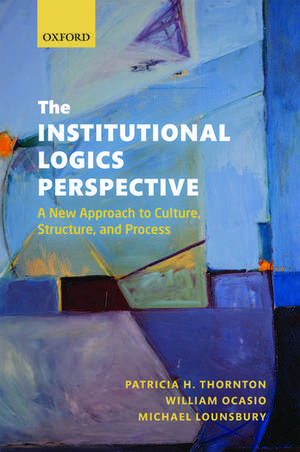
The Institutional Logics Perspective: A New Approach to Culture, Structure and Process
Autor Patricia H. Thornton, William Ocasio, Michael Lounsburyen Limba Engleză Paperback – 16 feb 2012
Preț: 365.21 lei
Preț vechi: 463.79 lei
-21%
Puncte Express: 548
Carte tipărită la comandă
Livrare economică 20 noiembrie-01 decembrie
Livrare prin curier în România Termenul estimat este afișat lângă disponibilitate.
Transport gratuit de la 400.00 lei Plată online sau ramburs, în funcție de opțiunile comenzii.
Retur gratuit în 14 zile Comandă securizată și suport în română.
Specificații
ISBN-13: 9780199601943
ISBN-10: 0199601941
Pagini: 248
Ilustrații: black & white illustrations, black & white tables, figures
Dimensiuni: 155 x 234 x 14 mm
Greutate: 0.4 kg
Editura: Oxford University Press
Colecția OUP Oxford
Locul publicării:Oxford, United Kingdom
ISBN-10: 0199601941
Pagini: 248
Ilustrații: black & white illustrations, black & white tables, figures
Dimensiuni: 155 x 234 x 14 mm
Greutate: 0.4 kg
Editura: Oxford University Press
Colecția OUP Oxford
Locul publicării:Oxford, United Kingdom
V-ar putea interesa
-
 Small Is BeautifulE F Schumacher-37%Preț: 58.04 lei92.61 lei
 -
 -21%Preț: 385.05 lei489.83 lei
 -
 Why We Need a New Welfare StateGøsta Esping-Andersen-19%Preț: 359.54 lei445.34 lei
 -
 -19%Preț: 373.03 lei457.82 lei
 -
 The Politics of Working LifePaul Edwards-19%Preț: 355.34 lei437.73 lei
 -
 -30%Preț: 533.20 lei765.87 lei
 -
 The Employment Relationship: Examining Psychological and Contextual PerspectivesJacqueline A-M. Coyle-Shapiro-28%Preț: 370.33 lei512.90 lei
 -
 The Changing Distribution of Earnings in OECD CountriesA. B. Atkinson-30%Preț: 584.58 lei840.47 lei
 -
 Reforming Early Retirement in Europe, Japan and the USABernhard Ebbinghaus-12%Preț: 272.47 lei310.49 lei
 -
 Styles of Organizing: The Will to FormGibson Burrell-22%Preț: 365.17 lei468.00 lei
 -
 The Oxford Handbook of Management ConsultingMatthias Kipping-19%Preț: 335.87 lei416.23 lei
 -
 Moral Mazes: The World of Corporate ManagersRobert Jackall-16%Preț: 188.53 lei224.99 lei
 -
 Work, Happiness, and UnhappinessPeter Warr-15%Preț: 591.33 lei695.68 lei
 -
 LondonlandBennett. SimonPreț: 146.55 lei
Recenzii
In The Institutional Logics Perspective, Thornton, Ocasio, and Lounsbury have crafted a foundational treatise that will be a touchstone for future inquiry on logics. As an explanation for how actors, actions, and context come together in organizational and institutional settings, the institutional logics perspective has found a broad and diverse audience; this book will only widen its appeal. The authors break fresh theoretical ground and offer a solid conceptual footing for the study of logics; as such, the book has much to recommend it.
No concept in the field of organization studies has been more promising than that of institutional logics and no concept has been more elusive, at times to the point of evanescence. The authors bring institutional logics down to earth, unpacking the concept, tracing its history and exploring its ambiguities, identifying its component parts, and giving each the close attention it deserves. This much-needed and well-conceived volume provides an invaluable service to students of institutions and organizational fields.
The Institutional Logics Perspective is an essential road map to and program for the future development of theories of institutional logic. Thornton, Ocasio, and Lounsbury offer a host of uncharted, under-theorized, unthought, and unexplored causal mechanisms linking the macro and the micro, practice and interaction, value and identity. The authors lay out the inter-institutional system, the doubleness of rationality, the cultural contingency of interest, the ideality of material practice, and the ways in which we have mistakenly assumed that institution effaces agency and hence politics. We are going to have to think and work this text for a while.
Over the past generation, neoinstitutional theory has become perhaps the dominant perspective in the sociology of organizations. The institutional logics perspective has became an intriguing alternative that seeks to encompass and extend the insights of neoinstitutionalism to both lower and higher units of analysis. This book goes farther than any prior work in advancing the institutional logics perspective.
This book is a must-read. Thornton, Ocasio and Lounsbury take stock, in a poised and systematic manner, of what has been achieved so far by the Institutional Logics perspective. They also point to what remains to be done. Building on a rich heritage, the Institutional Logics perspective threads the path to new and exciting frontiers a multi-levels theory of institutions, the stabilization of solid micro-foundations, a refreshing return to history and the exploration of the dynamics of identities. The agenda is attractive and this book develops a highly useful road map.
No concept in the field of organization studies has been more promising than that of institutional logics and no concept has been more elusive, at times to the point of evanescence. The authors bring institutional logics down to earth, unpacking the concept, tracing its history and exploring its ambiguities, identifying its component parts, and giving each the close attention it deserves. This much-needed and well-conceived volume provides an invaluable service to students of institutions and organizational fields.
The Institutional Logics Perspective is an essential road map to and program for the future development of theories of institutional logic. Thornton, Ocasio, and Lounsbury offer a host of uncharted, under-theorized, unthought, and unexplored causal mechanisms linking the macro and the micro, practice and interaction, value and identity. The authors lay out the inter-institutional system, the doubleness of rationality, the cultural contingency of interest, the ideality of material practice, and the ways in which we have mistakenly assumed that institution effaces agency and hence politics. We are going to have to think and work this text for a while.
Over the past generation, neoinstitutional theory has become perhaps the dominant perspective in the sociology of organizations. The institutional logics perspective has became an intriguing alternative that seeks to encompass and extend the insights of neoinstitutionalism to both lower and higher units of analysis. This book goes farther than any prior work in advancing the institutional logics perspective.
This book is a must-read. Thornton, Ocasio and Lounsbury take stock, in a poised and systematic manner, of what has been achieved so far by the Institutional Logics perspective. They also point to what remains to be done. Building on a rich heritage, the Institutional Logics perspective threads the path to new and exciting frontiers a multi-levels theory of institutions, the stabilization of solid micro-foundations, a refreshing return to history and the exploration of the dynamics of identities. The agenda is attractive and this book develops a highly useful road map.
Notă biografică
Patricia Thornton is Adjunct Professor affiliated with the Centre for Innovation and Entrepreneurship at Duke University Fuqua School of Business and affiliated faculty to the Program on Organizations, Business, and the Economy, Department of Sociology, Stanford University. Her research focuses on institutional and organizational change, innovation and entrepreneurship, and institutional logics and strategic management. Her book, Markets from Culture: Institutional Logics and Organizational Decisions, (Stanford University Press) was published in 2004. She received her Ph.D. in 1993 in Sociology from Stanford University.William Ocasio is the John L. and Helen Kellogg Distinguished Professor of Management and Organizations at the Kellogg School of Management, and Professor of Sociology, by Courtesy, Northwestern University. In addition to institutional logics, his research focuses on attention, vocabularies, and strategy processes in organizations and institutional fields. Currently he is Senior Editor at Organization Science. He received his Ph.D. in 1992 in Organizational Behavior from Stanford University.Michael Lounsbury is a Professor, Thornton A. Graham Chair, and Associate Dean of Research at the University of Alberta School of Business. He is also a Principal Investigator at the National Institute of Nanotechnology. His research focuses on institutional emergence and change, entrepreneurship, and the cultural dynamics of organizations and practice. He serves on a number of editorial boards and is the Series Editor of Research in the Sociology of Organizations, Associate Editor of Academy of Management Annals, as well as Co-Editor of Organization Studies. He received his Ph.D. in 1999 from Northwestern University in Sociology and Organizational Behavior.
Cuprins
- 1: Introduction to the Institutional Logics Perspective
- 2: Precursors to the Institutional Logics Perspective
- 3: Defining the Inter-institutional System
- 4: The Emergence, Stability and Change of the Inter-institutional System
- 5: Micro-Foundations of Institutional Logics
- 6: The Dynamics of Organizational Practices and Identities
- 7: The Emergence and Evolution of Field-Level Logics
- 8: Implications for Future Research