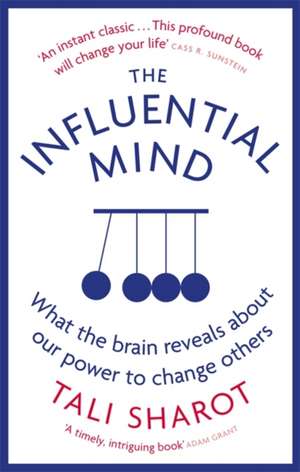
The Influential Mind: What the Brain Reveals About Our Power to Change Others
Autor Tali Sharoten Limba Engleză Paperback – 2 aug 2018
În activitatea cotidiană, fie că suntem în sala de clasă, în consiliul de administrație sau pe rețelele sociale, exercităm constant influență asupra celor din jur. Totuși, The Influential Mind pornește de la o premisă contraintuitivă: cele mai multe dintre instinctele noastre de persuasiune — cum ar fi prezentarea datelor brute sau corectarea agresivă a interlocutorului — eșuează deoarece sunt incompatibile cu funcționarea biologică a creierului. Recomandăm această lucrare pentru modul în care reușește să transforme cercetarea fundamentală în strategii de comunicare aplicabile, demonstrând că succesul în schimbarea convingerilor depinde de alinierea mesajului cu elementele ce guvernează mintea umană. Structura volumului este riguroasă, debutând cu analiza modului în care confirmarea ne distorsionează percepția asupra dovezilor și continuând cu explorarea rolului vital al emoțiilor și al agenției personale în luarea deciziilor. Autorul dedică secțiuni importante modului în care stresul afectează capacitatea de procesare și importanței învățării sociale. Considerăm că această abordare completează perspectiva oferită de Influence de Jenny Nabben, adăugând o bază neuroștiințifică solidă acolo unde alte manuale se rezumă la tehnici practice de comunicare. Spre deosebire de alte titluri axate pe manipulare, Tali Sharot pune accentul pe înțelegerea mecanismelor de curiozitate și pe valoarea informației. Această lucrare se înscrie natural în opera autorului, rafinând temele explorate în The Optimism Bias. Dacă în lucrările anterioare Sharot analiza tendința creierului de a menține o viziune pozitivă, aici extinde analiza către exterior, investigând modul în care aceste mecanisme interne ne definesc interacțiunile sociale. Textul este lucid, ancorat în experimente de laborator și studii de caz, fiind esențial pentru înțelegerea puterii de schimbare într-o lume saturată de informație.
Preț: 59.09 lei
Preț vechi: 79.32 lei
-26%
Carte disponibilă
Livrare economică 14-28 noiembrie
Livrare express 03-07 noiembrie pentru 41.18 lei
Specificații
ISBN-10: 0349140634
Pagini: 256
Dimensiuni: 134 x 200 x 19 mm
Greutate: 0.23 kg
Editura: Little Brown
Colecția Abacus
Locul publicării:London, United Kingdom
V-ar putea interesa
-
 Stumbling on HappinessDaniel GilbertPreț: 79.45 lei
 -
 -10%Preț: 136.35 lei151.56 lei
 -
 Sapiens: A Brief History of Human KindYuval Noah Harari-17%Preț: 80.04 lei95.89 lei
 -
 Enlightenment NowSteven Pinker-27%Preț: 89.30 lei122.81 lei
 -
 The Road to CharacterDavid Brooks-30%Preț: 65.22 lei93.30 lei
 -
 Descartes' ErrorAntonio DamasioPreț: 104.18 lei
 -
 -25%Preț: 101.85 lei136.71 lei
 -
 The Power of MythBill MoyersPreț: 109.52 lei
 -
 Maps of Meaning: The Architecture of BeliefJordan B. PetersonPreț: 303.26 lei
 -
 -16%Preț: 112.14 lei133.54 lei
 -
 The ArgonautsMaggie Nelson-18%Preț: 64.58 lei78.87 lei
 -
 Confessions of a Public SpeakerScott BerkunPreț: 137.80 lei
 -
 The As If PrincipleRichard WisemanPreț: 121.20 lei
 -
 The Strange Death of Europe: Immigration, Identity, IslamDouglas Murray-26%Preț: 79.85 lei107.59 lei
 -
 -27%Preț: 68.12 lei93.00 lei
 -
 Principles: Life and WorkRay Dalio-21%Preț: 175.17 lei221.01 lei
 -
 -39%Preț: 124.93 lei205.47 lei
 -
 Untamed: Stop pleasing, start livingGlennon Doyle-27%Preț: 89.52 lei122.52 lei
 -
 -30%Preț: 65.75 lei93.44 lei
 -
 -16%Preț: 80.33 lei96.03 lei
 -
 The Power of HabitCharles DuhiggPreț: 86.85 lei
 -
 MindsightDaniel J. Siegel-20%Preț: 75.82 lei94.78 lei
 -
 MeditationsMarcus AureliusPreț: 44.79 lei
 -
 Gândire rapidă, gândire lentăDaniel KahnemanPreț: 99.00 lei
De ce să citești această carte
Recomandăm această carte profesioniștilor, educatorilor și liderilor care doresc să înțeleagă de ce faptele singure nu reușesc să convingă. Cititorul va câștiga o perspectivă științifică asupra modului în care emoțiile și controlul personal influențează deciziile, învățând să evite capcanele comunicării ineficiente. Este un ghid indispensabil pentru oricine vrea să genereze o schimbare reală de comportament, bazându-se pe modul în care creierul procesează realitatea.
Despre autor
Tali Sharot este profesor de neuroștiințe și psihologie la University College London, unde conduce Affective Brain Lab, și cercetător în cadrul Wellcome Trust. Cu studii la Universitatea din New York, Sharot a devenit o voce autorizată în domeniul neuroștiințelor cognitive, publicând în reviste de prestigiu precum Nature și Science. Este cunoscută la nivel internațional pentru studiile sale despre optimism, memoria emoțională și disonanța cognitivă, fiind distinsă cu premii importante, inclusiv British Psychological Society Book Award pentru volumul său de debut. Experiența sa academică este completată de prezențe constante ca speaker TED și colaborări cu publicații precum Time și The New York Times.
Descriere
Selected as a best book of 2017 by Forbes, The Times, Huffington Post, Bloomberg, Greater Good Magazine, Stanford Business School and more. 'A timely, intriguing book' Adam Grant, New York Times bestselling author of Originals and Give and Take'This profound book will change your life. An instant classic' Cass R.
Sunstein, bestselling co-author of NudgePart of our daily job as humans is to influence others; we teach our children, guide our patients, advise our clients, help our friends and inform our online followers. We do this because we each have unique experiences and knowledge that others may not. But how good are we at this role? It turns out we systematically fall back on suboptimal habits when trying to change other's beliefs and behaviors.
Many of these instincts-from trying to scare people into action, to insisting the other is wrong or attempting to exert control-are ineffective, because they are incompatible with how the mind operates.
Recenzii
'This book is not only a primer on persuasion; it is far more valuable than that. It explains why so many of our well-meaning attempts to change people's minds can backfire so badly' RORY SUTHERLAND, VICE CHAIRMAN, OGLIVY & MATHER
Part of our daily job as humans is to influence others; we teach our children, guide our patients, advise our clients, help our friends and inform our online followers. But how good are we at this role? The Influential Mind shows how we systematically fall back on sub-optimal habits when trying to change others' beliefs and behaviours. Many of these instincts are ineffective, because they are incompatible with how the mind operates.
'A witty survey of techniques to influence and guide human behavior' New York Times Book Review
'Advertising, politics, education - any juxtaposition of human and message involves influence. But why might a patently ill-informed demagogue sway more people than a scientist? In this perceptive study, cognitive neuroscientist Tali Sharot isolates seven factors central to influence' Nature
Better facts tend to be counterproductive on hot-button issues like gun control. As Tali Sharot notes in her book The Influential Mind . . . The smarter a person is, the greater his or her ability to rationalize and reinterpret discordant information, and the greater the polarizing boomerang effect is likely to be
In the age of big data, it's easy to assume that cold, hard facts can drive change. Not so fast, argues cognitive scientist Tali Sharot, whose new book, The Influential Mind, explores how emotion tends to overpower reason when it comes to human decision-making
The Influential Mind will make you gasp with surprise - and laugh with recognition. Many of our most cherished beliefs about how to influence others turn out to be wrong; Sharot sets them right. Packed with practical insights, this profound book will change your life. An instant classic
Take it from a leading neuroscientist: every day, we all miss opportunities to influence others. This timely, intriguing book explains why it's so difficult to shift the attitudes and actions of others - and what we can do about it
This brilliant and timely book is essential reading for anyone who wants an intelligent, principled guide to getting their ideas heard and their hopes fulfilled. If you follow Tali Sharot's scientifically-backed guidance, you'll become one of those great communicators and changemakers that everyone raves about - persuasive and inspirational in equal measure
This book not only a primer on persuasion; it is far more valuable than that. It explains why so many of our well-meaning attempts to change people's minds can backfire so badly. Trump haters take note
Lucid and engaging . . . Sharot's treatment is particularly valuable for its balance between accessibility to the reader and solid grounding in scientific research. In today's "posttruth" environment, her efforts to increase awareness of the pitfalls of human reasoning, and how to overcome them, are an indispensable contribution from the coalface of cognitive scientific research
The Influential Mind covers the topic more fully and more authoritatively in a book whose title gives appropriately equal billing to thought, behavior and neurons . . . A witty survey of techniques to influence and guide human behavior
Advertising, politics, education - any juxtaposition of human and message involves influence. But why might a patently ill-informed demagogue sway more people than a scientist? In this perceptive study, cognitive neuroscientist Tali Sharot isolates seven factors central to influence
A fantastic journey through the process of forming beliefs and ideas
In the arena of behavioral science, little has held more potential than the streaking advances in behavioral neuroscience and little has stood to gain as much from those advances as the study of social influence. With The Influential Mind, Tali Sharot has offered an account that makes the connection in a way that is both instructive and engaging
With a scientist's vision and a writer's grace, Sharot unmasks the secrets of influence: how people make and change their minds-and why
The Influential Mind brilliantly unpacks the science of influence, offering guidance not only on how to influence others - but how to stop others from influencing us
Concisely written, compellingly presented, and eminently applicable
In every chapter of this book about social psychology, its neuroscientist author manages an insightful and discomforting observation about the human mind
Cuprins
1. (Priors) Does Evidence Change Beliefs? -- The Power of Confirmation and the Weakness of Data
2. (Emotion) How We Were Persuaded to Reach for the Moon -- The Incredible Sway of Emotion
3. (Incentives) Should You Scare People into Action? -- Moving with Pleasure and Freezing with Fear
4. (Agency) How You Obtain Power by Letting Go -- The Joy of Agency and the Fear of Losing Control
5. (Curiosity) What Do People Really Want to Know? -- The Value of Information and the Burden of Knowledge
6. (State) What Happens to Minds Under Threat? -- The Influence of Stress and the Ability of Overcome
7. (Others, part I) Why Do Babies Love iPhones? -- The Strength of Social Learning and the Pursuit of Uniqueness
8. (Others, part II) Is "Unanimous" as Reassuring as It Sounds? -- How to Find Answers in an Unwise Crowd
9. The Future of Influence? -- Your Mind in My Body