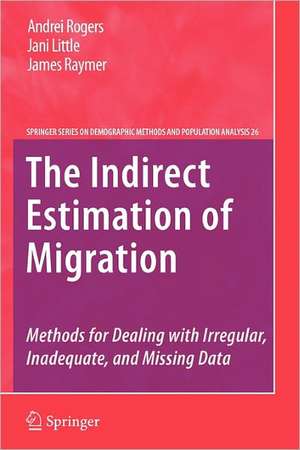
The Indirect Estimation of Migration
Autor Andrei Rogers, Jani Little, James Raymeren Limba Engleză Paperback – 30 noi 2010
| Toate formatele și edițiile | Preț | Express |
|---|---|---|
| Paperback (1) | 740.93 lei 6-8 săpt. | |
| Springer – 30 noi 2010 | 740.93 lei 6-8 săpt. | |
| Hardback (1) | 611.09 lei 6-8 săpt. | |
| SPRINGER NETHERLANDS – 5 iul 2010 | 611.09 lei 6-8 săpt. |
Preț: 740.93 lei
Preț vechi: 903.57 lei
-18% Nou
Puncte Express: 1111
Preț estimativ în valută:
131.16€ • 152.51$ • 114.60£
131.16€ • 152.51$ • 114.60£
Carte tipărită la comandă
Livrare economică 22 ianuarie-05 februarie 26
Preluare comenzi: 021 569.72.76
Specificații
ISBN-13: 9789400704510
ISBN-10: 9400704518
Pagini: 170
Ilustrații: XIV, 170 p.
Dimensiuni: 156 x 233 x 20 mm
Greutate: 0.27 kg
Ediția:2010 edition
Editura: Springer
Locul publicării:Dordrecht, Netherlands
ISBN-10: 9400704518
Pagini: 170
Ilustrații: XIV, 170 p.
Dimensiuni: 156 x 233 x 20 mm
Greutate: 0.27 kg
Ediția:2010 edition
Editura: Springer
Locul publicării:Dordrecht, Netherlands
V-ar putea interesa
-
 -23%Preț: 592.94 lei770.05 lei
 -
 Ronald Reagan and the Politics of Immigration ReformNicholas Laham-41%Preț: 451.59 lei766.43 lei
 -
 -18%Preț: 1066.52 lei1300.63 lei
 -
 Preț: 427.88 lei
 -
 -15%Preț: 410.08 lei482.44 lei
 -
 Preț: 215.40 lei
 -
 Migrant Marginality: A Transnational PerspectivePhilip Kretsedemas-18%Preț: 1124.62 lei1371.48 lei
 -
 Preț: 109.34 lei
 -
 BracerosDeborah CohenPreț: 276.90 lei
 -
 Intimate MigrationsDeborah A BoehmPreț: 240.06 lei
 -
 Walls: Travels Along the BarricadesMarcello DicintioPreț: 97.25 lei
 -
 Preț: 364.71 lei
 -
 Demographic Aspects of MigrationThomas SalzmannPreț: 373.60 lei
 -
 Women, Migration, and Conflict: Breaking a Deadly CycleSusan Forbes Martin-15%Preț: 620.55 lei730.06 lei
 -
 -15%Preț: 624.95 lei735.24 lei
 -
 Preț: 220.37 lei
 -
 A Life-Course Perspective on Migration and IntegrationMatthias Wingens-15%Preț: 622.11 lei731.90 lei
 -
 -15%Preț: 612.05 lei720.07 lei
 -
 American Jewish Year Book 2012Arnold Dashefsky-18%Preț: 928.63 lei1132.47 lei
 -
 -20%Preț: 615.17 lei768.96 lei
 -
 -18%Preț: 913.75 lei1114.33 lei
 -
 International Handbook of Migration and Population DistributionMichael J. White-18%Preț: 1775.25 lei2164.93 lei
 -
 -18%Preț: 906.34 lei1105.29 lei
 -
 -15%Preț: 615.05 lei723.59 lei
Public țintă
ResearchCuprins
Describing Age Structures of Migration.- Describing Spatial Structures of Migration.- Smoothing Age and Spatial Patterns.- Imposing Age and Spatial Patterns.- Inferring Age and Spatial Patterns.- Conclusion.
Recenzii
From the reviews:
“The book contains much of interest to established researchers, but it should also prove helpful to those new to the area of migration modelling given its lucid descriptions of methods, simple examples and an accompanying website which contains data and programs. … this is an impressive volume. … The Indirect Estimation of Migration should provide an excellent reference for any researcher or practitioner involved in migration and projections research who has to deal with imperfect migration data.” (Tom Wilson, Journal of Population Research, Vol. 27, 2010)
“The book contains much of interest to established researchers, but it should also prove helpful to those new to the area of migration modelling given its lucid descriptions of methods, simple examples and an accompanying website which contains data and programs. … this is an impressive volume. … The Indirect Estimation of Migration should provide an excellent reference for any researcher or practitioner involved in migration and projections research who has to deal with imperfect migration data.” (Tom Wilson, Journal of Population Research, Vol. 27, 2010)
Textul de pe ultima copertă
This unique book introduces an essential element in applied demographic analysis: a tool-kit for describing, smoothing, repairing and - in instances of totally missing data - inferring directional migration flows. Migration rates combine with fertility and mortality rates to shape the evolution of human populations. Demographers have found that all three generally exhibit persistent regularities in their age and spatial patterns, when changing levels are controlled for. Drawing on statistical descriptions of such regularities, it is often possible to improve the quality of the available data by smoothing irregular data, imposing the structures of borrowed and related data on unreliable data, and estimating missing data by indirect methods. Model migration schedules and log-linear models are presented as powerful methods for helping population researchers, historical demographers, geographers, and migration analysts work with the data available to them.
Caracteristici
Converts irregular sample data into smooth and more valid migration patterns Combines various migration data together to provide a more complete and accurate picture of population movements Fills in the gaps found in historical censuses that lack a migration question as well as the migration data from data poor developing countries