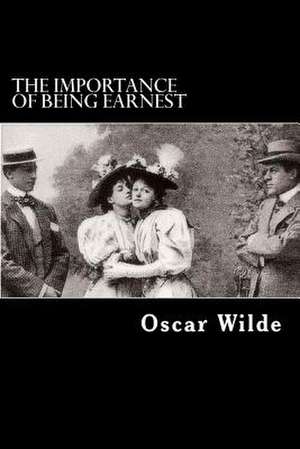
The Importance of Being Earnest
Autor Oscar Wilde Ilustrat de Alex Struiken Limba Engleză Paperback
Ne-a atras atenția, încă de la primele pagini, dualitatea fascinantă a acestui volum: pe de o parte, strălucirea acidă a saloanelor victoriene, iar pe de altă parte, umbra densă a simbolismului din Salome. Această piesă, scrisă inițial în limba franceză și interzisă de cenzura vremii, oferă un contrast visceral față de ușurătatea aparentă a celorlalte scrieri. Apreciem modul în care Oscar Wilde reușește să transforme conversatia mondenă într-o armă de disecție a moralității și a politicii de gen, fără a-și pierde niciun moment eleganța stilistică. Atmosfera te trimite cu gândul la The Best of Oscar Wilde, deși selecția de față pune un accent mai puternic pe tranziția autorului de la esteticismul pur la critica socială ascuțită. Dacă în The Picture of Dorian Gray explorarea decadenței era una introspectivă și tragică, aici, în piese precum The Importance of Being Earnest, Wilde alege satira și farsa pentru a demasca ipocrizia societății. Ritmul este alert, susținut de epigramisme care au rămas la fel de proaspete și astăzi, iar structura dramatică trădează geniul unui autor care a dominat scena londoneză a anilor 1890. Este o experiență de lectură care navighează între râsul complice și reflecția sobră asupra măștilor pe care le purtăm în public.
Preț: 57.54 lei
Carte disponibilă
Livrare economică 09-23 noiembrie
Specificații
ISBN-10: 1480098299
Pagini: 102
Dimensiuni: 152 x 229 x 5 mm
Greutate: 0.15 kg
Editura: CreateSpace Independent Publishing Platform
V-ar putea interesa
-
 The Picture of Dorian GrayOscar WildePreț: 28.01 lei
 -
 XCLASSICS-LEAVES OF GRASS PBWalt WhitmanPreț: 28.98 lei
 -
 -13%Preț: 133.58 lei153.68 lei
 -
 -15%Preț: 125.81 lei148.74 lei
 -
 -14%Preț: 112.17 lei130.14 lei
 -
 The Narrative of Trajan's ColumnItalo Calvino-21%Preț: 43.86 lei55.43 lei
 -
 The Freedom to Be FreeHannah Arendt-20%Preț: 45.13 lei56.53 lei
 -
 Being HappyEpicurus-21%Preț: 44.52 lei56.19 lei
 -
 Preț: 24.96 lei
 -
 The PrinceNiccolò MachiavelliPreț: 21.63 lei
 -
 Romeo & JulietWilliam Shakespeare-19%Preț: 20.29 lei24.96 lei
 -
 Preț: 38.44 lei
 -
 100 Best-Loved PoemsPhilip Smith-18%Preț: 23.62 lei28.88 lei
 -
 Today Everything ChangesAndy McNab-35%Preț: 22.99 lei35.16 lei
 -
 The Catcher in the Rye. InterpretationshilfeNigel TookeyPreț: 45.75 lei
 -
 Kokoro YogaMark DivinePreț: 112.65 lei
 -
 Preț: 175.52 lei
 -
 UlyssesJames JoycePreț: 41.38 lei
 -
 Finnegans WakeJames JoycePreț: 40.75 lei
 -
 The Classic Yoga Bible: Godsfield BiblesChristina Brown-23%Preț: 96.37 lei125.93 lei
 -
 A Portrait of the Artist as a Young ManJames JoycePreț: 36.70 lei
 -
 Les Fleurs du MalCharles BaudelairePreț: 54.46 lei
 -
 HokusaiOlaf MextorfPreț: 83.96 lei
De ce să citești această carte
Recomandăm acest volum celor care doresc să descopere spiritul ludic și critic al lui Wilde dincolo de proza sa celebră. Cititorul câștigă acces la o ediție academică riguroasă, care clarifică nuanțele epocii victoriene prin adnotări detaliate. Este o lectură esențială pentru oricine apreciază umorul inteligent, jocurile de cuvinte sclipitoare și critica socială deghizată în divertisment de înaltă clasă.
Despre autor
Oscar Wilde (1854–1900) a fost un scriitor, poet și dramaturg irlandez, devenit una dintre cele mai emblematice figuri ale estetismului și decadenței din secolul al XIX-lea. Format la Trinity College Dublin și Oxford, Wilde s-a remarcat prin inteligența sa sclipitoare și stilul de viață extravagant. Deși este autorul celebrului roman The Picture of Dorian Gray, gloria sa absolută a venit prin piesele de teatru care au redefinit comedia engleză. Cariera sa a fost întreruptă tragic de condamnarea pentru „indecență gravă”, experiență care i-a marcat ultimii ani de viață și opera târzie.
Descriere scurtă
Descriere
The Importance of Being Earnest marks a central moment in late-Victorian literature, not only for its wit but also for its role in the shift from a Victorian to a Modern consciousness. The play began its career as a biting satire directed at the very audience who received it so delightedly, but ended its initial run as a harbinger of Wilde’s personal downfall when his lover’s father, who would later bring about Wilde’s arrest and imprisonment, attempted to disrupt the production.
In addition to its focus on the textual history of the play, this Broadview Edition of Earnest provides a wide array of appendices. The edition locates Wilde’s work among the artistic and cultural contexts of the late nineteenth century and will provide scholars, students, and general readers with an important sourcebook for the play and the social, creative, and critical contexts of mid-1890s English life.
Textul de pe ultima copertă
Notă biografică
Wilde's parents were successful Anglo-Irish intellectuals in Dublin. Their son became fluent in French and German early in life. At university, Wilde read Greats; he proved himself to be an outstanding classicist, first at Trinity College Dublin, then at Oxford. He became known for his involvement in the rising philosophy of aestheticism, led by two of his tutors, Walter Pater and John Ruskin. After university, Wilde moved to London into fashionable cultural and social circles.
As a spokesman for aestheticism, he tried his hand at various literary activities: he published a book of poems, lectured in the United States and Canada on the new "English Renaissance in Art" and interior decoration, and then returned to London where he worked prolifically as a journalist. Known for his biting wit, flamboyant dress and glittering conversational skill, Wilde became one of the best-known personalities of his day. At the turn of the 1890s, he refined his ideas about the supremacy of art in a series of dialogues and essays, and incorporated themes of decadence, duplicity, and beauty into what would be his only novel, The Picture of Dorian Gray(1890). The opportunity to construct aesthetic details precisely, and combine them with larger social themes, drew Wilde to write drama. He wrote Salome (1891) in French while in Paris but it was refused a licence for England due to an absolute prohibition on the portrayal of Biblical subjects on the English stage. Unperturbed, Wilde produced four society comedies in the early 1890s, which made him one of the most successful playwrights of late-Victorian London.
At the height of his fame and success, while The Importance of Being Earnest (1895) was still being performed in London, Wilde had the Marquess of Queensberry prosecuted for criminal libel. The Marquess was the father of Wilde's lover, Lord Alfred Douglas. The libel trial unearthed evidence that caused Wilde to drop his charges and led to his own arrest and trial for gross indecency with men.
Cuprins
Introduction
Oscar Wilde: A Brief Chronology
A Note on the Text
The Importance of Being Earnest:
A Trivial Comedy for Serious People
Appendix A: Playbills for The Importance of Being Earnest (1895)
- The First, Uncensored Playbill
- The Second, Censored Playbill
- From The Daily Graphic (15 February 1895)
- From William Archer, The World (20 February 1895)
- From The Observer (17 February 1895)
- From The Times (15 February 1895)
- From Bernard Shaw, Saturday Review (1895)
- From Max Beerbohm, Around Theatres (1902)
- Ada Leverson, “The Advisability of Not Being Brought Up in a Handbag,” Punch; or,The London Charivari (2 March 1895)
- Telegram from Oscar Wilde to Ada Leverson (15 February 1895)
- From W.S. Gilbert and Arthur Sullivan, Patience; or, Bunthorne’s Bride (1881)
- From W.S. Gilbert and Arthur Sullivan, The Gondoliers; or, The King of Barataria (1889)
- From W.S. Gilbert and Arthur Sullivan, HMS Pinafore; or, The Lass That Loved a Sailor (1878)
Appendix F: Conduct Manuals
- From Mrs. Humphrey, Manners for Men (1897)
- From Julia McNair Wright, Practical Life; or,Ways andMeans for Developing Character and Resources (1881)
- From Charles Kendrick, Ye Soul Agonies in Ye Life of Oscar Wilde (1882)
- George Frederick Keller, “The Modern Messiah,” Wasp (31 March 1882)
- Linley Sambourne, “O.W. [Punch’s Fancy Portraits 37],” Punch; or,The London Charivari (25 June 1881)
- From Lloyd Lewis and Henry Justin Smith, “No Wave of His Chiseled Hand” (1936)
- “Aestheticism as Oscar Understands It” (1882)
- “Mr. Wild [sic] of Borneo” (1882)
- W.H. Beard, “The Aesthetic Monkey” (1882)
- From “A Few Maxims for the Instruction of the Over-Educated” (1894)
- From “Phrases and Philosophies for the Use of the Young” (1894)
- From “Preface,” The Picture of Dorian Gray (1891)
- From “The Decay of Lying” (1889)
- From De Profundis (1897; published 1962)
- Letter to Philip Houghton (February 1894)
- Letter to George Alexander (July 1894)
- Letter to George Alexander (September 1894)
- Letter to George Alexander (October 1894)
- Letter to an Unidentified Correspondent (February 1895)
- Letter to Lord Alfred Douglas (February 1895)
- Letter to R.V. Shone (February 1895)
- Passages Regarding Algernon’s and Ernest’s Past-due Accounts
- Passages Illuminating the Characters and Roles of Miss Prism and Canon Chasuble
- Additional Passages
Recenzii
In addition to its focus on the textual history of the play, this Broadview Edition of Earnest provides a wide array of appendices. The edition locates Wilde’s work among the artistic and cultural contexts of the late nineteenth century and will provide scholars, students, and general readers with an important sourcebook for the play and the social, creative, and critical contexts of mid-1890s English life.
“Samuel Lyndon Gladden’s edition of The Importance of Being Earnest continues Broadview Press’s proven tradition of excellence. This book will serve the undergraduate, general reader, and scholar. Gladden’s introduction is provocative, and the ancillary materials are especially welcome. Gladden balances familiar with unexpected contemporary works — from Gilbert and Sullivan to Ada Leverson, playbills to reviews, poems to pictures, conduct manuals to dandy tracts — plus excerpts of Wilde’s writings, including an earlier version of the play. Bibliography and chronology complete the presentation as one-stop shopping for an earnest acquaintance with Wilde’s charmer as social text.” — Frederick S. Roden, University of Connecticut
“Broadview’s Importance of Being Earnest carries on the press’s excellent series of texts for general readers and students alike. Samuel Lyndon Gladden presents the three-act text, as well as an appendix with important scenes and lines from the original four-act version. The volume includes many useful annotations and glosses, appendices with contextual information, illustrations, and extracts from letters and documents that will enhance understanding and interpretation of the play. The introduction places the play in up-to-date critical and biographical contexts, illuminating issues without closing down other approaches to making sense of Wilde’s carefully composed dramatic nonsense.” — Philip E. Smith, University of Pittsburgh