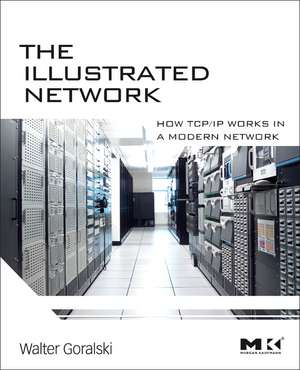
The Illustrated Network: How TCP/IP Works in a Modern Network
Autor Walter Goralskien Limba Engleză Hardback – 10 dec 2008
Problema fundamentală în învățarea rețelelor de calculatoare este adesea decalajul dintre teoria abstractă și comportamentul real al pachetelor pe echipamente de producție. Suntem de părere că The Illustrated Network rezolvă această deficiență prin adoptarea metodologiei practice consacrate de W. Richard Stevens, dar adaptată rigorilor tehnologice actuale. Ne-a atras atenția faptul că autorul nu se bazează pe simulări, ci pe date extrase dintr-o rețea fizică funcțională, oferind urme de diagnostic (traces) care permit vizualizarea precisă a modului în care protocoalele interacționează în timp real.
Complementar volumului TCP/IP Illustrated de Kevin Fall, care rămâne o referință academică solidă, The Illustrated Network acoperă zona critică a implementărilor moderne: securitatea ruterelor, rețelele optice cu corecție de erori (FEC) și tehnologiile de virtualizare precum EVPN și VXLAN. Structura cărții este riguros organizată în șase părți, pornind de la nivelul fizic și link-uri, trecând prin mecanismele de adresare IPv4 și IPv6, până la protocoale de rutare complexă (BGP, IS-IS) și servicii de aplicație.
În contextul operei sale, Walter Goralski continuă expertiza demonstrată în The Complete IS-IS Routing Protocol, păstrând predilecția pentru claritatea formatelor de date și extensibilitatea protocoalelor. Volumul de față integrează peste 330 de ilustrații tehnice, transformând concepte aride precum multiplexarea socket-urilor sau ierarhiile MPLS în procese vizuale ușor de urmărit. Abordarea este una neutră din punctul de vedere al furnizorilor, punând accent pe standarde și pe modul în care acestea sunt rulate pe sisteme de operare diverse, de la distribuții Linux la medii telco.
Preț: 428.24 lei
Preț vechi: 658.44 lei
-35%
Carte tipărită la comandă
Livrare economică 28 noiembrie-12 decembrie
Specificații
ISBN-10: 0123745411
Pagini: 832
Ilustrații: Approx. 280 illustrations
Dimensiuni: 191 x 235 x 48 mm
Greutate: 1.59 kg
Editura: ELSEVIER SCIENCE
V-ar putea interesa
-
 Computer Networks: A Systems ApproachLarry L. Peterson-41%Preț: 558.53 lei941.05 lei
 -
 Introduction to Networks Companion Guide (Ccnav7)Cisco Networking Academy-19%Preț: 579.09 lei714.92 lei
 -
 TCP/IP IllustratedKevin Fall-20%Preț: 403.13 lei503.92 lei
 -
 -20%Preț: 249.78 lei312.23 lei
 -
 -24%Preț: 432.06 lei571.07 lei
 -
 Data Communications and Networking with TCP/IP Protocol Suite ISEBehrouz A. Forouzan-38%Preț: 355.79 lei572.44 lei
 -
 Internetworking with TCP/IP, Volume 1Douglas Comer-13%Preț: 576.39 lei662.51 lei
 -
![Computer Networking [Global Edition]](https://i1.books-express.ro/bt/9781292405469/computer-networking-global-edition.jpg) Computer Networking [Global Edition]James Kurose-20%Preț: 655.16 lei818.95 lei
Computer Networking [Global Edition]James Kurose-20%Preț: 655.16 lei818.95 lei -
 Networking All-In-One for DummiesDoug Lowe-20%Preț: 258.11 lei322.63 lei
 -
 -20%Preț: 447.36 lei559.21 lei
 -
 The TCP/IP GuideCharles M. Kozierok-27%Preț: 498.01 lei686.90 lei
 -
 -35%Preț: 255.02 lei392.83 lei
 -
 CompTia Network+ 2009 in DepthTamara Dean-24%Preț: 510.16 lei670.68 lei
 -
 The Book of PF, 4th Edition: A No-Nonsense Guide to the OpenBSD FirewallPeter N.M. Hansteen-35%Preț: 282.41 lei437.64 lei
 -
 Packet Tracer for Young Beginning AdminsDamian Strojek-20%Preț: 260.34 lei325.42 lei
 -
 Packet Tracer for Young Intermediate AdminsDamian Strojek-20%Preț: 265.27 lei331.59 lei
 -
 Computer Networks in Packet Tracer for BeginnersDamian Strojek-20%Preț: 264.34 lei330.42 lei
 -
 Computer Networks in Packet Tracer for Intermediate UsersDamian Strojek-20%Preț: 265.31 lei331.65 lei
Public țintă
Network administrators, operators, engineers, architects and managers as well as other professionals from the technical community needing a networking overview, i.e., chip designers, telco engineers, software engineers CTOs, etc. Secondary market as student text in lower-level course offerings in computer networking, i.e., tech school and community college.De ce să citești această carte
Recomandăm această lucrare administratorilor de rețea și inginerilor care au nevoie de o înțelegere vizuală și practică a suitei TCP/IP. Cititorul câștigă o perspectivă aplicată asupra diagnosticării rețelelor moderne, beneficiind de exemple reale de configurare pentru rute, securitate și VPN-uri. Este un instrument esențial pentru tranziția de la suport teoretic la operarea infrastructurilor complexe de tip Cloud și SDN.
Despre autor
Walter Goralski deține o experiență de peste 25 de ani în domeniul comunicațiilor de date, incluzând 14 ani în cadrul gigantului AT&T. În prezent, face parte din echipa tehnică a Hill Associates și activează ca profesor adiacent de informatică la Pace University Graduate School din New York. Expertiza sa vastă în tehnologii precum ATM, SONET și protocoale de rutare este reflectată în numeroasele sale publicații tehnice. Abordarea sa pedagogică pune accent pe claritatea diagramelor și pe validarea conceptelor prin date experimentale, fiind considerat un specialist de referință în arhitectura rețelelor.
Descriere scurtă
This book takes the popular Stevens approach and modernizes it, employing 2008 equipment, operating systems, and router vendors. It presents an ?illustrated? explanation of how TCP/IP works with consistent examples from a real, working network configuration that includes servers, routers, and workstations. Diagnostic traces allow the reader to follow the discussion with unprecedented clarity and precision. True to the title of the book, there are 330+ diagrams and screen shots, as well as topology diagrams and a unique repeating chapter opening diagram. Illustrations are also used as end-of-chapter questions. A complete and modern network was assembled to write this book, with all the material coming from real objects connected and running on the network, not assumptions. Presents a real world networking scenario the way the reader sees them in a device-agnostic world. Doesn't preach one platform or the other.
Here are ten key differences between the two:
StevensGoralski's
Older operating systems (AIX,svr4,etc.)Newer OSs (XP, Linux, FreeBSD, etc.)
Two routers (Cisco, Telebit (obsolete))Two routers (M-series, J-series)
Slow Ethernet and SLIP linkFast Ethernet, Gigabit Ethernet, and SONET/SDH links (modern)
Tcpdump for tracesNewer, better utility to capture traces (Ethereal, now has
a new name!)
No IPSecIPSec
No multicastMulticast
No router security discussedFirewall routers detailed
No WebFull Web browser HTML consideration
No IPv6IPv6 overview
Few configuration details More configuration details (ie, SSH, SSL, MPLS, ATM/FR consideration, wireless LANS, OSPF and BGP routing protocols
- New Modern Approach to Popular Topic
Adopts the popular Stevens approach and modernizes it, giving the reader insights into the most up-to-date network equipment, operating systems, and router vendors. - Shows and Tells
Presents an illustrated explanation of how TCP/IP works with consistent examples from a real, working network configuration that includes servers, routers, and workstations, allowing the reader to follow the discussion with unprecedented clarity and precision. - Over 330 Illustrations
True to the title, there are 330 diagrams, screen shots, topology diagrams, and a unique repeating chapter opening diagram to reinforce concepts - Based on Actual Networks
A complete and modern network was assembled to write this book, with all the material coming from real objects connected and running on the network, bringing the real world, not theory, into sharp focus.