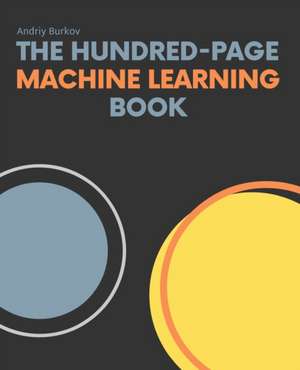
The Hundred-Page Machine Learning Book
Autor Andriy Burkoven Limba Engleză Paperback – 2019
Preț: 220.95 lei
Preț vechi: 276.18 lei
-20%
Carte tipărită la comandă
Livrare economică 12-26 noiembrie
Specificații
ISBN-10: 199957950X
Pagini: 160
Dimensiuni: 191 x 235 x 11 mm
Greutate: 0.39 kg
Editura: Andriy Burkov
V-ar putea interesa
-
 Machine Learning with Python for EveryoneMark Fenner-20%Preț: 262.03 lei327.53 lei
 -
 Just Enough Data Science and Machine LearningMark LevenePreț: 342.01 lei
 -
 Quantum Theory: A Very Short IntroductionJohn Polkinghorne-21%Preț: 54.82 lei69.55 lei
 -
 -21%Preț: 55.01 lei69.49 lei
 -
 Machine LearningKevin P. Murphy-21%Preț: 714.20 lei902.37 lei
 -
 Deep LearningIan Goodfellow-20%Preț: 605.33 lei756.66 lei
 -
 Probabilistic Machine LearningKevin P. Murphy-22%Preț: 834.21 lei1065.72 lei
 -
 Understanding Deep LearningSimon J. D. Prince-29%Preț: 604.26 lei855.35 lei
 -
 -20%Preț: 655.10 lei818.88 lei
 -
 Pattern Recognition and Machine LearningChristopher M Bishop-20%Preț: 575.45 lei719.30 lei
 -
 The Elements of Statistical LearningJerome Friedman-20%Preț: 539.59 lei674.49 lei
 -
 -39%Preț: 385.64 lei636.10 lei
 -
 -31%Preț: 607.05 lei885.58 lei
 -
 Mueller, J: Machine Learning For DummiesJohn Paul Mueller-20%Preț: 176.20 lei220.25 lei
 -
 Machine Learning For DummiesLuca Massaron-20%Preț: 147.82 lei184.77 lei
 -
 The Essential Book of AIAnne Rooney-20%Preț: 74.61 lei93.27 lei
 -
 Grokking Machine LearningLuis Serrano-20%Preț: 342.83 lei428.55 lei
 -
 -20%Preț: 242.09 lei302.62 lei
 -
 -20%Preț: 240.65 lei300.81 lei
 -
 Practical Deep Learning, 2nd Edition: A Python-Based IntroductionRonald T. Kneusel-36%Preț: 324.86 lei507.78 lei
 -
 Materials Data ScienceStefan Sandfeld-15%Preț: 591.20 lei695.53 lei
 -
 Machine Learning Interview GuideRehan Guha-20%Preț: 226.46 lei283.08 lei
Notă biografică
Descriere
"Burkov has undertaken a very useful but impossibly hard task in reducing all of machine learning to 100 pages. He succeeds well in choosing the topics--both theory and practice--that will be useful to practitioners, and for the reader who understands that this as the first 100 (or actually 150) pages you will read, not the last, provides a solid introduction to the field." -- Peter Norvig, Research Director at Google, author of the most popular artificial intelligence textbook in the world Artificial Intelligence: A Modern Approach
"The breadth of topics the book covers is amazing for just 100 pages (plus few bonus pages!). Burkov doesn't hesitate to go into the math equations: that's one thing that short books usually drop. I really liked how the author explains the core concepts in just a few words. The book can be very useful for newcomers in the field, as well as for old-timers who can gain from such a broad view of the field." -- Aurélien Géron, Senior Artificial Intelligence Engineer, author of a #1 Amazon bestseller Hands-On Machine Learning with Scikit-Learn and TensorFlow
"This book is a great introduction to machine learning from a world-class practitioner and LinkedIn superstar Andriy Burkov. He managed to find a good balance between the math of the algorithms, intuitive visualizations, and easy-to-read explanations. This book will benefit the newcomers to the field as a thorough introduction to the fundamentals of machine learning, while the experienced professionals will definitely enjoy the practical recommendations from Andriy's rich experience in the field." -- Karolis Urbonas, Head of Data Science at Amazon
"I wish such a book existed when I was a statistics graduate student trying to learn about machine learning. There is the right amount of math which demystify the centerpiece of an algorithm with succinct but very clear descriptions. I'm also impressed by the widespread coverage and good choices of important methods as an introductory book (not all machine learning books mention things like learning to rank or metric learning). Highly recommended to STEM major students or professionals who are interested to get started with machine learning for their analytics projects or preparing for data science interviews." -- Chao Han, VP, Head of R&D at Lucidworks
"Whether you want to become a machine learning practitioner or looking for an everyday resource, Andriy's book does a fantastic job of cutting the noise and hitting the tracks and full speed from the first page. It manages to structure all the important concepts from foundations to applications into a relatively quick read and leave the reader engaged at all times. " -- Sujeet Varakhedi, Head of Engineering at eBay
"This book provides a great practical guide to get started and execute on ML within a few days without necessarily knowing much about ML apriori. The first five chapters are enough to get you started and the next few chapters provide you a good feel of more advanced topics to pursue. A wonderful book for engineers who want to incorporate ML in their day-to-day work without necessarily spending an enormous amount of time going through a formal degree program. " -- Deepak Agarwal, VP of Artificial Intelligence at LinkedIn
Table of Contents:
Preface
1 Introduction
1.1 What is Machine Learning
1.2 Types of Learning
1.2.1 Supervised Learning
1.2.2 Unsupervised Learning
1.2.3 Semi-Supervised Learning
1.2.4 Reinforcement Learning
1.3 How Supervised Learning Works
1.4 Why the Model Works on New Data
2 Notation and Definitions
2.1 Notation
2.1.1 Data Structures
2.1.2 Capital Sigma Notation
2.1.3 Capital Pi Notation
2.1.4 Operations on Sets
2.1.5 Operations on Vectors
2.1.6 Functions
2.1.7 Max and Arg Max
2.1.8 Assignment Operator
2.1.9 Derivative and Gradient
2.2 Random Variable
2.3 Unbiased Estimators
2.4 Bayes' Rule
2.5 Parameter Estimation
2.6 Parameters vs. Hyperparameters
2.7 Classification vs. Regression
2.8 Model-Based vs. Instance-Based Learning
2.9 Shallow vs. Deep Learning
3 Fundamental Algorithms
3.1 Linear Regression
3.1.1 Problem Statement
3.1.2 Solution
3.2 Logistic Regression
3.2.1 Problem Statement
3.2.2 Solution
3.3 Decision Tree Learning
3.3.1 Problem Statement
3.3.2 Solution
3.4 Support Vector Machine
3.4.1 Dealing with Noise
3.4.2 Dealing with Inherent Non-Linearity
3.5 k-Nearest Neighbors
4 Anatomy of a Learning Algorithm
4.1 Building Blocks of a Learning Algorithm
4.2 Gradient Descent
4.3 How Machine Learning Engineers Work
4.4 Learning Algorithms' Particularities
5 Basic Practice
5.1 Feature Engineering
5.1.1 One-Hot Encoding
5.1.2 Binning
5.1.3 Normalization
5.1.4 Standardization
5.1.5 Dealing with Missing Features
5.1.6 Data Imputation Techniques
5.2 Learning Algorithm Selection
5.3 Three Sets
5.4 Underfitting and Overfitting
5.5 Regularization
5.6 Model Performance Assessment
5.6.1 Confusion Matrix
5.6.2 Precision/Recall
5.6.3 Accuracy
5.6.4 Cost-Sensitive Accuracy
5.6.5 Area under the ROC Curve (AUC)
5.7 Hyperparameter Tuning
5.7.1 Cross-Validation
6 Neural Networks and Deep Learning
6.1 Neural Networks
6.1.1 Multilayer Perceptron Example
6.1.2 Feed-Forward Neural Network Architecture
6.2 Deep Learning
6.2.1 Convolutional Neural Network
6.2.2 Recurrent Neural Network
7 Problems and Solutions
7.1 Kernel Regression
7.2 Multiclass Classification
7.3 One-Class Classification
7.4 Multi-Label Classification
7.5 Ensemble Learning
7.5.1 Boosting and Bagging
7.5.2 Random Forest
7.5.3 Gradient Boosting
7.6 Learning to Label Sequences
7.7 Sequence-to-Sequence Learning
7.8 Active Learning
7.9 Semi-Supervised Learning
7.10 One-Shot Learning
7.11 Zero-Shot Learning
8 Advanced Practice
8.1 Handling Imbalanced Datasets
8.2 Combining Models
8.3 Training Neural Networks
8.4 Advanced Regularization
8.5 Handling Multiple Inputs
8.6 Handling Multiple Outputs
8.7 Transfer Learning
8.8 Algorithmic Efficiency
9 Unsupervised Learning
9.1 Density Estimation
9.2 Clustering
9.2.1 K-Means
9.2.2 DBSCAN and HDBSCAN
9.2.3 Determining the Number of Clusters
9.2.4 Other Clustering Algorithms
9.3 Dimensionality Reduction
9.3.1 Principal Component Analysis
9.3.2 UMAP
9.4 Outlier Detection
10 Other Forms of Learning
10.1 Metric Learning
10.2 Learning to Rank
10.3 Learning to Recommend
10.3.1 Factorization Machines
10.3.2 Denoising Autoencoders
10.4 Self-Supervised Learning: Word Embeddings
11 Conclusion
Index
Publisher Marketing:
As its title says, it's the hundred-page machine learning book. It was written by an expert in machine learning holding a Ph.D. in Artificial Intelligence with almost two decades of industry experience in computer science and hands-on machine learning.
This is a unique book in many aspects. It is the first successful attempt to write an easy to read book on machine learning that isn't afraid of using math. It's also the first attempt to squeeze a wide range of machine learning topics in a systematic way and without loss in quality.
The book contains only those parts of the huge body of material on machine learning developed since the 1960s that have proven to have a significant practical value. A beginner in machine learning will find in this book just enough details to get a comfortable level of understanding of the field and start asking the right questions. Practitioners with experience will use this book as a collection of pointers to the directions of further self-improvement.
The book also comes in handy when brainstorming at the beginning of a project, when you try to answer the question whether a given technical or business problem is "machine-learnable" and, if yes, which techniques you should try to solve it.
The book comes with a wiki which contains pages that extend some book chapters with additional information: Q&A, code snippets, further reading, tools, and other relevant resources. Thanks to the continuously updated wiki this book like a good wine keeps getting better after you buy it.