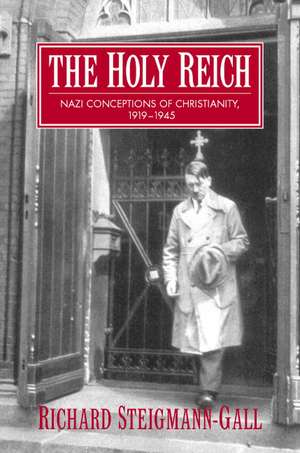
The Holy Reich
Autor Richard Steigmann-Gallen Limba Engleză Hardback – 30 iun 2010
În cadrul programelor universitare de istorie contemporană și sociologie a religiilor, The Holy Reich ocupă un loc central prin revizuirea unei paradigme fundamentale: relația dintre ideologia național-socialistă și credința creștină. Remarcăm curajul cu care Richard Steigmann-Gall provoacă teza tradițională a unei rupturi totale între cele două sisteme de valori, argumentând că mulți lideri naziști și-au fundamentat viziunea despre comunitatea rasială pe o interpretare specifică, deși distorsionată, a creștinismului. Analiza sa nu se rezumă la o simplă descriere a politicii religioase, ci pătrunde în mecanismele interne ale partidului, unde conceptul de „creștinism pozitiv” a servit drept punte de legătură între tradiția religioasă germană și radicalismul politic. Subliniem modul în care autorul detaliază lupta internă dintre facțiunile partidului, punând față în față viziunea „creștinilor pozitivi” cu cea a paganiștilor care respingeau creștinismul ca fiind o influență străină. Comparabil cu The Nazi Religion and the Rise of the French Christian Resistance de Kathleen Burton în rigurozitatea cu care tratează termenul de „creștinism pozitiv”, volumul de față se distinge printr-o documentare mult mai vastă a viziunilor elitei naziste din perioada 1919–1945. Dacă alte lucrări, precum cele semnate de Richard J. Bonney, tind să pună accentul pe persecuția bisericilor, Richard Steigmann-Gall oferă o perspectivă nuanțată asupra modului în care elementele de bază ale nazismului — antisemitismul și antimarxismul — au fost concepute de unii adepți ca o misiune de salvare creștină a Germaniei. Rezultatul este o explorare densă, esențială pentru înțelegerea complexității ideologice a celui de-al Treilea Reich.
Preț: 617.64 lei
Preț vechi: 693.97 lei
-11%
Carte tipărită la comandă
Livrare economică 20 noiembrie-04 decembrie
Specificații
ISBN-10: 0521823714
Pagini: 312
Ilustrații: 15 b/w illus.
Dimensiuni: 157 x 235 x 23 mm
Greutate: 0.66 kg
Ediția:New.
Editura: Cambridge University Press
Locul publicării:New York, United States
V-ar putea interesa
-
 Christianity: A Global HistoryDavid ChidesterPreț: 135.52 lei
 -
 Sacred ViolenceBrent D. ShawPreț: 419.49 lei
 -
 Preț: 392.68 lei
 -
 Preț: 246.21 lei
 -
 The Westminster Handbook to OrigenJohn Anthony McguckinPreț: 256.84 lei
 -
 Preț: 80.29 lei
 -
 Religious Experience in Earliest ChristianityLuke Timothy JohnsonPreț: 190.19 lei
 -
 The Beginnings of ChristianityAndrew WelburnPreț: 276.06 lei
 -
 Preț: 122.03 lei
 -
 -11%Preț: 619.17 lei695.69 lei
 -
 The New Knighthood (Canto Classics)Malcolm BarberPreț: 163.00 lei
 -
 Christian Responses to Roman Art and ArchitectureLaura Salah NasrallahPreț: 452.10 lei
 -
 ReformationAppoldPreț: 327.82 lei
 -
 Preț: 432.68 lei
 -
 ReformationAndrew CookPreț: 46.90 lei
 -
 From Cranmer to SancroftProf Patrick Collinson-38%Preț: 484.09 lei782.56 lei
De ce să citești această carte
Recomandăm această carte studenților și cercetătorilor care doresc să înțeleagă rădăcinile ideologice ale nazismului dincolo de clișeele simpliste. Cititorul va câștiga o perspectivă documentată asupra modului în care religia poate fi instrumentalizată politic, oferind un argument solid împotriva ideii că nazismul a fost o mișcare pur seculară. Este o resursă academică de prim rang pentru oricine studiază istoria Europei și intersecția dintre credință și totalitarism.
Despre autor
Richard Steigmann-Gall este profesor asociat de istorie la Kent State University, fiind un specialist recunoscut în istoria Germaniei și a mișcărilor politice europene. Activitatea sa academică a fost susținută prin burse și distincții importante primite în Canada, Germania și Israel, reflectând rigoarea cercetărilor sale. A publicat numeroase articole în jurnale de prestigiu precum Central European History și German History, consolidându-și reputația de expert în analizarea legăturilor complexe dintre ideologia politică și structurile religioase în contextul ascensiunii regimurilor totalitare.
Descriere scurtă
Cuprins
Recenzii
'The Holy Reich is a brilliant and provocative work that will recast the whole debate on Christianity and Nazism. We have come to realize that Christianity embraced Nazism more than we used to believe. Now, in a work of deep revisionist import, Richard Steigmann-Gall shows us that the embrace was more than reciprocated.' Helmut Walser Smith, author of The Butcher's Tale: Murder and Anti-Semitism in a German Town
'There has been a huge amount of research on the attitude of the Christian Churches to the Nazis and their policies, but astonishingly until now there has been no thorough study of the Nazis' own religious beliefs. Richard Steigmann-Gall has now provided it. He has trawled through a lot of very turgid literature to show that active Nazis from the leadership down to the lower levels of the party were bitterly opposed to the Catholic Church, but had a much more ambivalent attitude to Protestantism and to Christianity in a wider sense … Far from being uniformly anti-Christian, Nazism contained a wide variety of religious beliefs, and Steigmann-Gall has performed a valuable service in providing a meticulously documented account of them in all their bizarre variety.' Richard J. Evans, University of Cambridge
'In the crowded field of Third Reich history, The Holy Reich really does have something original to say … an uncomfortably thought-provoking work of admirable scholarship.' The Times Higher Education Supplement
'… connects Nazism to liberal Protestantism in a convincing way.' The Sunday Times
'… excellently documented and deeply disturbing …' Church Times
'… an incisive study … this book is an admirable attempt to rethink the ethical and theological nature of Nazi ideology and practice. Steigmann-Gall is not trying to discard past perspectives or to act as a revisionist, but rather to deepen our current understanding of the relationship between Nazi ideology and Christian thought. In the process, he exposes lucidly the very contested nature of the meaning of Christianity as it emerged during the Nazi debates and the entire period of the third Reich.' European History Quarterly
' This is an important and well-researched study … a very thought provoking, controversial and important book which deserves a wide readership because it radically challenges some widely-held assumptions about Nazism''s pagan and/or anti-Christian core.' German History
'… fascinating and detailed …'. German Politics
'His archive work is impressive and the text's story is pieced together with both thought and art. Its sweep takes in everything one would expect and displays well the competing tendencies within Hitler's movement … More unusually it also discusses possible connections between Christianity and Nazi social policy …'. Reviews in History
'This rigorously researched and deeply disturbing book questions the scholarly consensus that Nazism was either unrelated to Christianity or actively opposed to it.' The Times (Weekend Review)
'… this book is one that will be easily included on anyone's bibliography of the Nazi regime. It is a book to be mulled over and considered deeply.' Open History
'This is a meticulous, even exhaustive book, offering a dense exploration of a great field of material. … a truly important book which will lead many scholars to refashion or sharpen their perspectives, and even to think again.' English Historical Review