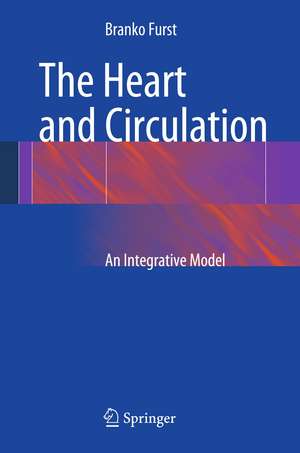
The Heart and Circulation: An Integrative Model
Autor Branko Fursten Limba Engleză Hardback – 22 aug 2013
În literatura de specialitate dedicată sistemului cardiovascular, The Heart and Circulation reprezintă o perspectivă provocatoare și necesară. Putem afirma că lucrarea semnată de Branko Furst se distinge fundamental de manualele clasice de fiziologie, precum Cardiovascular Physiology de Achilles J. Pappano. Dacă manualele din seria Mosby's Physiology Monograph se concentrează pe mecanismele standard presiune-propulsie pentru a explica funcționarea inimii în sănătate și boală, Branko Furst propune un model integrativ care pune sub semnul întrebării rolul inimii de simplă pompă peristaltică.
Merită menționat că autorul își construiește argumentația plecând de la embriologie și filogenie. Reținem analiza detaliată a circulației embrionare timpurii, unde fluxul sanguin precede dezvoltarea valvelor și a contracțiilor ritmice, sugerând o forță motrice intrinsecă a sângelui. Structura cărții ghidează cititorul de la ontogenie către morfologia complexă a miocardului și dinamica vortexurilor intracardiace. În contrast cu The Mechanics of the Circulation de C. G. Caro, care pune accent pe ecuațiile mecanicii clasice aplicate vaselor de sânge, lucrarea de față utilizează fenomenele clinice — cum ar fi fistulele arteriovenoase sau defectele septale — pentru a demonstra că inima funcționează mai degrabă ca un organ de rezistență sau impedanță, care reglează fluxul prin presiune, dar nu îl generează în totalitate.
Această ediție publicată de SPRINGER LONDON oferă o sinteză clinică riguroasă, transformând înțelegerea sângelui dintr-un simplu fluid de transport într-un „organ lichid” cu autonomie funcțională. Este o lectură densă, cu un ton academic precis, care invită la o reevaluare a hemodinamicii moderne prin prisma dovezilor acumulate în ultimele decenii.
Preț: 1105.63 lei
Preț vechi: 1163.81 lei
-5%
Carte disponibilă
Livrare economică 17 noiembrie-01 decembrie
Specificații
ISBN-10: 144715276X
Pagini: 218
Ilustrații: XXIX, 226 p.
Dimensiuni: 155 x 235 x 17 mm
Greutate: 0.62 kg
Ediția:2014
Editura: SPRINGER LONDON
Colecția Springer
Locul publicării:London, United Kingdom
V-ar putea interesa
-
 Heart FailureMarc Semigran-5%Preț: 599.50 lei631.06 lei
 -
 Clinical Guide to Primary AngioplastyStephen Brecker-5%Preț: 575.10 lei605.37 lei
 -
 Pulmonary HypertensionMarc Humbert-5%Preț: 580.23 lei610.77 lei
 -
 -5%Preț: 292.43 lei307.83 lei
 -
 -5%Preț: 1614.28 lei1699.24 lei
 -
 Specialized Aspects of ECGPeter W. Macfarlane-5%Preț: 507.36 lei534.07 lei
 -
 British Cardiology in the 20th CenturyMark E. Silverman-5%Preț: 727.08 lei765.35 lei
 -
 Sir Thomas LewisArthur Hollmann-5%Preț: 721.61 lei759.60 lei
 -
 Exercise Cardiopulmonary Function in Cardiac PatientsMichael S. Sagiv-5%Preț: 751.97 lei791.54 lei
 -
 Cardiac Valvular MedicineNalini M. Rajamannan-5%Preț: 751.87 lei791.44 lei
 -
 Practical Pediatric CardiologyAlan G. Magee-5%Preț: 807.96 lei850.48 lei
 -
 -5%Preț: 1347.43 lei1418.35 lei
 -
 Transcatheter Aortic Valve ImplantationArturo Giordano-5%Preț: 1164.62 lei1225.92 lei
 -
 Diseases of the AortaRobert S. Dieter-5%Preț: 1322.30 lei1391.90 lei
 -
 Textbook of Three-Dimensional EchocardiographyLuigi P. Badano-5%Preț: 1292.16 lei1360.17 lei
 -
 Contrast EchocardiographyHarald Becher-5%Preț: 893.45 lei940.47 lei
 -
 Textbook of Vascular MedicineRhian M. Touyz-5%Preț: 945.02 lei994.76 lei
 -
 -5%Preț: 1054.49 lei1109.99 lei
 -
 Clinical Autonomic and Mitochondrial DisordersNicholas L. Depace-5%Preț: 1036.05 lei1090.59 lei
 -
 Noncompaction CardiomyopathyKadir Caliskan-5%Preț: 668.42 lei703.60 lei
 -
 Cardiovascular HemodynamicsArman T. Askari-5%Preț: 997.04 lei1049.51 lei
 -
 -5%Preț: 662.88 lei697.77 lei
 -
 Cardiorenal Syndrome in Heart FailureW. H. Wilson Tang-5%Preț: 753.67 lei793.34 lei
 -
 Cardiac RepolarizationNabil El-Sherif-5%Preț: 779.53 lei820.56 lei
 -
 Angiotensin-(1-7)Robson Augusto Souza Santos-5%Preț: 748.64 lei788.04 lei
 -
 An Illustrated Guide to Congenital Heart DiseaseIn Sook Park-5%Preț: 2274.47 lei2394.18 lei
Public țintă
Professional/practitionerDe ce să citești această carte
Această lucrare este esențială pentru cardiologi, rezidenți și cercetători care doresc să depășească modelul mecanicist tradițional al inimii. Cititorul câștigă o înțelegere profundă a fenomenelor hemodinamice complexe, precum vortexurile intracardiace și circulația embrionară. Este o recomandare solidă pentru cei care caută o fundamentare teoretică nouă pentru patologii precum sindromul Eisenmenger sau insuficiența cardiacă, oferind o perspectivă integrativă asupra interacțiunii dintre sânge și miocard.
Despre autor
Branko Furst este un cercetător și clinician recunoscut pentru abordările sale inovatoare în domeniul fiziologiei cardiovasculare. Prin activitatea sa, autorul a explorat limitele modelelor fizice actuale, aducând în prim-plan observații din embriologie și anatomie comparată care fuseseră anterior marginalizate în literatura clinică standard. Expertiza sa se concentrează pe integrarea datelor experimentale cu practica medicală, fiind un susținător al modelului inimii ca organ de impedanță, teorie care a generat dezbateri importante în comunitatea științifică internațională și a fost publicată sub egida prestigioasei edituri Springer.
Descriere scurtă
Cuprins
Recenzii
“With this monograph Branko Furst succeeded to lay a foundation for a new physiology of the cardiovascular system. His excellent overview and presentation of a wide selection of topics is presented with clarity and depth of knowledge. … this book will serve as a basis for a more encompassing, specifically human cardiovascular physiology arising from the evolutionary-biologic model of circulation.” (Original book review in German language, Hans Christoph Kümmell, Der Merkurstab, Vol. 67 (3), 2014)
Notă biografică
The author currently holds the position of Associate Professor in Anesthesiology at Albany Medical College, Albany, NY, where his time is shared between clinical work, resident teaching and research.
Textul de pe ultima copertă
A unifying circulation model is proposed in which the blood, responding to metabolic demands of the tissues, is the primary regulator of cardiac output. This new model arises from accumulated clinical and experimental evidence. The heart, rather than being an organ of blood propulsion, assumes a secondary role and generates pressure by impeding the flow of blood. This is supported by examples from the fields of early embryonic circulation, comparative phylogeny, functional morphology, exercise physiology and a range of clinical scenarios.
The Heart and Circulation: An Integrative Model offers a paradigm shift in the understanding of circulatory phenomena. It will become a valuable resource for all those clinicians, researchers, educators and students who, having been confronted with the paradox of the circulation, are looking for a broader interpretation.