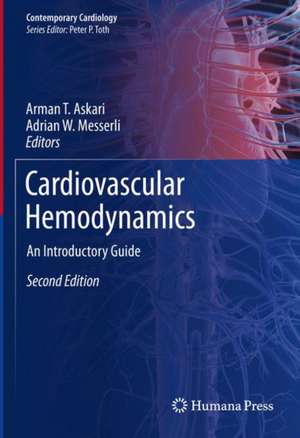
Cardiovascular Hemodynamics: Contemporary Cardiology
Editat de Arman T. Askari, Adrian W. Messerlien Limba Engleză Hardback – 24 iul 2019
The second edition of this key resource provides a broad and fundamental overview of basic cardiovascular (CV) hemodynamic principles with a focus on clinical assessment of CV physiology. Extensively updated, the book includes new coverage on noninvasive hemodynamic assessment and the effects of selected interventions on CV hemodynamics. It provides an introduction to the basic concepts such as preload, afterload, myocardial contractility, and cardiac output. Subsequent chapters examine the effects of interventions such as vasodilators, beta blockers, pressor agents, inotropes, and different forms of invasive circulatory support. The book also focuses on various methods of hemodynamic evaluation including echocardiography, CT/MRI, noninvasive hemodynamic assessment, and cardiac catheterization. The book concludes with a discussion of proper diagnosis, evaluation, and management of patients using hemodynamic data on a variety of specific disease states.
An invaluable contribution to the Contemporary Cardiology Series, the Second Edition of Cardiovascular Hemodynamics: An Introductory Guide is an essential resource for physicians, residents, fellows, medical students, and researchers in cardiology, emergency medicine, critical care, and internal medicine.
Din seria Contemporary Cardiology
- 5%
 Preț: 1247.75 lei
 - 5%
 Preț: 948.05 lei
 - 5%
 Preț: 1014.91 lei
 - 5%
 Preț: 411.78 lei
 - 5%
 Preț: 883.99 lei
 - 5%
 Preț: 1137.73 lei
 - 5%
 Preț: 1550.63 lei
 - 5%
 Preț: 1371.07 lei
 - 5%
 Preț: 1334.69 lei
 - 5%
 Preț: 1468.39 lei
 - 5%
 Preț: 762.81 lei
 - 5%
 Preț: 1187.52 lei
 - 5%
 Preț: 1478.08 lei
 - 5%
 Preț: 767.31 lei
 - 5%
 Preț: 1512.09 lei
 - 5%
 Preț: 1481.06 lei
 - 5%
 Preț: 1506.16 lei
 - 5%
 Preț: 1586.90 lei
 - 5%
 Preț: 1056.66 lei
 - 5%
 Preț: 744.52 lei
 - 5%
 Preț: 691.35 lei
 - 5%
 Preț: 1949.23 lei
 - 5%
 Preț: 1475.22 lei
 - 5%
 Preț: 1498.32 lei
 - 5%
 Preț: 1107.28 lei
 - 5%
 Preț: 1485.72 lei
 - 5%
 Preț: 1145.93 lei
 - 5%
 Preț: 1072.18 lei
 - 5%
 Preț: 751.69 lei
 - 5%
 Preț: 1492.16 lei
 - 5%
 Preț: 1486.06 lei
 - 5%
 Preț: 1142.63 lei
 - 5%
 Preț: 750.95 lei
 - 5%
 Preț: 1571.85 lei
 - 5%
 Preț: 2114.76 lei
 - 5%
 Preț: 768.49 lei
 - 5%
 Preț: 756.56 lei
 - 5%
 Preț: 1142.51 lei
Preț: 997.04 lei
Preț vechi: 1049.51 lei
-5%
Puncte Express: 1496
Carte tipărită la comandă
Livrare economică 24-30 noiembrie
Livrare prin curier în România Termenul estimat este afișat lângă disponibilitate.
Transport gratuit pentru acest produs Plată online sau ramburs, în funcție de opțiunile comenzii.
Retur gratuit în 14 zile Comandă securizată și suport în română.
Specificații
ISBN-13: 9783030191306
ISBN-10: 3030191303
Pagini: 420
Ilustrații: XLVI, 371 p. 158 illus., 116 illus. in color.
Dimensiuni: 183 x 260 x 27 mm
Greutate: 1.01 kg
Ediția:Second Edition 2019
Editura: Springer
Colecția Contemporary Cardiology
Seria Contemporary Cardiology
Locul publicării:Cham, Switzerland
ISBN-10: 3030191303
Pagini: 420
Ilustrații: XLVI, 371 p. 158 illus., 116 illus. in color.
Dimensiuni: 183 x 260 x 27 mm
Greutate: 1.01 kg
Ediția:Second Edition 2019
Editura: Springer
Colecția Contemporary Cardiology
Seria Contemporary Cardiology
Locul publicării:Cham, Switzerland
V-ar putea interesa
-
 PERIPHERAL VASCULAR DISEASEAlvaro Alonso-5%Preț: 569.00 lei598.94 lei
 -
 JEFFERSON HEART INSTITUTE HANDBOOK OF CARDIOLOGYPaul J Mather-5%Preț: 1070.78 lei1127.14 lei
 -
 Antithrombotic Drug Therapy in Cardiovascular DiseaseArman T. Askari-5%Preț: 1506.16 lei1585.44 lei
 -
 Aneurysms: Types, Risks, Formation & TreatmentAlain Laurent-23%Preț: 1533.35 lei2000.51 lei
 -
 Cardiovascular Hemodynamics: An Introductory GuideSaif Anwaruddin-5%Preț: 1107.28 lei1165.56 lei
 -
 COPD is / is Not a Systemic Disease?Claudio F Donner-23%Preț: 815.96 lei1060.97 lei
 -
 -5%Preț: 1581.49 lei1664.73 lei
 -
 Safety of Biologics TherapyBrian A. Baldo-5%Preț: 1227.02 lei1291.60 lei
 -
 Resistant HypertensionMassimo Salvetti-5%Preț: 362.25 lei381.32 lei
 -
 Infective EndocarditisGilbert Habib-5%Preț: 1109.62 lei1168.02 lei
 -
 Hypertension and ComorbiditiesAgostino Virdis-5%Preț: 371.97 lei391.55 lei
 -
 Hypertension and Metabolic Cardiovascular Risk FactorsArrigo F. G. Cicero-5%Preț: 359.18 lei378.09 lei
 -
 -5%Preț: 620.99 lei653.67 lei
 -
 -5%Preț: 639.60 lei673.27 lei
 -
 Therapeutic Strategies for Heart FailureNaoki Satô-5%Preț: 497.49 lei523.68 lei
Cuprins
Part I. Components of Myocardial Performance.- Chapter 1. Preload.- Chapter 2. Afterload.- Chapter 3. Contractility.- Chapter 4. Cardiac Output.- Part II. Effects of Selected Interventions on CV Hemodynamics.- Chapter 5. Renin Angiotensin Aldosterone Axis Modulators and Other Vasodilators.- Chapter 6. Beta Blockers and Calcium Channel Blockers.- Chapter 7. Pressor Agents, Pure Inotropes, Mixed Function Agents.- Chapter 8. Recently Approved Agents to Improve Outcomes in Heart Failure.- Chapter 9. Invasive Circulatory Support – IABP, IMPELLA, LVAD as Destination Therapy.- Part III. Methods of Hemodynamic Evaluation.- Chapter 10. Key Clinical Findings.- Chapter 11. Echocardiography.- Chapter 12. CT/MRI.- Chapter 13. Non-invasive Hemodynamic Assessment.- Chapter 14. Cardiac Catheterization – RHC/LHC.- Part IV. Specific Hemodynamically Compromised Situations.- Chapter 15. Tamponade.- Chapter 16. Constriction / Restriction.- Chapter 17. Valvular Heart Disease –Including Cases / Issues of TAVR, Mitral Clip.- Chapter 18. Pulmonary Hypertension.- Chapter 19. Acute Decompensated Heart Failure.- Chapter 20. Intracardiac Shunts.- Chapter 21. Shock.- Chapter 22. Intracoronary Hemodynamics.
Recenzii
“It will indeed be of high ‘value and interest to every student and practitioner of cardiovascular medicine who wishes to fully learn the hemodynamic foundation of cardiovascular medicine.’” (Matthias Heringlake, Anesthesia & Analgesia, Vol. 131 (2), August, 2020)
Notă biografică
Arman T. Askari, MD, FACC
Founder, Premier Health Advocates
Clinical Associate Professor of Medicine Consulting Staff, Cleveland Clinic
Teaching Faculty, University Hospitals Cleveland Medical Center
Founder, Premier Health Advocates
Clinical Associate Professor of Medicine Consulting Staff, Cleveland Clinic
Teaching Faculty, University Hospitals Cleveland Medical Center
Adrian W. Messerli, MD
Associate Professor of Medicine
Medical Director, Cardiac Catheterization Laboratory Gill Heart Institute
University of Kentucky
Textul de pe ultima copertă
The second edition of this key resource provides a broad and fundamental overview of basic cardiovascular (CV) hemodynamic principles with a focus on clinical assessment of CV physiology. Extensively updated, the book includes new coverage on noninvasive hemodynamic assessment and the effects of selected interventions on CV hemodynamics. It provides an introduction to the basic concepts such as preload, afterload, myocardial contractility, and cardiac output. Subsequent chapters examine the effects of interventions such as vasodilators, beta blockers, pressor agents, inotropes, and different forms of invasive circulatory support. The book also focuses on various methods of hemodynamic evaluation including echocardiography, CT/MRI, noninvasive hemodynamic assessment, and cardiac catheterization. The book concludes with a discussion of proper diagnosis, evaluation, and management of patients using hemodynamic data on a variety of specific disease states.
An invaluable contribution to the Contemporary Cardiology Series, the Second Edition of Cardiovascular Hemodynamics: An Introductory Guide is an essential resource for physicians, residents, fellows, medical students, and researchers in cardiology, emergency medicine, critical care, and internal medicine.
Caracteristici
Includes new coverage on noninvasive assessment and the effects of interventions on cardiovascular hemodynamics Provides board-style questions, clinical cases, and vignettes Discusses diagnosis, evaluation, and management of patients using hemodynamic data Details techniques available for assessing cardiovascular performance