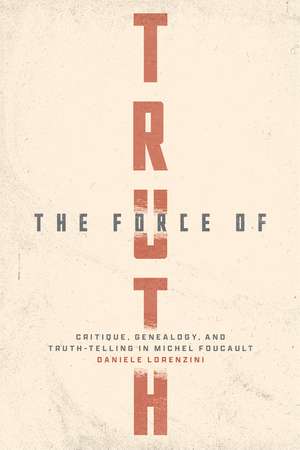
The Force of Truth: Critique, Genealogy, and Truth-Telling in Michel Foucault
Autor Daniele Lorenzinien Limba Engleză Paperback – 13 sep 2023
Observăm în ultimul deceniu o reevaluare profundă a modului în care filosofia politică abordează conceptul de post-adevăr, o evoluție pe care The Force of Truth o reflectă prin repoziționarea radicală a moștenirii lui Michel Foucault. Suntem de părere că Daniele Lorenzini reușește o performanță teoretică rară: aceea de a demonstra că Foucault nu a subminat validitatea adevărului, ci a investigat ceea ce autorul numește „forța adevărului” — mecanismele prin care anumite afirmații dobândesc puterea de a ne guverna conduita.
Notăm cu interes modul în care Lorenzini construiește o punte între tradiția continentală și filosofia analitică, utilizând conceptele lui J.L. Austin și Stanley Cavell pentru a explica parresia (rostirea curajoasă a adevărului) ca act de vorbire perlocuționar. Această abordare oferă o rigoare conceptuală nouă studiilor foucaultiene, transformând genealogia dintr-un instrument pur subversiv într-unul „posibilizator”. Structura volumului urmărește o progresie logică impecabilă, de la „evenimentul-adevăr” și emergența subiectului alethurgic, până la o analiză finală a dezbaterii dintre Foucault și Habermas asupra normativității.
Ca alternativă la "Discourse and Truth" and "Parresia" pentru cursurile de filozofia limbii sau etică politică, lucrarea lui Lorenzini aduce avantajul unei sinteze critice care nu doar prezintă cursurile târzii ale lui Foucault, ci le și apără în fața criticilor contemporane privind relativismul. Poziționată în contextul operei editoriale a lui Lorenzini, care a îngrijit volume esențiale precum Madness, Language, Literature, această monografie reprezintă maturizarea unei viziuni asupra modului în care critica și „grija de sine” se împletesc în spațiul public.
Preț: 166.81 lei
Carte disponibilă
Livrare economică 16-30 mai
Livrare express 05-09 mai pentru 23.02 lei
Specificații
ISBN-10: 0226827453
Pagini: 192
Ilustrații: 2 tables
Dimensiuni: 152 x 229 x 15 mm
Greutate: 0.31 kg
Ediția:1
Editura: University of Chicago Press
Colecția University of Chicago Press
De ce să citești această carte
Recomandăm această carte cercetătorilor și studenților la filosofie care doresc să înțeleagă mecanismele puterii dincolo de simplele structuri de control. Cititorul câștigă o perspectivă clară asupra modului în care adevărul funcționează ca forță etică. Este o lectură esențială pentru a demonta mitul că Foucault ar fi părintele spiritual al erei post-adevăr, oferind în schimb instrumente pentru o critică socială responsabilă.
Despre autor
Daniele Lorenzini este profesor de filosofie la University of Pennsylvania și o figură centrală în editarea și interpretarea manuscriselor lui Michel Foucault. Expertiza sa este dublată de o activitate editorială prodigioasă, fiind co-editor al unor volume fundamentale precum "What Is Critique?" and "The Culture of the Self" și colaborator constant la proiectele ce vizează cursurile lui Foucault de la Collège de France. Prin contribuția sa la traducerea și prefațarea lucrării Don't Forget to Live de Pierre Hadot, Lorenzini demonstrează o preocupare constantă pentru legătura dintre exercițiile spirituale antice și critica modernă, teme care fundamentează și argumentația din volumul de față.
Descriere scurtă
Many blame Michel Foucault for our post-truth and conspiracy-laden society. In this provocative work, Daniele Lorenzini argues that such criticism fundamentally misunderstands the philosopher’s project. Foucault did not question truth itself but what Lorenzini calls “the force of truth,” or how some truth claims are given the power to govern our conduct while others are not. This interest, Lorenzini shows, drove Foucault to articulate a new ethics and politics of truth-telling precisely in order to evade the threat of relativism. The Force of Truth explores this neglected dimension of Foucault’s project by putting his writings on regimes of truth and parrhesia in conversation with early analytic philosophy and by drawing out the “possibilizing” elements of Foucault’s genealogies that remain vital for practicing critique today.
Notă biografică
Cuprins
A History of Truth That Does Not Rely on “the Truth”
Toward an Ethics and Politics of Truth-Telling
The Force of Words and the Force of Truth
1. Truth-Event
“A Little History of Truth in General”
The Emergence of the Alethurgic Subject
Confessional Sciences
2. Regimes of Truth
Truth Obligations?
Games and Regimes of Truth
A Critical (An)archaeology
Language Games and Games of Truth
The Value of Truth
Regimes of Truth and Spirituality
3. Truth as Force
Cavell, Austin, and the Perlocutionary
Parrhesia as Speech Act
Unpredictability, Freedom, and Criticism
Risk and Courage
Transparency, or Parrhesia and Rhetoric
4. Dramatics of Truth
Alethurgy
Sincerity, Authenticity, Confession
Putting the Truth to the Test of Life
5. Critique and Possibilizing Genealogy
Beyond the Vindicatory-Subversive Dichotomy
Foucault, Habermas, and the Question of Normativity
The Genealogy of Critique
Genealogy and We-Making
Conclusion: Rethinking Critique
Acknowledgments
Notes
Bibliography
Index