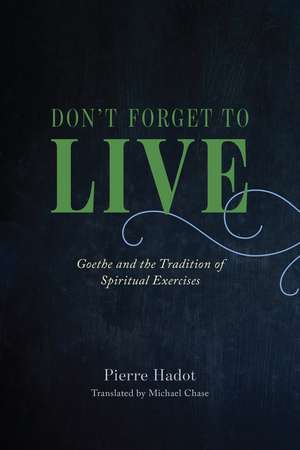
Don't Forget to Live: Goethe and the Tradition of Spiritual Exercises: The France Chicago Collection
Autor Pierre Hadot Traducere de Michael Chase Cuvânt înainte de Arnold I. Davidson, Daniele Lorenzinien Limba Engleză Hardback – 5 apr 2023
Nivel de studiu: masterat, doctorat și referință profesională în istoria ideilor și filozofie morală. Recomandăm acest volum, Don't Forget to Live, ca fiind testamentul intelectual al lui Pierre Hadot, o lucrare care sintetizează decenii de cercetare asupra filozofiei ca mod de viață. În acest text final, Hadot își îndreaptă atenția către Goethe, demonstrând cum autorul german a integrat exercițiile spirituale ale antichității — acte transformative ale intelectului și voinței — pentru a cultiva o 'conștiință cosmică'.
Remarcăm modul în care Hadot extinde cadrul propus în lucrarea sa clasică, Philosophy as a Way of Life, aplicând hermeneutica sa nu doar textelor antice, ci și modernității. Dacă în The Present Alone is Our Happiness, Second Edition autorul se concentra pe perspectiva epicureană a limitării dorințelor, aici el explorează o viziune mai expansivă: transformarea conștiinței ordinare prin iubirea de viață. Structura cărții urmărește o progresie logică, de la adorarea prezentului și 'privirea de sus' (view from above), până la analiza poemelor 'Urworte', oferind o perspectivă rară asupra modului în care Goethe a reușit să depășească fatalismul tradițional.
Această ediție în limba engleză, publicată de University of Chicago Press, beneficiază de traducerea precisă a lui Michael Chase și de un aparat critic solid, care poziționează opera lui Goethe în dialog cu stoicismul și neoplatonismul. Este o lectură care completează viziunea lui Hadot din What Is Ancient Philosophy?, demonstrând că filozofia nu este un sistem abstract, ci o practică neîncetată a prezenței.


Preț: 201.76 lei
Carte disponibilă
Livrare economică 21 octombrie-04 noiembrie
Livrare express 07-13 octombrie pentru 33.85 lei
Specificații
ISBN-10: 022649716X
Pagini: 200
Ilustrații: 7 halftones
Dimensiuni: 140 x 216 x 33 mm
Greutate: 0.52 kg
Ediția:First Edition
Editura: University of Chicago Press
Colecția University of Chicago Press
Seria The France Chicago Collection
De ce să citești această carte
Recomandăm această carte cercetătorilor și pasionaților de filozofie care doresc să înțeleagă cum tradiția antică a supraviețuit în modernitate. Cititorul va descoperi o analiză riguroasă a modului în care Goethe a transformat exercițiile spirituale în instrumente de afirmare a vieții. Este un volum esențial pentru a înțelege conceptul de 'conștiință cosmică' și pentru a redescoperi filozofia ca pe o formă de igienă spirituală și intelectuală.
Despre autor
Pierre Hadot a fost profesor emerit la Collège de France și unul dintre cei mai influenți istorici ai filozofiei antice din secolul XX. Opera sa a redefinit modul în care înțelegem filozofia, propunând viziunea acesteia ca un 'mod de viață' mai degrabă decât ca o construcție pur teoretică. Printre lucrările sale de referință se numără The Inner Citadel, o analiză magistrală a gândirii lui Marcus Aurelius, și The Veil of Isis, un studiu asupra istoriei ideii de natură. Lucrarea de față, Don't Forget to Live, încheie o carieră dedicată recuperării dimensiunii practice a înțelepciunii clasice.
Descriere scurtă
With a foreword by Arnold I. Davidson and Daniele Lorenzini.
In his final book, renowned philosopher Pierre Hadot explores Goethe’s relationship with ancient spiritual exercises—transformative acts of intellect, imagination, or will. Goethe sought both an intense experience of the present moment as well as a kind of cosmic consciousness, both of which are rooted in ancient philosophical practices. These practices shaped Goethe’s audacious contrast to the traditional maxim memento mori (Don’t forget that you will die) with the aim of transforming our ordinary consciousness. Ultimately, Hadot reveals how Goethe cultivated a deep love for life that brings to the forefront a new maxim: Don’t forget to live.
Notă biografică
Cuprins
Preface
1. “The Present Is the Only Goddess I Adore”
Faust and Helen
The Present, the Trivial, and the Ideal
Idyllic Arcadia
Unconscious Health or Conquered Serenity?
The Philosophical Experience of the Present
The Tradition of Ancient Philosophy in Goethe
The Present, the Instant, and Being-There in Goethe
2. The View from Above and the Cosmic Journey
The Instant and the View from Above
The View from Above in Antiquity: Peaks and Flight of the Imagination
The Philosophical Meaning of the View from Above among Ancient Philosophers
The Medieval and Modern Tradition
The Various Forms of the View from Above in Goethe
The View from Above after Goethe
Aeronauts and Cosmonauts
3. The Wings of Hope: The Urworte
Daimôn, Tukhê
Daimôn, Tukhê, Eros, Anankê, and Elpis
Human Destiny
Autobiographical Aspects?
The Caduceus
Elpis, Hope
4. The Yes to Life and the World
Great Is the Joy of Being-There (Freude des Daseins)
Greater Still Is the Joy One Feels in Existence Itself (Freude am Dasein)
The Yes to Becoming and the Terrifying
Goethe and Nietzsche
Conclusion
Translator’s Note
Notes
Bibliography
Index