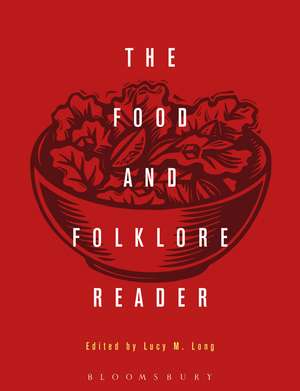
The Food and Folklore Reader
Editat de Lucy M. Longen Limba Engleză Hardback – 19 noi 2015
În cadrul programelor de studii culturale și antropologie, The Food and Folklore Reader se constituie ca prima introducere cuprinzătoare în metodologiile și conceptele folcloristicii aplicate domeniului gastronomic. Remarcăm efortul editorului Lucy M. Long de a cartografia evoluția disciplinei prin intermediul a 40 de texte esențiale, care fac tranziția de la lucrările fundamentale despre identitate și estetică la cercetările contemporane privind securitatea alimentară și turismul culinar. Reținem că această antologie nu este doar o colecție de eseuri, ci un instrument pedagogic structurat riguros în cinci părți, fiecare beneficiind de introduceri critice și întrebări de reflecție menite să ghideze procesul de învățare.
Din punct de vedere al ariei acoperite, volumul oferă o perspectivă globală, analizând practici alimentare din spații geografice diverse, de la America de Nord și Europa până la specificul culturilor filipineze. În raport cu alte lucrări ale sale, precum Ethnic American Cooking sau Regional American Food Culture, unde Lucy M. Long s-a concentrat pe specificul regional și etnic american, acest cititor academic extinde cadrul analizei către o dimensiune teoretică și aplicată mult mai vastă. Structura progresivă a cărții — de la fundamentele istorice și metodologice în Partea 1, până la rolul alimentelor ca instrumente de putere și comunicare în Partea 4 — facilitează o înțelegere nuanțată a modului în care hrana modelează comunitățile.
Acoperă aceeași arie tematică precum Food and Culture de Alice Julier, dar cu o abordare mult mai axată pe metodele specifice folcloristicii și pe dimensiunea simbolică a ritualurilor alimentare, spre deosebire de accentul pe sociologie și politică alimentară al titlului menționat. De asemenea, spre deosebire de Foodways and Folklore de Jacqueline S. Thursby, care este un manual introductiv axat pe tradițiile din SUA, volumul editat de Lucy M. Long oferă un aparat critic mult mai dens și o deschidere internațională, fiind adaptat rigorilor educației universitare.
Preț: 978.85 lei
Preț vechi: 1363.47 lei
-28%
Carte tipărită la comandă
Livrare economică 07-21 decembrie
Specificații
ISBN-10: 0857857231
Pagini: 480
Ilustrații: 3 bw
Dimensiuni: 189 x 246 x 27 mm
Greutate: 1.38 kg
Editura: Bloomsbury Publishing
Colecția Bloomsbury Academic
Locul publicării:London, United Kingdom
V-ar putea interesa
-
 Preț: 95.10 lei
 -
 Fast Food NationEric Schlosser-29%Preț: 64.04 lei90.58 lei
 -
 -14%Preț: 233.51 lei272.51 lei
 -
 Commensality: From Everyday Food to FeastSusanne Kerner-24%Preț: 900.50 lei1191.14 lei
 -
 The Ethnic RestaurateurKrishnendu Ray-16%Preț: 199.72 lei236.43 lei
 -
 The Emergence of National Food: The Dynamics of Food and NationalismAssociate Professor Atsuko Ichijo-23%Preț: 729.60 lei953.43 lei
 -
 -15%Preț: 251.60 lei296.99 lei
 -
 Eat, Drink, Think: What Ancient Greece Can Tell Us about Food and WineProfessor David Roochnik-26%Preț: 191.39 lei257.98 lei
 -
 -32%Preț: 661.89 lei975.50 lei
 -
 Food and Women in Italian Literature, Culture and Society: Eve's Sinful BiteDr Claudia Bernardi-32%Preț: 663.17 lei976.28 lei
 -
 Making Taste Public: Ethnographies of Food and the SensesProf Carole Counihan-24%Preț: 248.51 lei327.87 lei
 -
 Italian Food Activism in Urban Sardinia: Place, Taste, and CommunityProf Carole Counihan-24%Preț: 251.86 lei330.26 lei
 -
 The Globalization of WineDavid Inglis-19%Preț: 192.27 lei236.23 lei
 -
 -38%Preț: 719.12 lei1165.54 lei
 -
 The Complete Guide to Poultry BreedsMelissa NelsonPreț: 138.78 lei
 -
 Bioactive Molecules in Plant FoodsFlorence Ojiugo Uruakpa-27%Preț: 833.39 lei1134.53 lei
 -
 -27%Preț: 1215.19 lei1658.01 lei
 -
 PuddingJeri QuinzioPreț: 91.82 lei
 -
 How to Dine in StyleJ. ReyPreț: 77.68 lei
 -
 The Politics of FoodMarianne E. Lien-26%Preț: 214.81 lei288.69 lei
 -
 TesticlesBlandine ViePreț: 146.96 lei
 -
 Preț: 161.14 lei
 -
 Creative Chef: How to Create a Mind-Blowing Food ExperienceJasper Udink ten Cate-25%Preț: 157.04 lei209.39 lei
 -
 Preț: 175.96 lei
De ce să citești această carte
Recomandăm această lucrare studenților și cercetătorilor care doresc să înțeleagă hrana dincolo de nutriție, ca pe un limbaj cultural complex. Cititorul câștigă acces la o selecție curatoriată de texte fundamentale, îmbogățită cu analizele unui expert recunoscut în domeniu. Este un titlu esențial pentru oricine studiază modul în care tradițiile culinare definesc identitatea de grup și mecanismele de putere socială.
Descriere
The book also features:
- Expert commentary and comprehensive introductions to each of the book's five parts by renowned folklorist and food scholar Lucy M. Long
- Global coverage, with examples from the United States, Canada, Australia, Europe, Jewish and Filipino culture, and much more
- Questions for discussion and suggestions for further reading - supporting learning and encouraging students to explore these ideas in their own work
Definitive in scale and scope, this book defines the field of food and folklore for a new generation of students. An essential resource for all students in food studies, folklore studies, cultural studies, and anthropology.
Cuprins
Part 1: Foundations: History, Definitions, and Methodologies
Introduction to Part One
Discussion Questions
References and Further Reading
Readings
Part 2: Food in Groups, Community, and Identity
Introduction to Part One
Discussion Questions
References and Further Reading
Readings
Part 3: Food as Art, Symbol, and Ritual
Introduction to Part One
Discussion Questions
References and Further Reading
Readings
Part 4: Food as Communication, Performance, and Power
Introduction to Part One
Discussion Questions
References and Further Reading
Readings
Part 5: Food in Public and Applied Folklore
Introduction to Part One
Discussion Questions
References and Further Reading
Readings
Appendix of Sources
Index
Recenzii
This collection is sure to appeal to students in many disciplines, and really to anyone interested in the meaning of food. Accessible but sophisticated, the chapters start with foundational work, and then show us new angles on many familiar topics, from Spam to fruitcake, and draw us into the richness of contemporary folkloristics. This book belongs on every food scholar's shelves.
Want to understand why food is so important? Read this book. Expertly curated by Lucy Long, The Food and Folklore Reader traces the history of the field and details the depth and breadth of food in the vernacular. Appealing and accessible to the general reader, it is a must have for food studies scholars.
Folklore was one of the earliest disciplines to take food seriously and engage with popular disputations around literal taste. This excellent anthology reminds us of the insights that can be garnered in pursuing the productive methodologies and concepts in folkloristics. It is brimming with pedagogical tools for teaching about food, culture and society.
This is a major resource for the rapidly growing field of foodways and its study by folklorists. Opening with the pioneering work of Don Yoder in the 70s and closing with her own recent work on culinary tourism, Lucy Long casts a wide net as editor of this rich and diverse set of readings. From Jewish cuisine in the Mississippi Delta to the Dog's Eye Pie in Australia, Long leaves no stone unturned. Essential reading for understanding food worlds.
Food and Folklore Reader is an excellent contribution to the study of food from the distinctive angle that folklore provides.