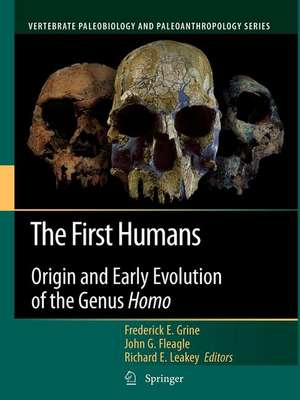
The First Humans: Vertebrate Paleobiology and Paleoanthropology
Editat de Frederick E. Grine, John G Fleagle, Richard E. Leakeyen Limba Engleză Paperback – 28 oct 2010
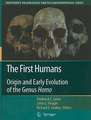
Ediția din 2009 a lucrării The First Humans reprezintă un reper fundamental în paleoantropologia contemporană, oferind o sinteză riguroasă asupra originii și evoluției timpurii a genului Homo. Observăm că această ediție reușește să consolideze datele despre tranziția de la australopitecine la primii reprezentanți ai speciei noastre, integrând capitole noi ce vizează sistematica, taxonomia și contextul climatic al Pliocenului și Pleistocenului. Apreciem în mod deosebit capitolul retrospectiv dedicat speciei Homo habilis, scris de unul dintre „părinții fondatori” ai descoperirii, care oferă o perspectivă istorică rară la peste patru decenii de la momentul zero. Structura volumului este organizată tematic pentru a acoperi toate palierele cercetării actuale: de la perspective teoretice și analize cranio-dentare (cum ar fi proporțiile cuspizilor molari în fosilele din Africa de Sud), până la perspective post-craniene care investighează evoluția umărului și capacitățile de alergare de rezistență. Găsim în această carte o progresie logică, finalizată cu secțiuni dedicate dietei și dezvoltării ontogenetice, inclusiv analize asupra celebrului specimen Nariokotome Youth. Ca alternativă la Stone Tools and Fossil Bones pentru cursurile de antropologie fizică, The First Humans are avantajul unei focalizări stricte pe biologia și taxonomia hominizilor, în timp ce lucrarea lui Manuel Domínguez Rodrigo pune un accent mai mare pe cultura materială și arheologie. În contextul operei editorului Frederick E. Grine, volumul continuă rigoarea metodologică din Evolutionary History of the Robust Australopithecines, dar extinde analiza către ramura care a condus direct la omul modern. Este o lucrare de referință care transformă întrebările teoretice în date empirice verificabile.
Din seria Vertebrate Paleobiology and Paleoanthropology
- 18%
 Preț: 760.78 lei
 - 15%
 Preț: 730.41 lei
 - 15%
 Preț: 736.91 lei
 - 18%
 Preț: 787.60 lei
 - 15%
 Preț: 738.68 lei
 -
 Preț: 400.21 lei
 - 15%
 Preț: 647.98 lei
 -
 Preț: 380.97 lei
 - 20%
 Preț: 679.92 lei
 -
 Preț: 399.88 lei
 - 24%
 Preț: 859.67 lei
 - 15%
 Preț: 719.70 lei
 - 15%
 Preț: 654.27 lei
 - 19%
 Preț: 569.51 lei
 -
 Preț: 436.01 lei
 -
 Preț: 437.58 lei
 -
 Preț: 477.80 lei
 - 24%
 Preț: 817.85 lei
 -
 Preț: 498.13 lei
 - 24%
 Preț: 724.21 lei
 - 20%
 Preț: 694.75 lei
 -
 Preț: 426.40 lei
 - 15%
 Preț: 729.67 lei
 - 18%
 Preț: 771.27 lei
 -
 Preț: 435.04 lei
 - 20%
 Preț: 669.52 lei
 -
 Preț: 403.02 lei
 - 24%
 Preț: 724.20 lei
 - 18%
 Preț: 934.43 lei
 -
 Preț: 392.64 lei
Preț: 876.74 lei
Preț vechi: 1069.20 lei
-18%
Carte tipărită la comandă
Livrare economică 30 noiembrie-14 decembrie
Specificații
ISBN-10: 9048182336
Pagini: 232
Ilustrații: XII, 220 p. 15 illus. in color.
Dimensiuni: 210 x 279 x 15 mm
Greutate: 0.65 kg
Ediția:Softcover reprint of hardcover 1st ed. 2009
Editura: Springer
Colecția Vertebrate Paleobiology and Paleoanthropology
Seria Vertebrate Paleobiology and Paleoanthropology
Locul publicării:Dordrecht, Netherlands
V-ar putea interesa
-
 10% HumanAlanna Collen-5%Preț: 76.00 lei80.00 lei
 -
 Preț: 122.75 lei
 -
 -20%Preț: 78.26 lei98.35 lei
 -
 How To Think Like a NeandertalThomas Wynn-20%Preț: 133.78 lei167.67 lei
 -
 PaleofantasyMarlene ZukPreț: 102.63 lei
 -
 TeethSimon Hillson-11%Preț: 539.63 lei606.33 lei
 -
 The Cambridge Encyclopedia of Human Growth and DevelopmentStanley J Ulijaszek-26%Preț: 1450.37 lei1951.00 lei
 -
 A Companion to Dental AnthropologyJoel D Irish-9%Preț: 1270.54 lei1396.19 lei
 -
 Preț: 374.05 lei
 -
 The Incredible Human JourneyAlice Roberts-26%Preț: 89.85 lei122.07 lei
Public țintă
ResearchDe ce să citești această carte
Această carte este esențială pentru cercetătorii și studenții la antropologie care doresc să înțeleagă mecanismele biologice din spatele apariției genului Homo. Cititorul câștigă acces la studii comparative detaliate între fosilele din Africa de Est și cele din Georgia (Caucaz), oferind o imagine clară asupra diversității umane timpurii. Este un instrument indispensabil pentru cineva care caută să depășească descrierile generale în favoarea unei analize morfologice și evolutive profunde.
Despre autor
Frederick E. Grine este profesor și președinte al Departamentului de Antropologie de la Universitatea de Stat din New York, Stony Brook. Specialist recunoscut în morfologie dentară și evoluție umană, Grine a contribuit masiv la literatura de specialitate prin numeroase articole și volume editate. Experiența sa în scanarea microscopică a țesuturilor mineralizate și anatomia umană regională îi conferă autoritatea necesară pentru a coordona un astfel de volum complex. Alături de Richard E. Leakey, o figură legendară a paleoantropologiei, Grine reușește să adune în acest volum cele mai relevante voci din domeniu.
Descriere scurtă
Cuprins
Recenzii
"This volume provides an up-to-date, concise synthesis of what is known about early Homo and highlights what still remains to be done.” Journal of Human Evolution, 2009
Notă biografică
Fred Grine is Professor of Anthropology and of Anatomical Sciences at Stony Brook University. He has published over 100 articles in scientific journals dealing with the subject of human evolution, and his work on the Late Pleistocene human fossil from Hofmeyr, South Africa, was named by Time Magazine as one of the top ten science stories of 2007. He edited Evolutionary History of the ‘Robust’ Australopithecines (1988, Aldine de Gruyter), and is author of Regional Human Anatomy: a Laboratory Workbook (2002, 2005, 2007, McGraw-Hill).
John G. Fleagle
John Fleagle is Distinguished Professor of Anatomical Sciences at Stony Brook University. He has conducted paleontological field work in many parts of the world, including Argentina, Egypt, Kenya, Ethiopia and India. He is the author of the textbook Primate Adaptation and Evolution (1988, 1999, Elsevier), co-editor of the Human Evolution Sourcebook (1993, 2006, Prentice Hall), and editor of the journal Evolutionary Anthropology.
Richard E. Leakey
Richard Leakey is Professor of Anthropology at Stony Brook University and former Director of the Kenya National Museums and the Kenya Wildlife Service. His field work around Lake Turkana, Kenya, has yielded a treasure trove of hominin fossils that has provided much of the paleontological record on which our understanding of human evolution is based. He has authored a number of books, including Origins, and most recently, The Sixth Extinction: Patterns of Life and The Future of Humankind. He is Chairman of the Board of the Turkana Basin Institute at Stony Brook University.