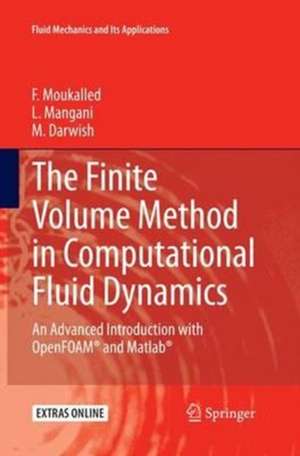
The Finite Volume Method in Computational Fluid Dynamics: Fluid Mechanics and Its Applications, cartea 113
Autor F. Moukalled, L. Mangani, M. Darwishen Limba Engleză Paperback – 25 oct 2016
În analiza sistemelor complexe de fluide, rigoarea numerică și arhitectura algoritmilor de rezolvare reprezintă coloana vertebrală a oricărei simulări de succes. Ne-a atras atenția The Finite Volume Method in Computational Fluid Dynamics tocmai prin abordarea sa metodologică extrem de structurată, care nu se limitează la prezentarea teoretică a ecuațiilor, ci pătrunde adânc în mecanismele de discretizare spațială și temporală. Volumul pune un accent deosebit pe design patterns în contextul CFD, oferind cititorului instrumentele necesare pentru a dezvolta un solver de presiune ne-structurat, esențial în ingineria modernă. Considerăm că forța acestui tratat, publicat de Springer, rezidă în dualitatea implementării practice. Autorii, F. Moukalled, L. Mangani și M. Darwish, ghidează cititorul prin două medii distincte: uFVM, un cod academic implementat în Matlab, ideal pentru înțelegerea structurii interne a algoritmilor, și OpenFOAM®, standardul industrial open-source pentru simulări la scară largă. Complementar volumului Fundamentals of Computational Fluid Dynamics de Clovis R. Maliska, care se concentrează pe fundamentele teoretice ale grilelor ne-structurate, lucrarea de față extinde aria de aplicabilitate prin module dedicate fluxurilor compresibile și modelării turbulenței, oferind o punte directă către producția industrială. Structura celor 764 de pagini reflectă o progresie logică, de la bazele matematice și calculul vectorial, la detalii tehnice despre schemele de înaltă rezoluție și discretizarea termenilor sursă. Fiecare capitol este conceput să sprijine cercetătorul în procesul de testare și validare a modelelor, transformând acest manual într-o resursă tehnică indispensabilă pentru cei care doresc să stăpânească The Finite Volume Method nu doar ca utilizatori de software, ci ca arhitecți de soluții computaționale.
Din seria Fluid Mechanics and Its Applications
- 15%
 Preț: 499.32 lei
 - 18%
 Preț: 793.89 lei
 - 18%
 Preț: 1047.82 lei
 - 15%
 Preț: 593.17 lei
 - 15%
 Preț: 667.93 lei
 - 18%
 Preț: 815.47 lei
 - 18%
 Preț: 809.27 lei
 -
 Preț: 451.85 lei
 - 15%
 Preț: 728.91 lei
 - 18%
 Preț: 986.57 lei
 - 18%
 Preț: 1635.90 lei
 - 18%
 Preț: 1153.12 lei
 - 18%
 Preț: 1157.20 lei
 - 15%
 Preț: 653.01 lei
 - 24%
 Preț: 1210.31 lei
 - 23%
 Preț: 848.62 lei
 - 18%
 Preț: 806.93 lei
 - 18%
 Preț: 995.84 lei
 - 18%
 Preț: 924.80 lei
 - 18%
 Preț: 1043.37 lei
 - 15%
 Preț: 613.57 lei
 - 15%
 Preț: 676.39 lei
 - 15%
 Preț: 669.62 lei
 - 15%
 Preț: 679.46 lei
 - 18%
 Preț: 1712.63 lei
 - 18%
 Preț: 773.54 lei
 - 15%
 Preț: 666.97 lei
 - 24%
 Preț: 890.93 lei
 - 18%
 Preț: 1520.64 lei
 - 18%
 Preț: 987.42 lei
Preț: 598.18 lei
Preț vechi: 738.49 lei
-19%
Carte tipărită la comandă
Livrare economică 30 noiembrie-07 decembrie
Specificații
ISBN-10: 3319348647
Pagini: 820
Ilustrații: XXIII, 791 p. 297 illus., 242 illus. in color.
Dimensiuni: 155 x 235 x 41 mm
Greutate: 1.37 kg
Ediția:Softcover reprint of the original 1st edition 2015
Editura: Springer
Colecția Fluid Mechanics and Its Applications
Seria Fluid Mechanics and Its Applications
Locul publicării:Cham, Switzerland
V-ar putea interesa
-
 Fluid MechanicsPijush K. Kundu-32%Preț: 668.54 lei980.75 lei
 -
 Introduction to Computational Fluid Dynamics, AnH. Versteeg-9%Preț: 615.20 lei676.03 lei
 -
 Incompressible Fluid DynamicsP. A. Davidson-20%Preț: 377.84 lei470.24 lei
 -
 Fluid Mechanics: Volume 4David TongPreț: 250.72 lei
 -
 Incompressible Flow, Fifth EditionRL Panton-23%Preț: 786.68 lei1021.67 lei
 -
 -24%Preț: 404.08 lei531.75 lei
 -
 -11%Preț: 453.17 lei509.18 lei
 -
 Essentials of Computational Fluid DynamicsJens-Dominik Mueller-9%Preț: 945.39 lei1038.88 lei
 -
 Fluid Power, Mathematical Design of Several ComponentsJosep M Bergada-26%Preț: 1338.90 lei1818.45 lei
 -
 An Introduction to SOLIDWORKS Flow Simulation 2024John E. Matsson-20%Preț: 489.28 lei611.60 lei
 -
 An Introduction to Ansys Fluent 2023John E. Matsson-20%Preț: 528.65 lei660.82 lei
 -
 An Introduction to Ansys Fluent 2024John E. Matsson-20%Preț: 541.36 lei676.70 lei
 -
 An Introduction to Ansys Fluent 2025John E. Matsson-20%Preț: 574.69 lei718.37 lei
 -
 -23%Preț: 789.72 lei1025.62 lei
 -
 Applied Numerical Methods for Partial Differential EquationsCarl L. Gardner-15%Preț: 410.77 lei483.25 lei
 -
 -15%Preț: 662.96 lei779.95 lei
 -
 Computational Fluid DynamicsGuoxiang Hou-18%Preț: 929.11 lei1133.07 lei
De ce să citești această carte
Recomandăm această carte cercetătorilor și inginerilor care au nevoie de o înțelegere profundă a algoritmilor din spatele OpenFOAM. Veți câștiga competențe practice de programare CFD prin exemplele în Matlab și veți stăpâni metodele de discretizare pentru fluxuri complexe. Este o investiție în expertiză tehnică, oferind peste 100 de exerciții ce transformă teoria abstractă în soluții numerice funcționale.
Despre autor
F. Moukalled, L. Mangani și M. Darwish sunt experți recunoscuți în domeniul mecanicii fluidelor computaționale, cu o experiență vastă în dezvoltarea algoritmilor numerici. Contribuția lor colectivă se concentrează pe optimizarea metodei volumelor finite pentru grile ne-structurate. M. Darwish și F. Moukalled sunt pionieri în dezvoltarea tehnicilor de discretizare, în timp ce L. Mangani aduce o expertiză valoroasă în implementarea acestor metode în cadrul platformei OpenFOAM®, facilitând tranziția de la cercetarea academică la aplicațiile industriale complexe.
Cuprins
Recenzii
“The book is very attractive, carefully written and easy to read by those interested in learning about finite volume methods for fluid dynamics. The authors have made an important effort to bridge the gap between classroom material and actual model development questions. The text is well illustrated by means of quality figures helping to understand the described concepts. Furthermore, the book contains pieces of academic codes in MATLAB … . It is certainly a useful, practical and valuable book.” (Pilar Garcia-Navarro, Mathematical Reviews, May, 2016)
Notă biografică
Luca Mangani received his PhD degree form the University of Florence in 2006, where he worked on the development of a state-of-the-art turbo machinery code in OpenFOAM® for heat transfer and combustion analysis. After three years of post-doc work,he joined the Lucerne University of Applied Sciences and Arts as Senior Research and chief engineer for CFD simulations. Since 2014 he is serving as an Associate Professor at the fluid mechanics and hydro-machines department, where he manages a variety of projects with industrial partners aimed at developing advanced and novel CFD tools. His research interests include pressure and density-based solvers, segregated and fully coupled algorithms, fluid-structure interaction (FSI), turbulence, and conjugate heat transfer modeling.
Marwan Darwish received his PhD degree in Materials Processing from BRUNEL University in 1991. He then joined the BICOM institute for one year as a post-doc before joining the Mechanical Engineering Department at the American University of Beirut in 1992, where he currently serves as a Professor. His research interest covers a range of topics including solidification, advanced numerics, free surface flow, high resolution schemes, multiphase flows, coupled algorithms, and algebraic multigrid. He is a founding member of the CFD Group at AUB.
Caracteristici
Descriere
This textbook explores both the theoretical foundation of the Finite Volume Method (FVM) and its applications in Computational Fluid Dynamics (CFD). Readers will discover a thorough explanation of the FVM numerics and algorithms used for the simulation of incompressible and compressible fluid flows, along with a detailed examination of the components needed for the development of a collocated unstructured pressure-based CFD solver. Two particular CFD codes are explored. The first is uFVM, a three-dimensional unstructured pressure-based finite volume academic CFD code, implemented within Matlab. The second is OpenFOAM®, an open source framework used in the development of a range of CFD programs for the simulation of industrial scale flow problems.
With over 220 figures, numerous examples and more than one hundred exercise on FVM numerics, programming, and applications, this textbook is suitable for use in an introductory course on the FVM, in an advanced course on numerics, and as a reference for CFD programmers and researchers.