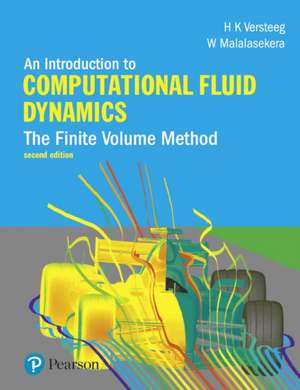
Introduction to Computational Fluid Dynamics, An
Autor H. Versteeg, W. Malalasekeraen Limba Engleză Paperback – 6 feb 2007
Descoperim în această ediție a doua a lucrării An Introduction to Computational Fluid Dynamics un set extins de resurse tehnice destinate înțelegerii fundamentelor mecanicii computaționale a fluidelor. Autorii H. Versteeg și W. Malalasekera pun accent pe metoda volumului finit, oferind o bază solidă pentru utilizatorul novice care dorește să stăpânească ecuațiile de guvernare și condițiile la limită ale fluxurilor de fluide vâscoase. Apreciem în mod deosebit modul în care volumul a evoluat, extinzând capitolele dedicate aplicațiilor complexe de la unul singur la patru, integrând acum teme esențiale precum modelarea arderii și transferul de căldură radiativ. Ca și Pradip Majumdar în Computational Fluid Dynamics and Heat Transfer, autorii distilează experiența reală în principii acționabile, făcând trecerea de la teorie la algoritmi numerici preciși. Structura cărții urmărește o progresie logică, pornind de la legile de conservare a mișcării fluidelor în capitolul 2 și avansând către modelarea turbulenței. Capitolele centrale, de la 4 la 8, sunt dedicate exclusiv metodei volumului finit pentru probleme de difuzie, convecție-difuzie și fluxuri instabile, oferind o claritate algoritmică necesară implementării pe calculator. Suntem de părere că includerea capitolului despre incertitudinea în modelarea CFD și a metodelor pentru geometrii complexe (capitolele 10 și 11) adaugă o valoare practică imensă pentru inginerii care lucrează în medii de producție. Spre deosebire de alte manuale teoretice, acest volum publicat de Pearson reușește să explice nu doar formalismul matematic, ci și soluțiile de cuplare presiune-viteză esențiale în simulările de regim staționar.
Preț: 615.20 lei
Preț vechi: 676.03 lei
-9%
Carte disponibilă
Livrare economică 18 noiembrie-02 decembrie
Livrare express 03-07 noiembrie pentru 54.55 lei
Specificații
ISBN-10: 0131274988
Pagini: 520
Dimensiuni: 189 x 246 x 28 mm
Greutate: 0.99 kg
Ediția:Nouă
Editura: Pearson
Locul publicării:Harlow, United Kingdom
V-ar putea interesa
-
 Fluid MechanicsPijush K. Kundu-31%Preț: 675.59 lei980.75 lei
 -
 -18%Preț: 942.52 lei1149.42 lei
 -
 Turbulence: An Introduction for Scientists and EngineersPeter Davidson-19%Preț: 554.45 lei681.84 lei
 -
 Fluid Mechanics: Volume 4David TongPreț: 250.72 lei
 -
 Modelling Turbulence in Engineering and the EnvironmentKemal Hanjalic-14%Preț: 1172.86 lei1363.79 lei
 -
 -24%Preț: 404.08 lei531.75 lei
 -
 -11%Preț: 453.17 lei509.18 lei
 -
 Essentials of Computational Fluid DynamicsJens-Dominik Mueller-9%Preț: 945.39 lei1038.88 lei
 -
 Computational Fluid Dynamics: Advances in Research and ApplicationsJames S. Hutchinson-26%Preț: 535.09 lei727.51 lei
 -
 An Introduction to ANSYS Fluent 2021John E. Matsson-20%Preț: 473.07 lei591.34 lei
 -
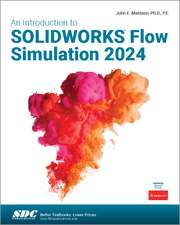 An Introduction to SOLIDWORKS Flow Simulation 2024John E. Matsson-20%Preț: 489.28 lei611.60 lei
 -
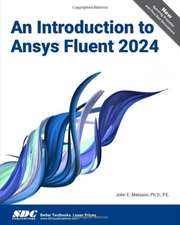 An Introduction to Ansys Fluent 2024John E. Matsson-20%Preț: 541.36 lei676.70 lei
 -
 An Introduction to Ansys Fluent 2025John E. Matsson-20%Preț: 574.69 lei718.37 lei
 -
 -23%Preț: 782.99 lei1016.88 lei
 -
 -15%Preț: 662.96 lei779.95 lei
 -
 -24%Preț: 1068.99 lei1406.56 lei
De ce să citești această carte
Această carte este esențială pentru studenții și inginerii care au nevoie de o introducere riguroasă în metoda volumului finit. Cititorul câștigă o înțelegere profundă a modului în care codurile comerciale de CFD funcționează „sub capotă”, învățând să modeleze turbulența, arderea și transferul termic. Este un instrument practic pentru oricine dorește să dezvolte simulări numerice precise pentru sisteme mecanice complexe.
Descriere
This book presents the fundamentals of computational fluid mechanics for the novice user. It provides a thorough yet user-friendly introduction to the governing equations and boundary conditions of viscous fluid flows, turbulence and its modelling, and the finite volume method of solving flow problems on computers.
Cuprins
Chapter 2 Conservation laws of fluid motion and their boundary conditions
Chapter 3 Turbulence and its modelling
Chapter 4 The finite volume method for diffusion problems
Chapter 5 The finite volume method for convection-diffusion problems
Chapter 6 Solution algorithms for pressure-velocity coupling in steady flows
Chapter 7 Solution of systems of discretised equations
Chapter 8 The finite volume method for unsteady flows
Chapter 9 Implementation of boundary conditions
Chapter 10 Uncertainty in CFD modelling
Chapter 11 Methods for dealing with complex geometries
Chapter 12 CFD modelling of combustion
Chapter 13 Numerical calculation of radiative heat transfer
Appendices
References
Index
Textul de pe ultima copertă
An Introduction to Computational Fluid Dynamics is the ideal text for the newcomer to the area whether they be undergraduates, graduates, or professionals. It provides thorough yet accessible coverage of commercial finite volume based CFD codes within the context of the underlying theory, giving the reader a full appreciation of CFD and its numerous engineering applications.
Key features
- Offers essential support for novice users of commercial CFD codes such as ANSYS CFX, FLUENT, STAR-CD and PHOENICS.
- Covers fluids and turbulence physics together with computational modelling techniques
- Uses a step-by-step approach to introduce the methodology
- Chapter summaries and worked examples throughout to reinforce understanding of the key concepts
- A new chapter describing unstructured meshing techniques
- A new chapter on CFD uncertainty
- New coverage of the fundamentals of Large-Eddy Simulation (LES) and Direct Numerical Simulation (DNS) techniques
- Summaries of TVD techniques and multi-grid solution techniques
- Added examples of the SIMPLE algorithm for pressure-velocity coupling
- Two new chapters with advanced material covering combustion and radiative heat transfer modelling
Caracteristici
- Presents a broad introduction to fluid and turbulence physics and computational modelling techniques.
- Incorporates an advanced applications section.
- Uses easy-to-programme computer algorithms for the PC.
- Includes a substantial review of the latest turbulence modelling techniques.
- Features the predominant commercial CFD codes: PHEONICS, FLUENT, FLOW3D and STARCD.
- SI units used throughout.