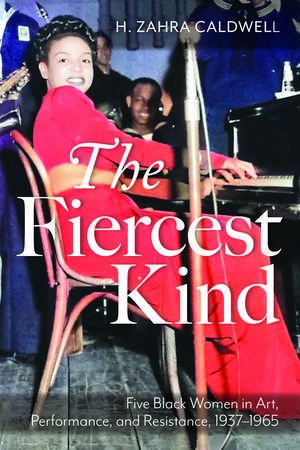
The Fiercest Kind
Autor H Zahra Caldwellen Limba Engleză Paperback – 2 iul 2026
In 1943, the production of the Columbia Pictures film The Heat’s On halted for three days due to an on-set protest by featured performer Hazel Scott. Appalled by the racially demeaning and stereotypical depictions of Black women extras and dancers, Scott—one of the top African American performers of the era—forced the studio to relent. But her protest of Hollywood racism angered powerful white men in the industry, and despite her rising career, she was soon banished from American film.
Scott was far from the only Black woman in a creative field to use her professional success as leverage against prejudice. In The Fiercest Kind, cultural historian H. Zahra Caldwell explores the biographical narratives of five Black women at the top of their artistic crafts in the mid-20th century to understand how they pushed back against racism and sexism. From 1937–1963, pianist Hazel Scott, dancer Katherine Dunham, cartoonist Jackie Ormes, multihyphenate fine artist (graphic artist, painter, and sculptor) Elizabeth Catlett, and singer Lena Horne were among the most popular and nationally known Black women in their respective fields, spanning film, television, print media, and fine art. Generating creative works at the end of the Great Depression through the Civil Rights era, they used their professional and personal lives to confront seemingly insurmountable repression through what Caldwell defines as “layered resistance.”
A Black feminist practice, layered resistance consists of four tactics: claiming and adapting cultural spaces for Black women; strategically crafting positive images of Black womanhood that directly challenge white supremacy; combining performance and/or visual representation with social and political activism; and choosing unconventional lifestyles that defy rigid gender and racial norms. These artists also lived in, worked in, and supported important Black spaces such as Harlem and Black Chicago. Using a methodology that combines textual analysis, archival research, and oral history, Caldwell understands this strategy within larger movements for Black freedom and equality that spanned the twentieth century and continue to the present day.
| Toate formatele și edițiile | Preț | Express |
|---|---|---|
| Paperback (1) | 248.87 lei Precomandă | |
| University of Massachusetts Press – 2 iul 2026 | 248.87 lei Precomandă | |
| Hardback (1) | 517.03 lei Precomandă | |
| University of Massachusetts Press – 2 iul 2026 | 517.03 lei Precomandă |
Preț: 248.87 lei
Precomandă
Puncte Express: 373
Preț estimativ în valută:
44.04€ • 51.64$ • 38.68£
44.04€ • 51.64$ • 38.68£
Carte nepublicată încă
Doresc să fiu notificat când acest titlu va fi disponibil:
Se trimite...
Preluare comenzi: 021 569.72.76
Specificații
ISBN-13: 9781625349323
ISBN-10: 1625349327
Pagini: 216
Ilustrații: 8 illus.
Dimensiuni: 152 x 229 mm
Greutate: 0.45 kg
Editura: University of Massachusetts Press
ISBN-10: 1625349327
Pagini: 216
Ilustrații: 8 illus.
Dimensiuni: 152 x 229 mm
Greutate: 0.45 kg
Editura: University of Massachusetts Press
Notă biografică
H. ZAHRA CALDWELL is associate professor of ethnic and gender studies at Westfield State University. Her work has appeared in Beyoncé in the World: Making Meaning with Queen Bey in Troubled Times and journals such as American Studies Journal, the Journal of African American Studies, and Praxis.
Cuprins
1. Introduction
2. “Whole New Vistas Were Opening”: Katherine Dunham, Race, Gender, and Modern Dance
3. “Colored Performers Represent Their People”: Hazel Scott and Popular and Private Resistance
4. “I Did Black Women Because They Had to Be Done”: Elizabeth Catlett in Resistance and Representation and The Negro Women Series
5. Framing/Claiming Black Womanhood and Outing Injustice: Cartoonist Jackie “Zelda” Ormes and Layered Resistance
6. “You're Getting the Singer Not the Woman”: Lena Horne in Three Acts
Epilogue. Five Women & Altered Landscapes
2. “Whole New Vistas Were Opening”: Katherine Dunham, Race, Gender, and Modern Dance
3. “Colored Performers Represent Their People”: Hazel Scott and Popular and Private Resistance
4. “I Did Black Women Because They Had to Be Done”: Elizabeth Catlett in Resistance and Representation and The Negro Women Series
5. Framing/Claiming Black Womanhood and Outing Injustice: Cartoonist Jackie “Zelda” Ormes and Layered Resistance
6. “You're Getting the Singer Not the Woman”: Lena Horne in Three Acts
Epilogue. Five Women & Altered Landscapes
Recenzii
“Through its rich exploration of the strategies undertaken by a generation of Black women, The Fiercest Kind fills in a gap in our understanding of the continuity and content of resistance against white supremacy, across three crucial decades of the twentieth century.”—Carol A. Stabile, author of The Broadcast 41: Women and the Anti-Communist Blacklist
“Caldwell has written, excellently and wonderfully, about how five individual women—many of whom are understudied—used their artistic opportunities, political consciousness, and personal life choices to claim space for Black women and to redefine Black womanhood.”—Sherrie Tucker, author of Swing Shift: “All-Girl” Bands of the 1940s
“Caldwell has written, excellently and wonderfully, about how five individual women—many of whom are understudied—used their artistic opportunities, political consciousness, and personal life choices to claim space for Black women and to redefine Black womanhood.”—Sherrie Tucker, author of Swing Shift: “All-Girl” Bands of the 1940s