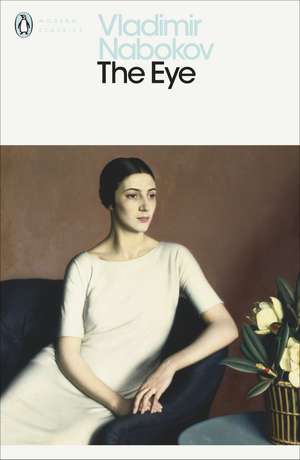
The Eye: Penguin Modern Classics
Autor Vladimir Nabokoven Limba Engleză Paperback – 30 ian 1992
Din seria Penguin Modern Classics
-
 Preț: 57.35 lei
 -
 Preț: 80.02 lei
 -
 Preț: 62.95 lei
 -
 Preț: 59.42 lei
 - 18%
 Preț: 88.47 lei
 -
 Preț: 107.89 lei
 - 27%
 Preț: 56.92 lei
 - 27%
 Preț: 57.22 lei
 - 26%
 Preț: 57.58 lei
 - 26%
 Preț: 53.47 lei
 - 33%
 Preț: 64.11 lei
 - 25%
 Preț: 59.39 lei
 - 28%
 Preț: 51.26 lei
 - 28%
 Preț: 50.90 lei
 - 26%
 Preț: 58.75 lei
 - 30%
 Preț: 66.18 lei
 - 20%
 Preț: 56.42 lei
 - 25%
 Preț: 59.19 lei
 - 24%
 Preț: 61.06 lei
 - 27%
 Preț: 57.17 lei
 - 27%
 Preț: 57.17 lei
 - 27%
 Preț: 51.50 lei
 - 20%
 Preț: 50.90 lei
 - 26%
 Preț: 53.60 lei
 - 25%
 Preț: 59.09 lei
 - 25%
 Preț: 54.09 lei
 - 26%
 Preț: 52.82 lei
 - 33%
 Preț: 65.20 lei
 - 28%
 Preț: 50.94 lei
 - 26%
 Preț: 53.57 lei
 - 20%
 Preț: 55.59 lei
 - 25%
 Preț: 59.29 lei
 - 25%
 Preț: 59.70 lei
 - 26%
 Preț: 57.93 lei
 - 25%
 Preț: 59.03 lei
 - 27%
 Preț: 56.90 lei
 - 27%
 Preț: 56.99 lei
 - 26%
 Preț: 58.06 lei
 - 26%
 Preț: 58.70 lei
 - 26%
 Preț: 57.63 lei
 - 29%
 Preț: 49.73 lei
 - 36%
 Preț: 60.43 lei
 - 26%
 Preț: 58.40 lei
 - 26%
 Preț: 58.53 lei
 - 27%
 Preț: 57.19 lei
 - 28%
 Preț: 49.96 lei
 - 28%
 Preț: 46.51 lei
 - 28%
 Preț: 45.82 lei
 - 26%
 Preț: 57.69 lei
 - 18%
 Preț: 76.38 lei
Preț: 54.56 lei
Preț vechi: 69.22 lei
-21%
Puncte Express: 82
Carte disponibilă
Livrare economică 13-24 noiembrie
Livrare express 24-30 octombrie pentru 28.28 lei
Livrare prin curier în România Termenul estimat este afișat lângă disponibilitate.
Transport gratuit de la 400.00 lei Plată online sau ramburs, în funcție de opțiunile comenzii.
Retur gratuit în 14 zile Comandă securizată și suport în română.
Specificații
ISBN-13: 9780140184822
ISBN-10: 0140184821
Pagini: 96
Dimensiuni: 128 x 198 x 10 mm
Greutate: 0.08 kg
Editura: Penguin Books
Colecția Penguin Modern Classics
Seria Penguin Modern Classics
Locul publicării:London, United Kingdom
ISBN-10: 0140184821
Pagini: 96
Dimensiuni: 128 x 198 x 10 mm
Greutate: 0.08 kg
Editura: Penguin Books
Colecția Penguin Modern Classics
Seria Penguin Modern Classics
Locul publicării:London, United Kingdom
V-ar putea interesa
-
 Einstein's MonstersMartin Amis-20%Preț: 51.13 lei63.84 lei
 -
 PninVladimir Nabokov-27%Preț: 57.22 lei78.09 lei
 -
 DespairVladimir Nabokov-27%Preț: 57.19 lei78.09 lei
 -
 Invitation to a BeheadingVladimir Nabokov-26%Preț: 57.69 lei78.35 lei
 -
 The GiftVladimir Nabokov-30%Preț: 66.18 lei94.11 lei
 -
 Laughter in the DarkVladimir Nabokov-26%Preț: 58.52 lei78.87 lei
 -
 GloryVladimir Nabokov-27%Preț: 57.39 lei78.20 lei
 -
 Look at the Harlequins!Vladimir Nabokov-26%Preț: 58.14 lei78.24 lei
 -
 Transparent ThingsVladimir Nabokov-21%Preț: 55.61 lei70.02 lei
 -
 The Bridge Over The Neroch And Other WorksLeonid TsypkinPreț: 71.57 lei
 -
 Preț: 108.19 lei
 -
 The Stolen Heart: The Kyiv MysteriesAndrey Kurkov-26%Preț: 84.46 lei114.01 lei
 -
 The Naked EyeYoko TawadaPreț: 124.35 lei
 -
 The Eye HunterSebastian Fitzek-25%Preț: 54.56 lei72.78 lei
 -
 A Shadow of MyselfPeter FlammPreț: 105.67 lei
 -
 The Man Who Died Seven TimesYasuhiko NishizawaPreț: 107.94 lei
 -
 Ada, or ArdorVladimir NabokovPreț: 125.89 lei
 -
 Nikolai GogolVladimir Nabokov-26%Preț: 58.05 lei78.60 lei
 -
 A Young Doctor's Notebook: New TranslationMikhail Afanasevich BulgakovPreț: 58.09 lei
 -
 Lovers of Franz K.Burhan Sonmez-20%Preț: 74.64 lei92.88 lei
Descriere
Smurov, a fussily self-conscious Russian tutor, shoots himself after a humiliating beating by his mistress' husband. Unsure whether his suicide has been successful or not, Smurov drifts around Berlin, observing his acquaintances, but finds he can discover very little about his own life from the opinions of his distracted, confused fellow-emigres.
Notă biografică
Vladimir Vladimirovich Nabokov was born on April 23, 1899, in St. Petersburg, Russia. The Nabokovs were known for their high culture and commitment to public service, and the elder Nabokov was an outspoken opponent of antisemitism and one of the leaders of the opposition party, the Kadets. In 1919, following the Bolshevik revolution, he took his family into exile. Four years later he was shot and killed at a political rally in Berlin while trying to shield the speaker from right-wing assassins.
The Nabokov household was trilingual, and as a child Nabokov was already reading Wells, Poe, Browning, Keats, Flaubert, Verlaine, Rimbaud, Tolstoy, and Chekhov, alongside the popular entertainments of Sir Arthur Conan Doyle and Jules Verne. As a young man, he studied Slavic and romance languages at Trinity College, Cambridge, taking his honors degree in 1922. For the next eighteen years he lived in Berlin and Paris, writing prolifically in Russian under the pseudonym Sirin and supporting himself through translations, lessons in English and tennis, and by composing the first crossword puzzles in Russian. In 1925 he married Vera Slonim, with whom he had one child, a son, Dmitri.
Having already fled Russia and Germany, Nabokov became a refugee once more in 1940, when he was forced to leave France for the United States. There he taught at Wellesley, Harvard, and Cornell. He also gave up writing in Russian and began composing fiction in English. In his afterword to Lolita he claimed: "My private tragedy, which cannot, and indeed should not, be anybody's concern, is that I had to abandon my natural idiom, my untrammeled, rich, and infinitely docile Russian tongue for a second-rate brand of English, devoid of any of those apparatuses--the baffling mirror, the black velvet backdrop, the implied associations and traditions--which the native illusionist, frac-tails flying, can magically use to transcend the heritage in his own way." [p. 317] Yet Nabokov's American period saw the creation of what are arguably his greatest works, Bend Sinister (1947), Lolita (1955), Pnin (1957), and Pale Fire (1962), as well as the translation of his earlier Russian novels into English. He also undertook English translations of works by Lermontov and Pushkin and wrote several books of criticism. Vladimir Nabokov died in Montreux, Switzerland, in 1977.
The Nabokov household was trilingual, and as a child Nabokov was already reading Wells, Poe, Browning, Keats, Flaubert, Verlaine, Rimbaud, Tolstoy, and Chekhov, alongside the popular entertainments of Sir Arthur Conan Doyle and Jules Verne. As a young man, he studied Slavic and romance languages at Trinity College, Cambridge, taking his honors degree in 1922. For the next eighteen years he lived in Berlin and Paris, writing prolifically in Russian under the pseudonym Sirin and supporting himself through translations, lessons in English and tennis, and by composing the first crossword puzzles in Russian. In 1925 he married Vera Slonim, with whom he had one child, a son, Dmitri.
Having already fled Russia and Germany, Nabokov became a refugee once more in 1940, when he was forced to leave France for the United States. There he taught at Wellesley, Harvard, and Cornell. He also gave up writing in Russian and began composing fiction in English. In his afterword to Lolita he claimed: "My private tragedy, which cannot, and indeed should not, be anybody's concern, is that I had to abandon my natural idiom, my untrammeled, rich, and infinitely docile Russian tongue for a second-rate brand of English, devoid of any of those apparatuses--the baffling mirror, the black velvet backdrop, the implied associations and traditions--which the native illusionist, frac-tails flying, can magically use to transcend the heritage in his own way." [p. 317] Yet Nabokov's American period saw the creation of what are arguably his greatest works, Bend Sinister (1947), Lolita (1955), Pnin (1957), and Pale Fire (1962), as well as the translation of his earlier Russian novels into English. He also undertook English translations of works by Lermontov and Pushkin and wrote several books of criticism. Vladimir Nabokov died in Montreux, Switzerland, in 1977.