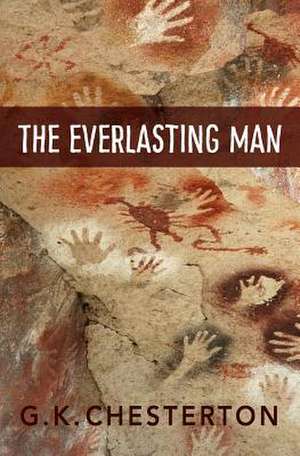
The Everlasting Man
Autor G. K. Chestertonen Limba Engleză Paperback
"The Everlasting Man" is a Christian apologetics book written by G. K. Chesterton. Published in 1925, it is to some extent a deliberate rebuttal of H. G. Wells' "The Outline of History, " disputing Wells' portrayals of human life and civilization as a seamless development from animal life and of Jesus Christ as merely another charismatic figure. Whereas "Orthodoxy" detailed Chesterton's own spiritual journey, in this book he tries to illustrate the spiritual journey of humanity, or at least of Western civilization.
Preț: 100.06 lei
Puncte Express: 150
Carte disponibilă
Livrare economică 30 noiembrie-14 decembrie
Livrare prin curier în România Termenul estimat este afișat lângă disponibilitate.
Transport gratuit de la 400.00 lei Plată online sau ramburs, în funcție de opțiunile comenzii.
Retur gratuit în 14 zile Comandă securizată și suport în română.
Specificații
ISBN-13: 9781942796046
ISBN-10: 1942796048
Pagini: 294
Dimensiuni: 133 x 203 x 17 mm
Greutate: 0.34 kg
Editura: Letcetera Publishing
ISBN-10: 1942796048
Pagini: 294
Dimensiuni: 133 x 203 x 17 mm
Greutate: 0.34 kg
Editura: Letcetera Publishing
V-ar putea interesa
-
 Mere ChristianityC. S. LewisPreț: 79.23 lei
-
 Christ and CultureH Richard NiebuhrPreț: 100.64 lei
-
 The Imitation of ChristThomas a. Kempis-36%Preț: 59.87 lei93.11 lei
-
 Philip Yancey Recommends: OrthodoxyG. K. ChestertonPreț: 74.34 lei
-
 OrthodoxyG. K. Chesterton-17%Preț: 30.33 lei36.40 lei
-
 A History of Western PhilosophyBertrand RussellPreț: 197.34 lei
-
 Why I Am Not a ChristianBertrand RussellPreț: 110.38 lei
-
 Collected Works of G.K. ChestertonG. K. ChestertonPreț: 129.24 lei
-
 Collected Works of G.K. ChestertonG. K. ChestertonPreț: 168.41 lei
-
 The Spiritual ManWatchman NeePreț: 138.74 lei
-
 A History of Philosophy: The Condensed CoplestonAnthony Carroll-49%Preț: 139.55 lei272.53 lei
-
 St. Thomas AquinasG. K. ChestertonPreț: 46.53 lei
-
 OrthodoxyGilbert K. ChestertonPreț: 47.95 lei
-
 HereticsG. K. ChestertonPreț: 46.29 lei
-
 The Everyman ChestertonG. K. Chesterton-15%Preț: 127.23 lei149.25 lei
-
 The Man Who Was ThursdayG. K. ChestertonPreț: 38.95 lei
-
 ManaliveG. K. ChestertonPreț: 39.70 lei
-
 The New JerusalemG. K. ChestertonPreț: 46.05 lei
-
 Everlasting Man (Edition2023)G. K. ChestertonPreț: 105.85 lei
Notă biografică
G. K. Chesterton (1874-1936) was a prolific English writer, philosopher, lay theologian, and literary and art critic. He is best known in mystery circles as the creator of the fictional priest-detective Father Brown and for the metaphysical thriller The Man Who Was Thursday. Often referred to as "the prince of paradox," Chesterton frequently made his points by turning familiar sayings and proverbs inside out. Chesterton attended the Slade School of Art, a department of University College London, where he took classes in illustration and literature, though he did not complete a degree in either subject. In 1895, at the age of twenty-one, he began working for the London publisher George Redway. A year later he moved to another publisher, T. Fisher Unwin, where he undertook his first work in journalism, illustration, and literary criticism. In addition to writing fifty-three Father Brown stories, Chesterton authored articles and books of social criticism, philosophy, theology, economics, literary criticism, biography, and poetry.