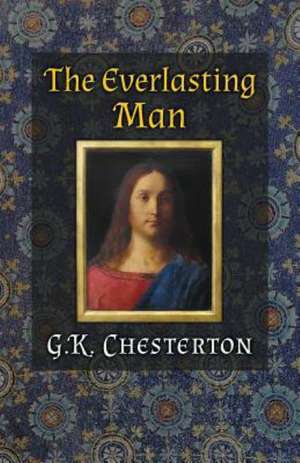
The Everlasting Man
Autor G. K. Chestertonen Limba Engleză Paperback – 19 iul 2013
As Chesterton writes, "when we do make this imaginative effort to see the whole thing from the outside, we find that it really looks like what is traditionally said about it inside." Looking at Christianity with such new-found sight, one can only be astonished at "the strangest story in the world." The Everlasting Man is the tale of a unique creature, man, made in the image of God, and of the God-Made-Man who fully reveals this fact to him. There is a spiritual path, and mankind has wandered over it with myriad gaits through the centuries. Nevertheless, the path that leads to man's true home begins with the Nativity and ends with the Resurrection, and in between is contained all life and all holiness.
Preț: 79.92 lei
Puncte Express: 120
Carte tipărită la comandă
Livrare economică 25 noiembrie-09 decembrie
Livrare prin curier în România Termenul estimat este afișat lângă disponibilitate.
Transport gratuit de la 400.00 lei Plată online sau ramburs, în funcție de opțiunile comenzii.
Retur gratuit în 14 zile Comandă securizată și suport în română.
Specificații
ISBN-13: 9781621380436
ISBN-10: 1621380432
Pagini: 248
Dimensiuni: 140 x 216 x 15 mm
Greutate: 0.36 kg
Editura: Angelico Press
ISBN-10: 1621380432
Pagini: 248
Dimensiuni: 140 x 216 x 15 mm
Greutate: 0.36 kg
Editura: Angelico Press
V-ar putea interesa
-
 Mere ChristianityC. S. LewisPreț: 79.23 lei
 -
 Christ and CultureRichard H NeibuhrPreț: 97.46 lei
 -
 The Imitation of ChristThomas À Kempis-37%Preț: 58.99 lei93.04 lei
 -
 Philip Yancey Recommends: OrthodoxyG. K. ChestertonPreț: 71.82 lei
 -
 OrthodoxyG. K. Chesterton-18%Preț: 30.00 lei36.40 lei
 -
 A History of Western PhilosophyBertrand RussellPreț: 197.03 lei
 -
 Why I Am Not a ChristianBertrand RussellPreț: 106.13 lei
 -
 Collected Works of G.K. ChestertonG. K. ChestertonPreț: 124.34 lei
 -
 Collected Works of G.K. ChestertonG. K. ChestertonPreț: 165.32 lei
 -
 The Spiritual ManWatchman NeePreț: 137.96 lei
 -
 A History of Philosophy: The Condensed CoplestonAnthony Carroll-49%Preț: 137.75 lei272.53 lei
 -
 St. Thomas AquinasG. K. ChestertonPreț: 46.53 lei
 -
 OrthodoxyGilbert K. ChestertonPreț: 47.95 lei
 -
 HereticsG. K. ChestertonPreț: 46.29 lei
 -
 The Everyman ChestertonG. K. Chesterton-16%Preț: 125.06 lei149.03 lei
 -
 The Man Who Was ThursdayG. K. ChestertonPreț: 38.95 lei
 -
 ManaliveG. K. ChestertonPreț: 38.39 lei
 -
 The New JerusalemG. K. ChestertonPreț: 44.37 lei
 -
 Everlasting Man (Edition2023)G. K. ChestertonPreț: 102.00 lei
Notă biografică
G.K.Chesterton, in full Gilbert Keith Chesterton (29 May 1874-14 June 1936), English critic and author of poetry, essays, novels, and short stories, known also for his dynamic personality and obese figure. He was an important English writer of the early twentieth century. His productive and various output included journalism, poetry, biography, Christian apologetics, fantasy and detective fiction. He has been concerned to as the 'prince of paradox'. He devoted his extraordinary brain and creative power to the reform of English government and society. He was knowledgeable at St. Paul's, and went to art school at University College London. He wrote 100 books, contributions to 200 more, hundreds of poems, including the epic Ballad of the White Horse, five plays, five novels, and some short stories, including a popular series featuring the priest-detective, Father Brown. Chesterton expired on 14 June 1936 at his home in Beaconsfield, Buckinghamshire.