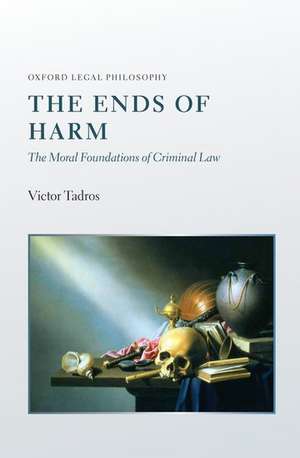
The Ends of Harm: The Moral Foundations of Criminal Law: Oxford Legal Philosophy
Autor Victor Tadrosen Limba Engleză Hardback – 15 sep 2011
Din seria Oxford Legal Philosophy
- 15%
 Preț: 364.29 lei
 - 33%
 Preț: 677.81 lei
 - 32%
 Preț: 700.34 lei
 - 30%
 Preț: 557.84 lei
 - 30%
 Preț: 799.69 lei
 - 30%
 Preț: 729.63 lei
 - 20%
 Preț: 304.16 lei
 - 21%
 Preț: 302.44 lei
 - 11%
 Preț: 267.15 lei
 -
 Preț: 354.01 lei
 - 31%
 Preț: 775.83 lei
 - 31%
 Preț: 708.21 lei
 - 32%
 Preț: 597.27 lei
 - 31%
 Preț: 708.65 lei
 - 30%
 Preț: 668.32 lei
 - 31%
 Preț: 739.14 lei
Preț: 934.01 lei
Preț vechi: 1334.01 lei
-30%
Puncte Express: 1401
Carte tipărită la comandă
Livrare economică 10-16 decembrie
Livrare prin curier în România Termenul estimat este afișat lângă disponibilitate.
Transport gratuit pentru acest produs Plată online sau ramburs, în funcție de opțiunile comenzii.
Retur gratuit în 14 zile Comandă securizată și suport în română.
Specificații
ISBN-13: 9780199554423
ISBN-10: 0199554420
Pagini: 384
Dimensiuni: 163 x 236 x 30 mm
Greutate: 0.75 kg
Editura: OUP OXFORD
Colecția OUP Oxford
Seria Oxford Legal Philosophy
Locul publicării:Oxford, United Kingdom
ISBN-10: 0199554420
Pagini: 384
Dimensiuni: 163 x 236 x 30 mm
Greutate: 0.75 kg
Editura: OUP OXFORD
Colecția OUP Oxford
Seria Oxford Legal Philosophy
Locul publicării:Oxford, United Kingdom
V-ar putea interesa
-
 -32%Preț: 661.32 lei975.38 lei
 -
 Punishment for the Greater GoodAdam J. Kolber-29%Preț: 523.49 lei734.98 lei
 -
 Responsibility and DesertMichael McKenna-29%Preț: 395.73 lei560.38 lei
 -
 The Oxford Handbook of the Philosophy of PunishmentJesper Ryberg-31%Preț: 699.14 lei1009.98 lei
 -
 Rights and Resistance: Interpersonal and Political Implications of Our RightsChristopher Heath Wellman-29%Preț: 447.69 lei628.12 lei
 -
 A Reader on PunishmentR. A. Duff-23%Preț: 453.06 lei584.99 lei
 -
 From Morality to Law and Back Again: A Liber Amicorum for John GardnerMichelle Madden Dempsey-32%Preț: 667.70 lei976.74 lei
 -
 Violence in ProportionPatrick Tomlin-29%Preț: 533.60 lei755.33 lei
 -
 Wrongdoing and the Moral EmotionsDerk Pereboom-20%Preț: 162.62 lei203.46 lei
 -
 Preț: 259.96 lei
 -
 On What Matters: Volume OneDerek Parfit-14%Preț: 230.09 lei267.29 lei
 -
 Preț: 303.07 lei
 -
 The Morality of LawLon L. FullerPreț: 195.53 lei
 -
 Wrongs and Rights Come ApartNicolas CornellPreț: 357.03 lei
 -
 Just DesertsDaniel C DennettPreț: 94.26 lei
 -
 Rights in Criminal Law: Studies on a New Paradigm in Criminal Law and ProcedurePhilipp-Alexander Hirsch-32%Preț: 649.79 lei960.79 lei
 -
 -45%Preț: 476.82 lei865.77 lei
 -
 The Immorality of PunishmentMichael J. Zimmerman-14%Preț: 269.54 lei313.23 lei
 -
 NeurolawSjors Ligthart-9%Preț: 598.81 lei658.03 lei
Recenzii
Anyone who performs the seemingly impossible task of providing a plausible account of criminal punishment, especially a hybrid account that accommodates both deterrent and dentological intuitions, should be applauded ... I admire the ambition, the scope, and the ingenuity of Tadros's Duty and Theory of Punishment
A stimulating, original and well-written account that prompts a reconsideration of the existing foundation of punishment.
Tadros has put his agile, analytical mind to work to solve a problem that should be of central concern to all of us. And in that spirit, his work should be read and celebrated.
If Tadros is right, philosophers of punishment must be moral and political philosophers too, and their philosophical horizons must expand accordingly. That it doubles as an attempt to meet this challenge makes ^iThe End of Harm^r an invigorating read.
Victor Tadros has produced a powerful and highly original moral justification for a practice of state punishment that would be more purposeful and humane than any presently existing system of criminal punishment. He argues with great cogency that the permissibility of punishment and the permissibility of self-defense have their common source in the enforcement of duties that wrongdoers owe to their victims. In the course of meticulously defending these comprehensive accounts of the right to punish and the right of self-defense, he illuminates a range of central issues in normative ethics, political philosophy, and legal theory. The Ends of Harm presents a profound and brilliant challenge both to our institutions of punishment and to our traditional ways of justifying them.
Victor Tadros is one of the brightest, most inventive theorists working on the morality of punishment, and his admirable insight and creativity are on full display in this very impressive book.
Tadros's new book makes striking and original contributions not only to penal theory, but to moral philosophy more broadly. Starting from a vivid reminder of just how morally problematic the practice of state punishment is, he develops an instrumentalist account of punishment as general deterrence, but does so on the basis of a firmly non-instrumentalist, Kantian moral theory to which the idea of respect for persons (along with the 'means principle' that forbids treating people as means) is central. The key new idea here is that those who commit crimes acquire duties to their victims, including the duty to protect them against future harm; this, Tadros argues, can then justify the imposition of deterrent punishments as a way of enforcing those protective duties.
The book is rife with intriguing insights, original ideas but also new twists on old ones, and important and far-reaching arguments. Despite this wealth of content, however, Tadros keeps his eyes on the prize and the basic argument is precise, concise and admirably clearly developed.
A stimulating, original and well-written account that prompts a reconsideration of the existing foundation of punishment.
Tadros has put his agile, analytical mind to work to solve a problem that should be of central concern to all of us. And in that spirit, his work should be read and celebrated.
If Tadros is right, philosophers of punishment must be moral and political philosophers too, and their philosophical horizons must expand accordingly. That it doubles as an attempt to meet this challenge makes ^iThe End of Harm^r an invigorating read.
Victor Tadros has produced a powerful and highly original moral justification for a practice of state punishment that would be more purposeful and humane than any presently existing system of criminal punishment. He argues with great cogency that the permissibility of punishment and the permissibility of self-defense have their common source in the enforcement of duties that wrongdoers owe to their victims. In the course of meticulously defending these comprehensive accounts of the right to punish and the right of self-defense, he illuminates a range of central issues in normative ethics, political philosophy, and legal theory. The Ends of Harm presents a profound and brilliant challenge both to our institutions of punishment and to our traditional ways of justifying them.
Victor Tadros is one of the brightest, most inventive theorists working on the morality of punishment, and his admirable insight and creativity are on full display in this very impressive book.
Tadros's new book makes striking and original contributions not only to penal theory, but to moral philosophy more broadly. Starting from a vivid reminder of just how morally problematic the practice of state punishment is, he develops an instrumentalist account of punishment as general deterrence, but does so on the basis of a firmly non-instrumentalist, Kantian moral theory to which the idea of respect for persons (along with the 'means principle' that forbids treating people as means) is central. The key new idea here is that those who commit crimes acquire duties to their victims, including the duty to protect them against future harm; this, Tadros argues, can then justify the imposition of deterrent punishments as a way of enforcing those protective duties.
The book is rife with intriguing insights, original ideas but also new twists on old ones, and important and far-reaching arguments. Despite this wealth of content, however, Tadros keeps his eyes on the prize and the basic argument is precise, concise and admirably clearly developed.
Notă biografică
Victor Tadros is Professor of Criminal Law and Legal Theory at the University of Warwick. Prior to his appointment at Warwick he held positions at the Universities of Aberdeen and Edinburgh. He has written on criminal responsibility, criminal offences, criminal trials, the presumption of innocence, just war theory, and various aspects of moral and political philosophy. He is currently engaged in a major project on criminalization with Antony Duff, Lindsay Farmer, Sandra Marshall, and Massimo Renzo, funded by the AHRC for which he is currently writing a book entitled Wrongs and Crimes.