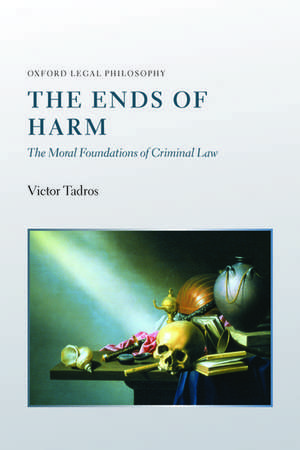
The Ends of Harm: The Moral Foundations of Criminal Law
Autor Victor Tadrosen Limba Engleză Paperback – 27 iun 2013
Reținem un fapt alarmant care stă la baza acestei analize riguroase: în fiecare an, statele democratice moderne privează de libertate mii de cetățeni, provocând distrugerea relațiilor sociale și pierderea locurilor de muncă, totul cu un efort financiar public colosal. În acest context, The Ends of Harm nu este doar o analiză juridică, ci o interogație morală profundă asupra modului în care o democrație poate justifica violența instituționalizată. Ne-a atras atenția modul în care Victor Tadros respinge dihotomia clasică dintre retributivism (pedeapsa ca scop în sine) și consecvențialism (pedeapsa ca mijloc de descurajare), propunând în schimb „perspectiva datoriei”. Autorul argumentează că permisiunea statului de a pedepsi derivă direct din datoriile pe care infractorul le dobândește prin actul său: datoria de a recunoaște eroarea morală și cea de a proteja comunitatea împotriva recidivei. Ca și Hyman Gross în Crime and Punishment, autorul distilează experiență reală în principii acționabile, însă Victor Tadros merge mai departe, integrând o teorie morală non-consecvențialistă care impune constrângeri etice stricte asupra modului în care statul poate urmări „binele comun”. Această lucrare continuă cercetările sale anterioare din Criminal Responsibility și The Boundaries of the Criminal Law, rafinând conceptele de responsabilitate și criminalizare. Merită menționat că structura narativă a cărții face o paralelă inedită între mecanismele autoapărării și cele ale pedepsei penale, oferind o bază logică solidă pentru utilizarea forței în dreptul public.
Preț: 341.60 lei
Preț vechi: 387.91 lei
-12%
Carte tipărită la comandă
Livrare economică 17-22 iulie
Specificații
ISBN-10: 0199681910
Pagini: 388
Dimensiuni: 197 x 234 x 22 mm
Greutate: 0.61 kg
Editura: Oxford University Press
Colecția OUP Oxford
Locul publicării:Oxford, United Kingdom
V-ar putea interesa
-
 -34%Preț: 606.50 lei912.74 lei
 -
 Punishment for the Greater GoodAdam J. Kolber-31%Preț: 473.76 lei685.58 lei
 -
 Responsibility and DesertMichael McKenna-31%Preț: 362.30 lei523.23 lei
 -
 The Oxford Handbook of the Philosophy of PunishmentJesper Ryberg-23%Preț: 1086.18 lei1410.62 lei
 -
 Rights and Resistance: Interpersonal and Political Implications of Our RightsChristopher Heath Wellman-31%Preț: 427.26 lei618.38 lei
 -
 A Reader on PunishmentR. A. Duff-23%Preț: 453.06 lei584.99 lei
 -
 From Morality to Law and Back Again: A Liber Amicorum for John GardnerMichelle Madden Dempsey-33%Preț: 608.70 lei914.09 lei
 -
 Violence in ProportionPatrick Tomlin-31%Preț: 514.07 lei743.48 lei
 -
 Wrongdoing and the Moral EmotionsDerk Pereboom-23%Preț: 148.16 lei191.22 lei
 -
 Preț: 250.22 lei
 -
 On What Matters: Volume OneDerek Parfit-16%Preț: 200.78 lei238.16 lei
 -
 Preț: 283.97 lei
 -
 The Morality of LawLon L. FullerPreț: 192.46 lei
 -
 Wrongs and Rights Come ApartNicolas CornellPreț: 343.21 lei
 -
 Preț: 249.76 lei
 -
 Just DesertsDaniel C. DennettPreț: 92.77 lei
 -
 Rights in Criminal Law: Studies on a New Paradigm in Criminal Law and ProcedurePhilipp-Alexander Hirsch-33%Preț: 622.38 lei931.39 lei
 -
 -46%Preț: 456.80 lei838.61 lei
 -
 NeurolawSjors Ligthart-9%Preț: 571.14 lei627.63 lei
De ce să citești această carte
Această carte este esențială pentru specialiștii în drept penal și filozofie politică. Veți învăța să priviți pedeapsa nu ca pe o răzbunare sau o simplă metodă de descurajare, ci ca pe o obligație morală a infractorului față de societate. Este o lectură densă care oferă argumente noi pentru legitimarea sistemului judiciar, fiind utilă celor care doresc să înțeleagă fundamentele etice din spatele gratiilor.
Despre autor
Victor Tadros este un reputat teoretician al dreptului, activând în prezent ca lector în cadrul Universității din Edinburgh. Expertiza sa se concentrează pe intersecția dintre filozofia morală și dreptul penal, fiind o voce de referință în dezbaterile contemporane despre criminalizare și etica războiului. Lucrările sale, precum Wrongs and Crimes sau To Do, To Die, To Reason Why, sunt recunoscute pentru rigoarea analitică și pentru capacitatea de a redefini concepte fundamentale precum responsabilitatea juridică și limitele intervenției statului în libertatea individuală.