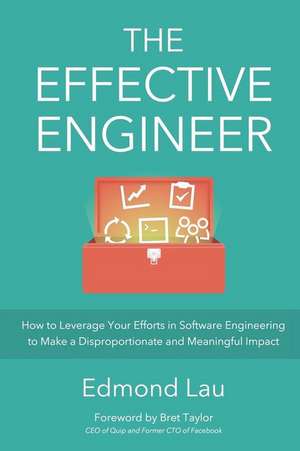
The Effective Engineer
Autor Edmond Lau Cuvânt înainte de Bret Tayloren Limba Engleză Paperback
Complementar volumului Software Engineering at Google: Lessons Learned from Programming Over Time, care se concentrează pe sustenabilitatea bazei de cod pe termen lung, The Effective Engineer acoperă zona productivității individuale și de echipă prin prisma impactului direct. Ne-a atras atenția modul în care Edmond Lau reușește să distileze experiențele colective ale liderilor din Silicon Valley într-un cadru de lucru unitar, bazat pe conceptul de „leverage” (pârghie). Spre deosebire de alte resurse teoretice, această lucrare este un ghid pragmatic despre cum să obții rezultate de zece ori mai mari fără a lucra de zece ori mai mult.
Apreciem rigoarea cu care autorul a documentat succesele unor echipe de elită. De exemplu, este analizat modul în care echipa de infrastructură de la Facebook a operat mii de servere de baze de date sau cum Quora a implementat un sistem ce permitea 40-50 de livrări de cod în producție pe zi. Aceste studii de caz nu sunt doar anecdotice; ele servesc drept fundament pentru tehnici deprinderea unor obiceiuri esențiale: scurtarea ciclurilor de debugging, producerea unor estimări software mai precise și găsirea echilibrului optim între abstractizare și datoria tehnică.
Textul este structurat pentru a fi aplicat imediat în fluxul de lucru zilnic. Nu este un manual de programare, ci unul de inginerie eficientă, punând accent pe măsurarea impactului prin metrici clare și pe validarea rapidă a ipotezelor pentru a reduce risipa de efort. Ritmul este alert, axat pe soluții la problemele de „bottleneck” atât tehnice, cât și umane, fiind o resursă valoroasă pentru cei care doresc să treacă de la simpla scriere de cod la generarea de valoare strategică în organizație.
Preț: 215.81 lei
Preț vechi: 269.75 lei
-20%
Carte disponibilă
Livrare economică 07-21 noiembrie
Specificații
ISBN-10: 0996128107
Pagini: 260
Dimensiuni: 152 x 226 x 18 mm
Greutate: 0.36 kg
Editura: Effective Bookshelf
V-ar putea interesa
-
 The Effective ExecutivePeter F. DruckerPreț: 205.65 lei
 -
 Modern Software EngineeringDavid Farley-20%Preț: 223.44 lei279.30 lei
 -
 Succeeding with AgileMike Cohn-20%Preț: 309.60 lei387.00 lei
 -
 Team: Getting Things Done with OthersDavid Allen-26%Preț: 101.79 lei137.24 lei
 -
 -17%Preț: 169.45 lei205.17 lei
 -
 ImpactJo OwenPreț: 90.80 lei
 -
 180 Business Hacks: Little Changes, Big DifferenceRoel de Graaf-27%Preț: 77.16 lei105.78 lei
 -
 -27%Preț: 98.73 lei135.68 lei
 -
 HBR's 10 Must Reads on LeadershipHarvard Business ReviewPreț: 131.37 lei
 -
 Preț: 135.29 lei
 -
 CodersClive Thompson-47%Preț: 53.51 lei100.38 lei
 -
 Street CoderSedat Kapanoglu-20%Preț: 277.22 lei346.53 lei
 -
 Good Code, Bad CodeTom Long-20%Preț: 370.73 lei463.41 lei
 -
 Think Like a Software Engineering ManagerAkanksha GuptaPreț: 340.66 lei
 -
 -19%Preț: 68.83 lei84.97 lei
 -
 Great by ChoiceJim CollinsPreț: 146.95 lei
 -
 ClickJake KnappPreț: 137.41 lei
 -
 Preț: 145.41 lei
De ce să citești această carte
Recomandăm această carte inginerilor software care vor să își accelereze cariera învățând să prioritizeze activitățile cu impact major. Cititorul câștigă un set de instrumente practice pentru a reduce timpul pierdut cu mentenanța și a maximiza livrarea de funcționalități noi. Este o investiție esențială pentru a înțelege mentalitatea care separă un programator obișnuit de un lider tehnic performant în companii de top.
Descriere scurtă
The most effective engineers - the ones who have risen to become distinguished engineers and leaders at their companies - can produce 10 times the impact of other engineers, but they're not working 10 times the hours.
They've internalized a mindset that took me years of trial and error to figure out. I'm going to share that mindset with you - along with hundreds of actionable techniques and proven habits - so you can shortcut those years.
Introducing "The Effective Engineer" - the only book designed specifically for today's software engineers, based on extensive interviews with engineering leaders at top tech companies, and packed with hundreds of techniques to accelerate your career.
For two years, I embarked on a quest seeking an answer to one question:
How do the most effective engineers make their efforts, their teams, and their careers more successful?
I interviewed and collected stories from engineering VPs, directors, managers, and other leaders at today's top software companies: established, household names like Google, Facebook, Twitter, and LinkedIn; rapidly growing mid-sized companies like Dropbox, Square, Box, Airbnb, and Etsy; and startups like Reddit, Stripe, Instagram, and Lyft.
These leaders shared stories about the most valuable insights they've learned and the most common and costly mistakes that they've seen engineers - sometimes themselves - make.
This is just a small sampling of the hard questions I posed to them: What engineering qualities correlate with future success? What have you done that has paid off the highest returns? What separates the most effective engineers you've worked with from everyone else? What's the most valuable lesson your team has learned in the past year? What advice do you give to new engineers on your team?
Everyone's story is different, but many of the lessons share common themes.
You'll get to hear stories like: How did Instagram's team of 5 engineers build and support a service that grew to over 40 million users by the time the company was acquired? How and why did Quora deploy code to production 40 to 50 times per day? How did the team behind Google Docs become the fastest acquisition to rewrite its software to run on Google's infrastructure? How does Etsy use continuous experimentation to design features that are "guaranteed" to increase revenue at launch? How did Facebook's small infrastructure team effectively operate thousands of database servers? How did Dropbox go from barely hiring any new engineers to nearly tripling its team size year-over-year?
What's more, I've distilled their stories into actionable habits and lessons that you can follow step-by-step to make your career and your team more successful.
The skills used by effective engineers are all learnable.
And I'll teach them to you. With "The Effective Engineer," I'll teach you a unifying framework called leverage - the value produced per unit of time invested - that you can use to identify the activities that produce disproportionate results.
Here's a sneak peek at some of the lessons you'll learn. You'll learn how to: Prioritize the right projects and tasks to increase your impact. Earn more leeway from your peers and managers on your projects. Spend less time "maintaining" and "fixing" software and more time "building" and "shipping" new features. Produce more accurate software estimates. Validate your ideas cheaply to reduce wasted work. Navigate organizational and people-related bottlenecks. Find the appropriate level of code reviews, testing, abstraction, and technical debt to balance speed and quality. Shorten your debugging workflow to increase your iteration speed. Use metrics to quantify your impact and consistently make progress.