
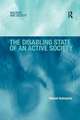
The Disabling State of an Active Society: Welfare and Society
Autor Mikael Holmqvisten Limba Engleză Hardback – 17 sep 2009
| Toate formatele și edițiile | Preț | Express |
|---|---|---|
| Paperback (1) | 443.51 lei 43-57 zile | |
| Taylor & Francis – 23 noi 2016 | 443.51 lei 43-57 zile | |
| Hardback (1) | 1065.31 lei 43-57 zile | |
| Taylor & Francis – 17 sep 2009 | 1065.31 lei 43-57 zile |
Preț: 1065.31 lei
Preț vechi: 1299.17 lei
-18% Nou
Puncte Express: 1598
Preț estimativ în valută:
188.54€ • 221.11$ • 165.31£
188.54€ • 221.11$ • 165.31£
Carte tipărită la comandă
Livrare economică 26 ianuarie-09 februarie 26
Preluare comenzi: 021 569.72.76
Specificații
ISBN-13: 9780754678328
ISBN-10: 0754678326
Pagini: 178
Dimensiuni: 156 x 234 x 11 mm
Greutate: 0.43 kg
Ediția:1
Editura: Taylor & Francis
Colecția Routledge
Seria Welfare and Society
Locul publicării:Oxford, United Kingdom
ISBN-10: 0754678326
Pagini: 178
Dimensiuni: 156 x 234 x 11 mm
Greutate: 0.43 kg
Ediția:1
Editura: Taylor & Francis
Colecția Routledge
Seria Welfare and Society
Locul publicării:Oxford, United Kingdom
V-ar putea interesa
-
 Master of WarSuzanne SimonsPreț: 102.45 lei
 -
 Angler: The Cheney Vice PresidencyBarton GellmanPreț: 135.26 lei
 -
 Brazil on the RiseLarry RohterPreț: 115.11 lei
 -
 Environmental Politics: The Age of Climate ChangeRobert GarnerPreț: 271.36 lei
 -
 Preț: 377.68 lei
 -
 Preț: 289.25 lei
 -
 The Cambridge Companion to MachiavelliJohn M. NajemyPreț: 270.19 lei
 -
 Imperialism and Global Political EconomyAlex CallinicosPreț: 169.09 lei
 -
 Vibrant MatterJane BennettPreț: 156.29 lei
 -
 Political Theory – ReaderP SchumakerPreț: 502.67 lei
 -
 A Companion to Political Philosophy. Methods, Tools, TopicsAntonella Besussi-34%Preț: 790.24 lei1195.66 lei
 -
 Preț: 224.39 lei
 -
 Cosmopolitanism: A Philosophy for Global EthicsStan van HooftPreț: 368.59 lei
 -
 Preț: 109.72 lei
Cuprins
Contents: Preface; Introduction; Samhall: a popular activation program; Identifying the needy; Entering Samhall; Preparatory examinations; Finding the client the right place; Developing teamwork; Structuring behavior; Specializing behavior; Motivating managers; Sheltering from reality's complexity; Developing in a disabled world; Exiting as 'non-disabled'; Lock-in as disabled; Good intentions, misunderstood results?; The disabling state of an active society; Appendix; Bibliography; Index.
Notă biografică
Mikael Holmqvist is Associate Professor in the School of Business at Stockholm University. He previously taught at Uppsala University and has been Visiting Fellow at Stanford and Cornell Universities. He is the author of two previous monographs in English, most recently The Institutionalization of Social Welfare (2008), and numerous articles and book chapters.
Recenzii
'Holmqvist’s intriguing study of a Swedish welfare agency organization, based on a Chicago sociology-style ethnography, provides first-hand insight into the everyday work life of an organization whose political ambitions and rationale do not always translate into practices that help the unemployed return to the regular labour market. This well-researched and informed scholarly work will be of interest to both organization theorists and policy makers.' Alexander Styhre, Chalmers University of Technology, Sweden 'The strengths of the work undoubtedly lie in the extensive amount of qualitative data that is presented and its organization. ... Holmqvist's study will undoubtedly prove invaluable to anyone with an interest in the ways in which disability is produced as a category through social policy. In particular, it adds considerably to a relative dearth of research about how actions at a micro-social level play a role of equal, or perhaps greater, significance to policies in shaping the category and experience of disability.' Sociology
Descriere
The Disabling State of an Active Society is based on a detailed ethnographic study of the highly praised Swedish rehabilitation organization Samhall, one of Scandinavia's largest corporations. Based on his empirical findings, Holmqvist makes controversial claims about the effects of activation programmes on their participants. The result is a key volume for those working and studying within welfare, poverty, disability and special needs.