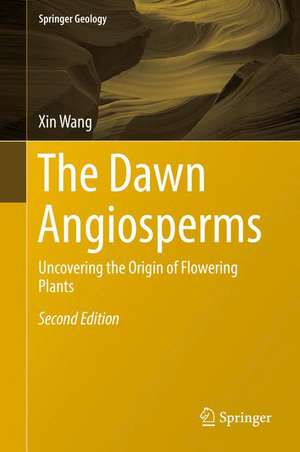
The Dawn Angiosperms: Springer Geology
Autor Xin Wangen Limba Engleză Hardback – 14 aug 2017
Accordingly, the new edition of this book not only includes more new fossil taxa, but also documents them in greater detail and corrects many commonly held misconceptions. In so doing, it makes related studies and teaching on the early history of angiosperms more realistic, concrete, andtangible, providing concrete fossil evidence as the basis for future research, and helping to distinguish the most accurate botanical hypotheses.
Din seria Springer Geology
- 15%
 Preț: 675.30 lei
 - 15%
 Preț: 678.03 lei
 - 18%
 Preț: 1178.35 lei
 - 18%
 Preț: 818.79 lei
 - 18%
 Preț: 980.86 lei
 - 18%
 Preț: 2427.49 lei
 - 18%
 Preț: 1293.71 lei
 - 18%
 Preț: 947.45 lei
 - 18%
 Preț: 901.99 lei
 - 18%
 Preț: 958.13 lei
 - 18%
 Preț: 1050.87 lei
 - 15%
 Preț: 710.52 lei
 - 18%
 Preț: 1455.99 lei
 - 18%
 Preț: 997.02 lei
 - 18%
 Preț: 818.18 lei
 - 18%
 Preț: 983.18 lei
 - 18%
 Preț: 1169.12 lei
 - 18%
 Preț: 1297.16 lei
 - 18%
 Preț: 985.05 lei
 - 24%
 Preț: 1250.03 lei
 - 15%
 Preț: 646.82 lei
 - 18%
 Preț: 1009.38 lei
 - 18%
 Preț: 996.06 lei
 - 18%
 Preț: 748.98 lei
 - 15%
 Preț: 660.83 lei
 - 15%
 Preț: 684.06 lei
 -
 Preț: 403.03 lei
 - 15%
 Preț: 680.99 lei
 - 20%
 Preț: 459.57 lei
 - 23%
 Preț: 984.15 lei
 - 18%
 Preț: 1282.73 lei
 - 24%
 Preț: 1104.89 lei
 - 18%
 Preț: 929.24 lei
 - 18%
 Preț: 927.31 lei
 - 18%
 Preț: 929.19 lei
 - 15%
 Preț: 662.36 lei
 - 18%
 Preț: 815.62 lei
 - 18%
 Preț: 990.13 lei
 - 18%
 Preț: 1047.87 lei
 - 20%
 Preț: 638.19 lei
 - 18%
 Preț: 987.18 lei
 - 18%
 Preț: 1168.29 lei
 - 24%
 Preț: 955.50 lei
 - 18%
 Preț: 950.22 lei
Preț: 995.12 lei
Preț vechi: 1213.55 lei
-18%
Carte disponibilă
Livrare economică 07-21 noiembrie
Specificații
ISBN-10: 3319583247
Pagini: 436
Ilustrații: XXVII, 407 p. 165 illus., 27 illus. in color.
Dimensiuni: 160 x 241 x 28 mm
Greutate: 0.84 kg
Ediția:Second Edition 2018
Editura: Springer
Colecția Springer Geology
Seria Springer Geology
Locul publicării:Cham, Switzerland
V-ar putea interesa
-
 -19%Preț: 80.48 lei99.25 lei
 -
 Geography in America at the Dawn of the 21st CenturyGary L. Gaile-27%Preț: 500.69 lei681.60 lei
 -
 Captain ScottRanulph Fiennes-26%Preț: 74.70 lei100.41 lei
 -
 Scott And Amundsen: The Last Place on EarthRoland Huntford-26%Preț: 90.24 lei121.88 lei
 -
 Fatal PassageKen Mcgoogan-31%Preț: 64.70 lei93.23 lei
 -
 Preț: 168.26 lei
 -
 Preț: 218.02 lei
 -
 Shackletons Boat JourneyFa WorsleyPreț: 106.37 lei
 -
 The Song Of The DodoDavid QuammenPreț: 153.49 lei
 -
 What is Geography?Alastair BonnettPreț: 395.35 lei
 -
 The SAGE Handbook of BiogeographyAndrew Millington-27%Preț: 1228.29 lei1682.59 lei
Cuprins
Textul de pe ultima copertă
Accordingly, the new edition of this book not only includes more new fossil taxa, but also documents them in greater detail and corrects many commonly held misconceptions. In so doing, it makes related studies and teaching on the early history of angiosperms more realistic, concrete, and tangible, providing concrete fossil evidence as the basis for future research, and helping to distinguish the most accurate botanical hypotheses.
Caracteristici
Notă biografică
Xin Wang received his Ph.D. degree in Computer Science and Technology from Chongqing University, Chongqing, China, 2015. From 2018 to 2019, he was a visiting scholar with the Humboldt University of Berlin, Berlin, Germany, and with the Potsdam Institute for Climate Impact Research, Potsdam, Germany. Since 2018, He has been a professor with the school of Electronic and Information Engineering, Southwest University, since 2023. He has published about more than 50 journal papers.
Huaqing Li (senior member, IEEE) received the BS degree in information and computing science from Chongqing University of Posts and Telecommunications, Chongqing, China, in 2009, and the Ph.D. degree in computer science and technology from Chongqing University, Chongqing, in 2013. He is currently a professor with the College of Electronic and Information Engineering, Southwest University, Chongqing. His main research interests include nonlinear dynamics and control, multiagent systems, and distributed optimization. He serves as a regional editor for Neural Computing and Applications and an Editorial Board Member for IEEE ACCESS.
Tingwen Huang is a professor at Texas A&M University at Qatar. He received his Ph.D. degree from Texas A&M University, College Station, Texas, 2002. After graduated from Texas A&M University, he worked as a visiting assistant professor there. Then he joined Texas A\& M University at Qatar (TAMUQ) as an Assistant Professor in August 2003, and then he was promoted to a professor in 2013. Dr. Huang's focus areas for research interests include neural networks, chaotic dynamical systems, complex networks, optimization, and control. He has authored and co-authored more than 100 refereed journal papers.
Descriere
Angiosperms are the most diversi ed plant group in the world, being represented by ca 300,000 species in about 400 families. Like all of Life, including ourselves, they have had their own history and gone through many evolutionary stages before they arrived at their current forms. The origin of Angiospermae ( owering plants) has been the subject of much dispute because this is a key event in the history of life, and has a far-reaching in uence on our understanding of relationships among seed plants as a whole as well as within the angiosperms. Until recently most of palae- otanists recognized angiosperms only from the Cretaceous and younger strata. This contradicts the results of molecular analyses. I have been working on Mesozoic fossil plants for the past two decades, during which time I have studied a number of fossil plants. Some of these fossil plants have been published as Jurassic angiosperms, and, unsurprisingly, many questions and doubts have been raised about them. These questions need to be addressed se- ously and journal papers do not provide suf cient space to compare and relate these early angiosperms. In this book these pioneer angiosperms are documented in detail, sometimes with new specimens not studied before. Also, I propose a de nition of angiosperms that could be adopted in palaeobotany. My aim is to improve clarity and objectivity of judgment about what constitutes a fossil angiosperm.